
India Faces Irrigation Challenge as Reservoir Storage Drops Below Key Thresholds
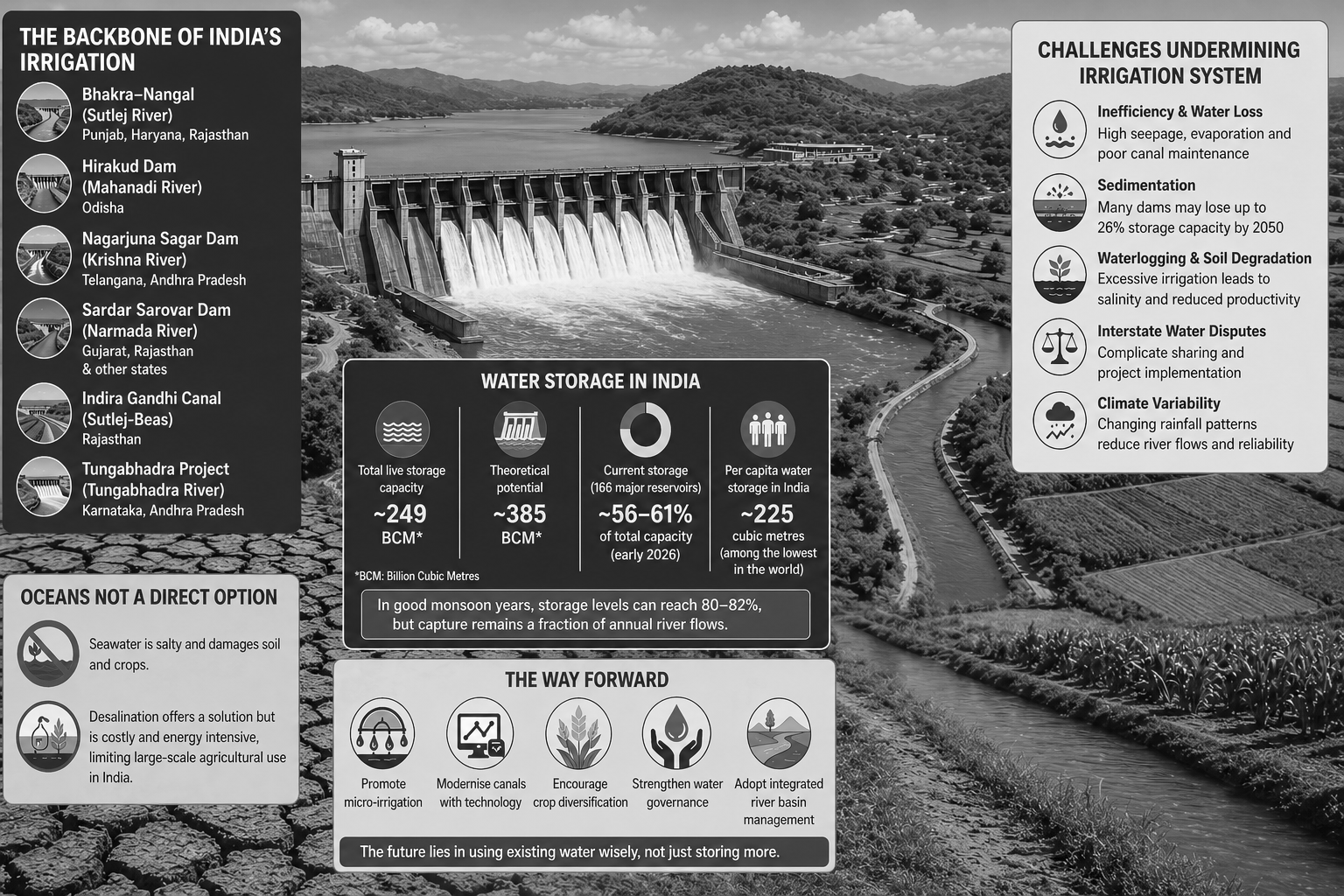
India’s water and irrigation landscape is once again in focus as recent data shows fluctuating reservoir levels across the country, raising concerns over water security. According to the Central Water Commission, storage in 166 major reservoirs stood at about 56–61% of total capacity in early 2026, reflecting uneven rainfall and regional stress. This comes even as policymakers emphasise the importance of strengthening irrigation infrastructure, highlighting a growing gap between capacity creation and actual water availability .
India’s irrigation system has historically depended on large river-based projects designed to stabilise agriculture in a monsoon-driven economy. Major dams such as the Bhakra–Nangal Dam on the Sutlej River, Hirakud Dam on the Mahanadi River, and Nagarjuna Sagar Dam on the Krishna River were built as multipurpose river valley projects combining irrigation , flood control , and hydropower generation . These projects enabled the Green Revolution , expanded canal networks , and significantly improved agricultural productivity by regulating seasonal river flows.
Yet, a closer look at national water storage reveals structural limitations. India’s total live storage capacity is estimated at around 249 billion cubic metres (BCM) , but only a portion of this is effectively utilised at any given time. The Central Water Commission monitors reservoirs that account for nearly 70% of this capacity , but storage levels frequently vary between 30% and 80% , depending on monsoon performance. This indicates that despite large infrastructure, India still captures only a fraction of its annual river flows, leaving agriculture vulnerable to rainfall variability.
The limitations are not just about storage, but also about efficiency. A significant share of water is lost due to inefficiency , including seepage, evaporation, and ageing canal systems. Over time, sedimentation has reduced reservoir capacity, with studies warning of substantial long-term losses. At the same time, excessive irrigation in certain regions has led to waterlogging and soil degradation, undermining productivity gains achieved through earlier investments. The situation is further complicated by interstate water disputes , particularly in major river basins, and rising climate variability , which is altering rainfall patterns and making water availability less predictable.
Despite these challenges, the sector continues to hold significant potential. Projects like the Sardar Sarovar Dam demonstrate how irrigation can transform drought-prone regions and support economic growth. However, experts argue that future gains will depend less on building new dams and more on improving distribution and usage. There is considerable scope in command area development , equitable water access, and crop diversification toward less water-intensive farming.
Importantly, while discussions occasionally explore alternative sources, oceans remain unsuitable for direct irrigation due to salinity. Desalination technologies offer a potential solution but are currently constrained by high costs and energy demands, limiting their use in large-scale agriculture.
Ultimately, India’s irrigation challenge is shifting from infrastructure expansion to sustainable water management . As recent reservoir data highlights growing stress on water systems, the focus must move toward efficiency, resilience, and smarter allocation. The success of India’s agricultural future will depend not just on how much water is stored, but on how effectively it is managed in an era of increasing uncertainty.