
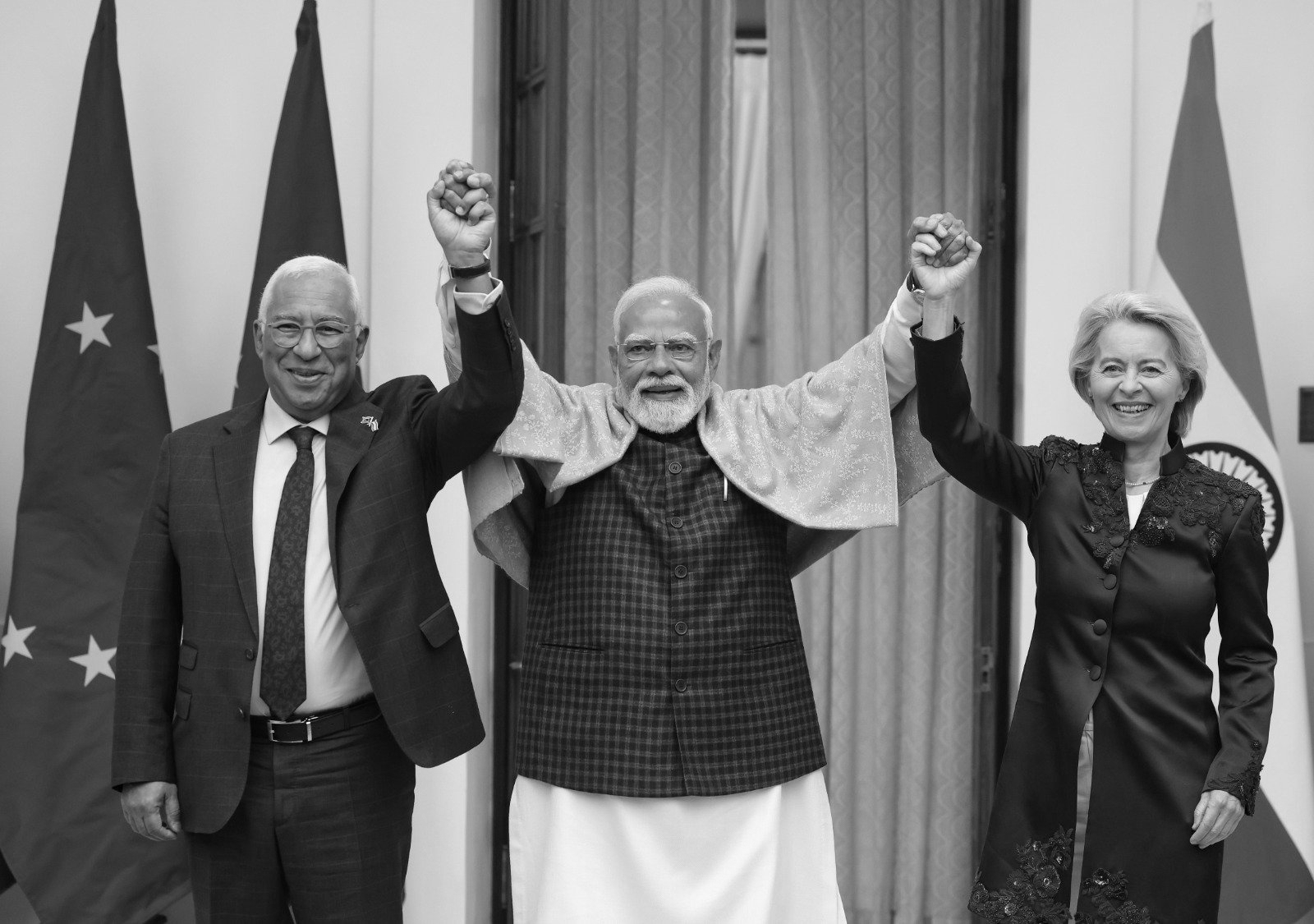
India, EU sign historic free trade agreement: ‘Mother of all deals’
India and the European Union (EU) on Tuesday signed a landmark Free Trade Agreement (FTA) , concluding negotiations that stretched over nearly two decades and creating what leaders on both sides described as the “mother of all deals.” The agreement brings together markets of about two billion people, accounting for nearly 25 per cent of global GDP and around one-third of global trade, making it India’s most ambitious trade pact to date.
Prime Minister Narendra Modi , addressing the Indian Energy Week virtually, called the signing a historic moment for India-EU relations . He said the agreement would open vast opportunities for 140 crore Indians, strengthen global supply chains, and boost confidence among businesses and investors worldwide. Modi added that the pact complements India’s trade arrangements with the UK and the European Free Trade Association, while significantly strengthening the manufacturing and services sectors.
The FTA, signed on January 27, 2026, at the 16th India-EU Summit in New Delhi , will now undergo legal vetting and ratification by India and the EU, including approval by the European Parliament and member states. Officials expect the pact to come into force early next year, with commitments implemented in a phased manner. Under the agreement, the EU will provide zero-duty access to over 93 per cent of Indian goods, covering nearly 99.5 per cent of trade value through immediate and phased tariff cuts. Duties on 90 per cent of Indian goods will be eliminated on day one, while most remaining tariffs will be removed within seven years. India, in turn, will grant duty concessions on about 97.5 per cent of EU trade value, with liberalisation spread over ten years.
Major Indian export sectors expected to benefit include textiles, apparel, leather and footwear, marine products, chemicals, gems and jewellery, and engineering goods , which currently face EU duties of up to 26 per cent. The FTA also improves market access for home décor, wooden crafts, and furniture, with tariff reductions of up to 10.5 per cent boosting competitiveness in high-value segments. Sensitive sectors such as dairy, cereals, and soya meal for India, and sugar, beef, and poultry for the EU, remain protected. India has agreed to quota-based concessions for high-end vehicles, while electric vehicle imports from the EU will be permitted under quotas from the fifth year. On services, the EU has opened 144 sub-sectors to India, while India has offered access to 102 sub-sectors. The pact also includes commitments on student mobility, digital trade, intellectual property, and regulatory cooperation. Bilateral goods trade of USD 136 billion is expected to cross USD 200 billion within three to four years, while services trade could rise to USD 125 billion. The agreement is projected to generate substantial employment, particularly in labour-intensive sectors, and support MSMEs through simplified procedures and clear rules of origin.
The FTA is expected to have transformational effects on India’s textile and apparel sector , the second-largest in exports to the EU after the US. Zero-duty access and tariff reductions of up to 12 per cent will enable Indian exporters to tap into the EU’s USD 263.5 billion textile and apparel market. The deal is anticipated to boost production, employment, and capacity utilisation across labour-intensive MSME clusters, while encouraging sustainability-linked upgrades, technological collaboration, and integration into global value chains. Indian textile exports to the EU are diversified across Ready-Made Garments, cotton textiles, man-made fibre products, handicrafts, carpets, jute, handlooms, woollen, and silk products , with export clusters spanning over 342 districts .
Speaking at India Energy Week 2026 in Betul, Canada’s Minister of Energy and Natural Resources, Tim Hodgson , called the India-EU trade deal a “perfect answer” to global hegemons who use tariffs and economic integration as tools of coercion , in a veiled reference to former US President Donald Trump. Hodgson said the global economy is undergoing a sharp rupture as major powers move away from rules-based, multilateral trade systems toward a more mercantilist approach. “India’s decision to conclude the trade deal with the EU sends a strong signal in favour of free trade and trusted partnerships,” he said, stressing the importance of diversifying supply chains.
The India-EU FTA, alongside India’s agreements with the UK, EFTA, Oman, Australia, and New Zealand , underscores India’s strategic push to expand market access, strengthen global trade linkages, and foster inclusive economic growth aligned with the vision of “Viksit Bharat 2047.” European Commission President Ursula von der Leyen welcomed the agreement as a milestone that will deepen economic integration, create jobs, and reduce strategic dependencies. The signing of the FTA coincided with discussions to enhance India-EU cooperation in security and defence, including defence supply chains, maritime security, and cybersecurity, reflecting the growing geopolitical significance of the partnership amid shifting global alignments.