
India Erupts Over Bangladesh Lynching, Mamata Banerjee Looks Away
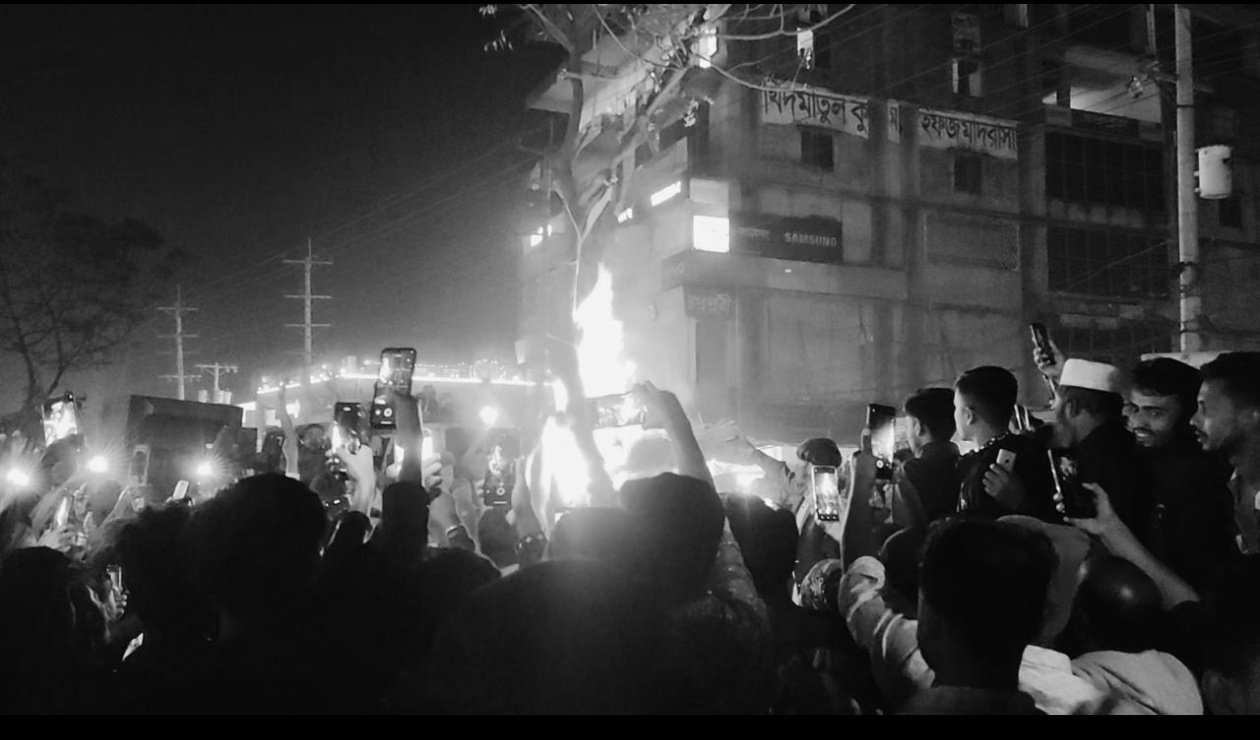
India has been gripped by anger and anguish since the lynching of Dipu Chandra Das , a Hindu garment worker in Bangladesh’s Bhaluka area of Mymensingh district. The killing took place on the night of December 18 , but became widely known on December 19 after graphic videos surfaced on social media. The footage, showing Das being beaten by a mob, tied to a tree and set on fire, sparked widespread condemnation and renewed fears over the safety of religious minorities in Bangladesh.
While the incident triggered outrage across India’s political and social spectrum, the most striking response has been the absence of one. Mamata Banerjee , Chief Minister of West Bengal, has not issued any statement condemning the killing even after it became public knowledge. On December 18, hours before news of the lynching emerged, she had posted a detailed message marking Minority Rights Day in her state, listing welfare schemes and budgetary allocations for minorities in West Bengal. Critics point out that while she could not have known of the killing at the time of that post, her silence since December 19 has been conspicuous. For a prominent regional leader, that too Chief Minister of West Bengal and representative of Bengalis in India and ambassador for Bengalis beyond , who frequently speaks on minority rights and governs a state sharing a long border and deep cultural ties with Bangladesh, the lack of a word on the killing of a Hindu minority member across the border has drawn sharp scrutiny and accusations of selective concern.
The focus on Mamata Banerjee’s silence has only intensified as days passed without comment. Political observers note that symbolic condemnation matters in cases of mob violence, particularly when religion is involved, and that silence from a prominent regional leader can carry its own message. Her critics argue that the contrast between vocal advocacy for minority rights at home and restraint over violence against Hindus abroad has unsettled even those who might otherwise defend her record.
The absence of public condemnation is not limited to the state level. As of press time, there have been no specific statements referencing Dipu Chandra Das from Prime Minister Narendra Modi , or External Affairs Minister S. Jaishankar . Supporters of the central government suggest that diplomatic engagement does not always unfold on social media, but critics counter that visible expressions of outrage serve as moral signals, particularly in cases involving minority persecution.
In contrast, Pawan Kalyan , the Deputy Chief Minister of Andhra Pradesh, issued a strong statement linking the lynching to what he described as a broader pattern of attacks on minorities in Bangladesh. He cited figures from minority rights groups, recalled India’s role in the 1971 liberation of Bangladesh , and urged international institutions, including United Nations bodies, to take note of what he called sustained persecution.
Exiled Bangladeshi writer Taslima Nasreen also weighed in, alleging that Das was falsely accused by a co-worker over a trivial dispute and questioning the conduct of the police. She claimed that Das had briefly been under police protection before being taken by the mob. While her account reflects allegations that have not been independently established, it has fuelled debate over institutional failure and the lethal consequences of unverified blasphemy accusations.
As videos showed bystanders recording the violence and chanting slogans, including anti-India slogans, the discussion in India widened from outrage to questions of response. Analysts argue that India’s practical options lie in sustained diplomatic pressure, international advocacy, and insisting on transparent prosecution, rather than overt punitive steps that could risk further harm to minorities on the ground.
For many Indians, however, the central issue has shifted from policy to principle. The killing of Dipu Chandra Das has become a moment that exposes not only the fragility of minority safety in Bangladesh but also the unevenness of political outrage at home. And in that reckoning, Mamata Banerjee’s continued silence after the facts were known has become the loudest statement of all.