
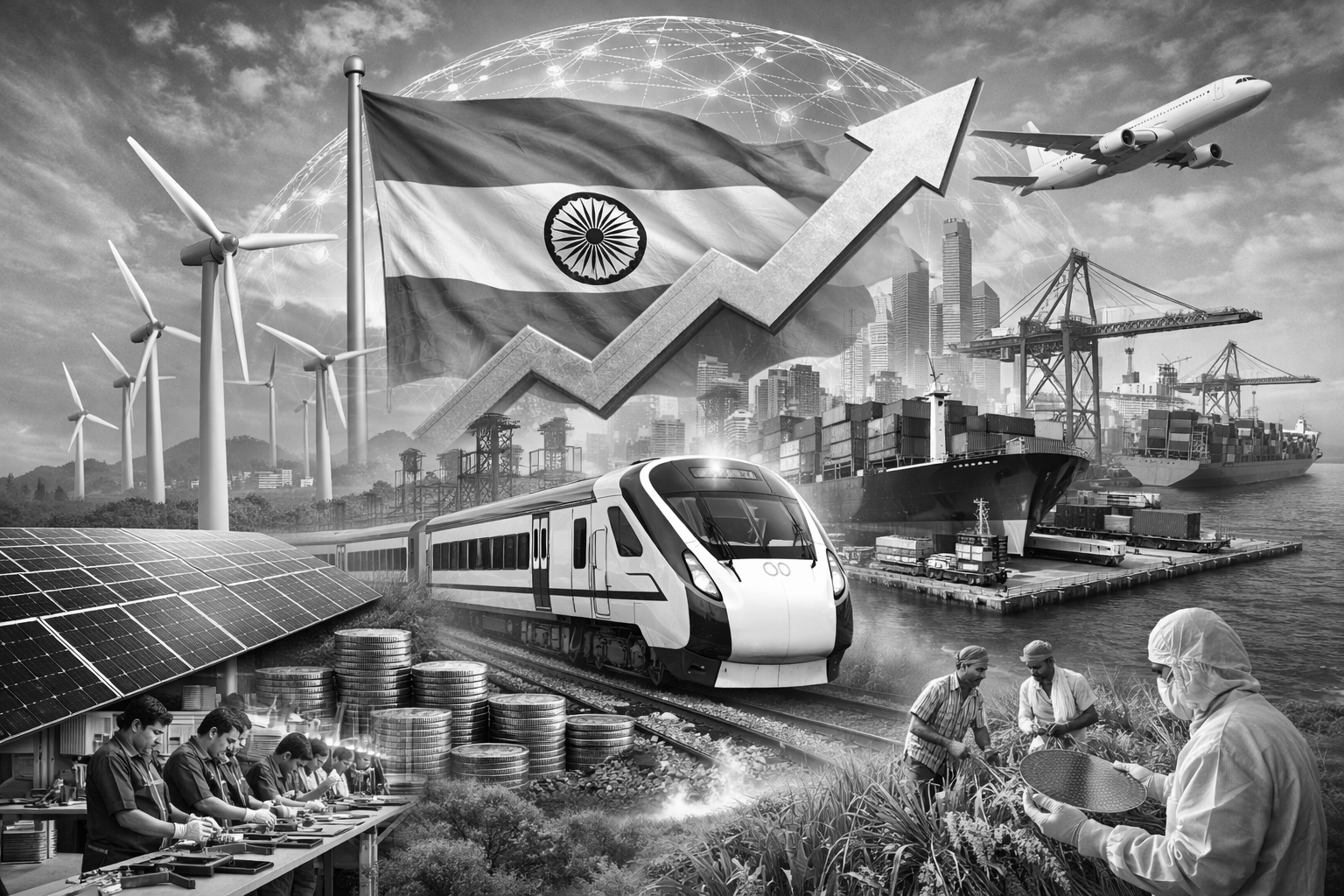
India Drives 16% of Global Growth as Reforms and Capex Power Economic Rise
Prime Minister Narendra Modi , speaking at the ET Now Global Business Summit 2026, said India now contributes more than 16% of global economic growth and is poised to emerge as a new engine of the world economy. He expressed confidence that the country is advancing toward becoming the world’s third-largest economy , stressing that reforms are being pursued with conviction despite global disruptions such as the pandemic and supply-chain shocks.
Economists note that this figure refers to India’s share in the annual increase in global GDP , not its total size. Currently, China remains the largest contributor to global growth at roughly 25–30% , followed by India at 15–16% , and the United States at 10–15% . Emerging economies such as Indonesia contribute around 2–3% , while Vietnam and Brazil add about 1–2% each. Mature economies including Germany , Japan , and the United Kingdom contribute smaller shares due to slower growth.
In terms of overall economic size, the United States accounts for roughly 25–26% of global GDP , while China contributes about 16–18% . Japan and Germany each hold around 4–5% , and India contributes approximately 3.5–4% , making it one of the fastest-rising major economies. The United Kingdom and France each account for about 3% , while Italy, Canada, and Brazil contribute roughly 2% each.
India’s rising global influence is supported by strong domestic demand, a youthful workforce, and a rapidly expanding middle class. Its globally competitive services sector, digital public infrastructure, and expanding manufacturing base are strengthening integration with global supply chains.
A central driver of this momentum is the government’s ₹17 lakh crore capital expenditure push , aimed at building long-term productive assets. Investments in highways, freight corridors, ports, and airports are expected to reduce logistics costs and enhance export competitiveness. Railway modernization and freight efficiency upgrades will improve cargo movement and strengthen industrial connectivity.
India’s trade footprint, though still modest compared to major exporters, is expanding. The country accounts for about 2% of global merchandise exports and roughly 4% of global services exports , driven by IT and business services. By comparison, China leads global exports with about 14–15% , followed by Germany at 7–8% , the United States at 7–8% , Japan at 3–4% , and South Korea at around 3% . The United States remains the world’s largest importer, accounting for 8–9% of global imports .
Energy transition initiatives, manufacturing incentives, trade agreements, and digital transformation are further strengthening India’s competitiveness. Together, infrastructure expansion, industrial growth, and rising consumption are lowering costs, attracting investment, boosting exports, and expanding demand — reinforcing India’s role as a key driver of global economic growth in the coming decade.