
India Clears Key Milestone for Kudankulam Units 5 & 6, Boosting Nuclear Expansion
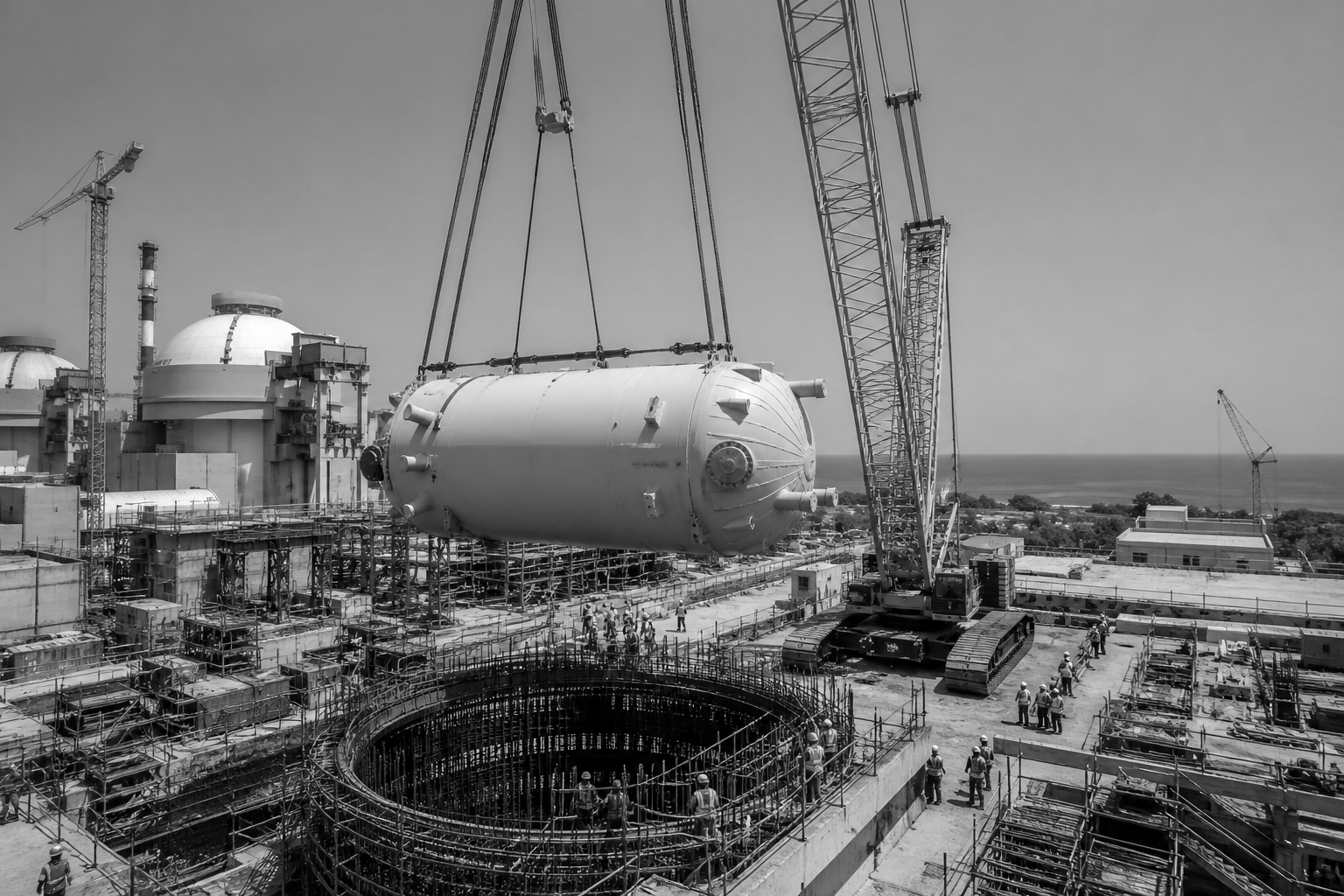
India has taken a significant step in strengthening its nuclear energy programme after the Atomic Energy Regulatory Board (AERB) granted permission for “major equipment erection” at Units 5 and 6 of the Kudankulam Nuclear Power Plant (KKNPP). The approval enables the Nuclear Power Corporation of India Limited (NPCIL) to install critical reactor components, including the reactor pressure vessel, steam generators and coolant pumps marking a decisive transition from civil construction to core plant development.
The clearance follows a rigorous multi-tier safety review by AERB, covering reactor design, safety systems and construction progress since the earlier approval for First Pour of Concrete (FPC) in April 2021. Officials said Units 5 and 6 incorporate advanced safety features in line with India’s stringent safety codes for light water reactors, reinforcing confidence in the project’s structural and operational integrity as it enters a crucial phase.
Located in Tamil Nadu’s Tirunelveli district, Kudankulam is India’s largest nuclear power complex, planned with six 1,000 MW pressurised water reactors based on VVER technology developed in collaboration with Russia. Units 1 and 2 have been operational since 2013 and 2015, while Units 3 and 4 are in advanced stages of construction. With the latest approval, Units 5 and 6 now move into one of the most technically complex stages before commissioning.
Beyond construction progress, the development carries significant strategic and economic implications. Once fully operational, the Kudankulam facility will generate 6,000 MW of reliable baseload power , providing a steady supply of electricity critical for India’s growing industrial and urban demand. Unlike renewable sources such as solar and wind, nuclear energy offers continuous power generation , helping stabilise the grid and ensure energy reliability.
The expansion also strengthens India’s clean energy transition , as nuclear power remains a low-carbon alternative to fossil fuels. By adding new nuclear capacity, India can reduce its dependence on coal and cut emissions while meeting rising electricity needs. At the same time, the project enhances energy security by lowering reliance on imported fuels and shielding the economy from global energy price volatility.
Technologically, Kudankulam represents a key pillar of Indo-Russian nuclear cooperation , enabling access to advanced reactor systems while supporting domestic capability building in high-end engineering and manufacturing. The project is also expected to generate employment, industrial growth and regional development in southern India.
With AERB’s latest clearance, Kudankulam Units 5 and 6 have crossed a critical milestone, underscoring India’s steady progress toward a safer, cleaner and more self-reliant energy future , even as it balances development with stringent safety oversight.