
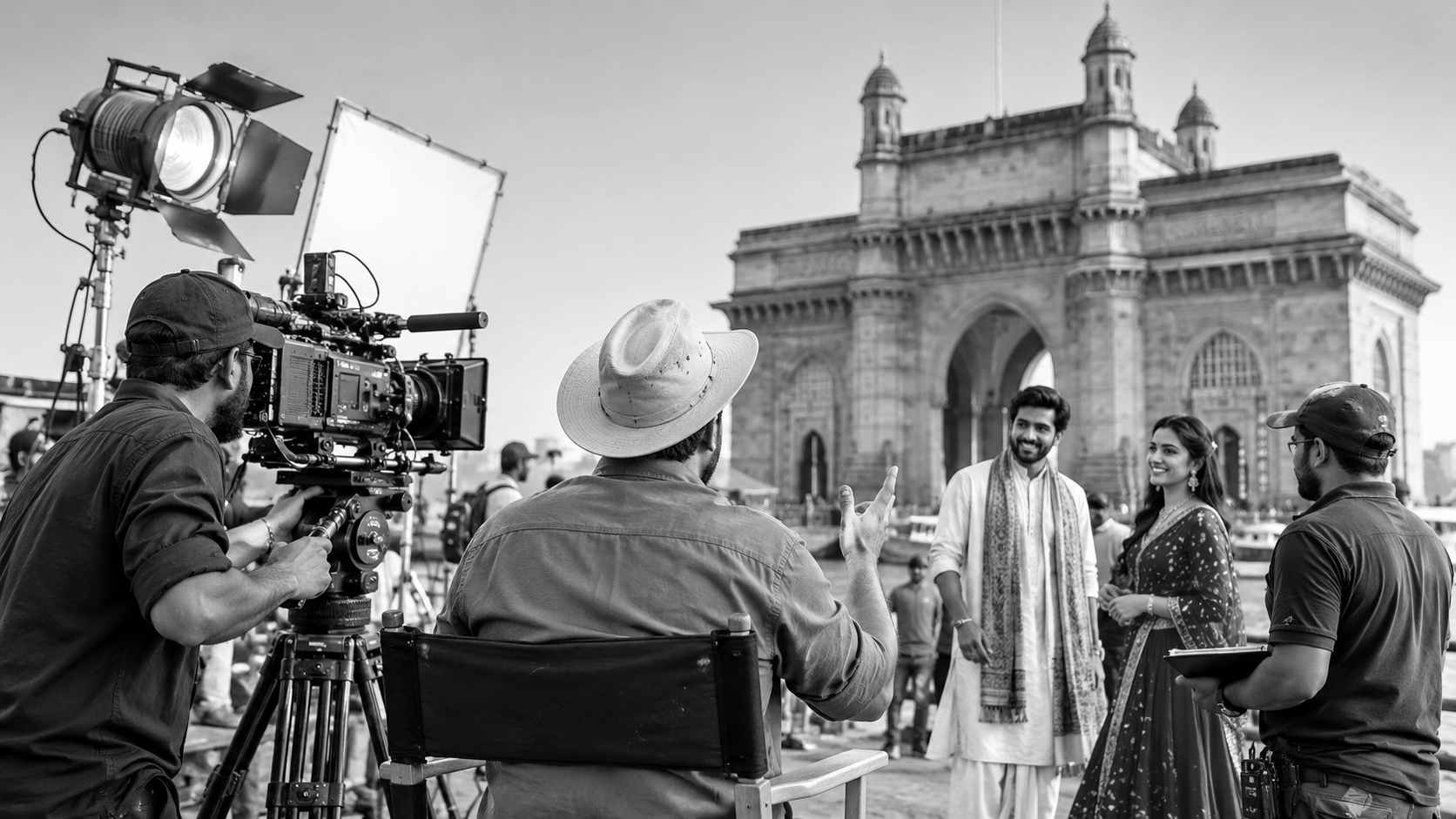
India Cine Hub Makes Filming Easier With Single-Window Digital Permission System
India is strengthening its position as an international filmmaking and production destination by simplifying shooting permissions, integrating State-level clearances and encouraging cross-border creative partnerships through its single-window digital platform, India Cine Hub (ICH). The initiative came into focus during a panel discussion at the 57th International Film Festival of India (IFFI) in Goa on November 22, where policymakers and industry representatives discussed ways to make India more accessible to international filmmakers and production companies.
The panel discussion, titled ‘Filming Made Easy: India’s Rise as a Global Filming and Production Hub’, featured Prithul Kumar, Joint Secretary in the Ministry of Information and Broadcasting; Grainne Brundson, Chief Operating Officer of Screen Australia; and veteran actor, director and producer Anupam Kher. Film critic and journalist Rajeev Masand moderated the session, which examined the role of government support, digital infrastructure and international collaborations in developing India's film production ecosystem.
India Cine Hub, spearheaded by the Ministry of Information and Broadcasting and operated by the National Film Development Corporation (NFDC), serves as a common digital platform for filmmakers seeking shooting permissions across the country. The integration of State governments into the portal is expected to reduce the time and effort involved in approaching multiple government departments separately. Filmmakers can submit a common application to seek clearances from different authorities, including municipal bodies, traffic departments, Indian Railways and the Archaeological Survey of India (ASI).
Explaining the progress made through the initiative, Prithul Kumar said around 32 services have been mapped onto the platform. Applicants can monitor the status of their applications through an online dashboard, while payments, wherever applicable, are facilitated through secure payment links. The government is also working towards integrating drone-related permissions available through the Digital Sky platform, which could further simplify the process for production teams planning aerial filming.
The platform is designed to address one of the longstanding challenges faced by filmmakers: obtaining permissions from several authorities before shooting at different locations. Earlier, production teams often had to coordinate separately with local administrations and other departments, resulting in additional paperwork and delays. By bringing multiple services under a common digital interface, India Cine Hub aims to make the process more transparent, accessible and convenient for both domestic and international production companies.
The government has also highlighted improvements in the processing time for international filming permissions. According to Kumar, such permissions have a stipulated processing period of 28 days, but applications have taken an average of just 18 days since 2015. He also referred to Madhya Pradesh's deemed-approval provision, under which applications are treated as approved if the authorities do not communicate a decision within 15 days. Such measures indicate how State-level policy support can contribute to creating a more favourable environment for film production.
The official India Cine Hub application process also provides a structured mechanism for international filmmakers. Foreign production companies seeking to shoot feature films, television or web shows and series, and reality programmes can register on the portal and submit the required documents. These generally include the script or synopsis, shooting locations and dates, details of cast and crew, passport information and a list of equipment to be temporarily brought into India. Applications are subject to evaluation by experts appointed by the Ministry.
The platform currently charges an application processing fee equivalent to USD 225 for national filming permission, payable online. The fee is non-refundable, irrespective of the outcome of the application. Filmmakers are advised to apply approximately 30 days before the proposed shooting schedule. The official portal states that applications involving non-restricted areas normally take up to three weeks to process after all the required documents have been submitted. Projects involving additional consultations with the Ministries of Home Affairs or External Affairs, particularly those concerning protected, restricted or sensitive locations, may require more time.
Another important aspect of the system is the coordination of State and local permissions. Every State and Union Territory has a designated nodal officer responsible for assisting filmmakers with local clearances and other shooting-related requirements. After receiving national filming permission, applicants can use their dashboards to submit requests for specific locations. The concerned State authorities process these applications and communicate any location-related charges directly to the production teams.
However, the platform does not provide blanket filming permissions. Applications must specify the exact shooting locations and dates, as approvals are granted for particular places and periods. Filming in protected or restricted areas may involve additional scrutiny and longer processing timelines. The system also distinguishes between different types of productions. International feature films, eligible television and web productions and reality shows can apply through the ICH process, while documentary films, audio-visual commercials and music videos require the relevant permissions through the Ministry of External Affairs.
Visa requirements are another important part of the process for foreign production teams. International filmmakers must first obtain shooting approval from the Ministry of Information and Broadcasting through India Cine Hub. They can subsequently apply for the appropriate Film Visa through the concerned Indian diplomatic mission. Foreign crew members are required to provide their particulars and relevant documents along with the government's shooting permission. This sequence is intended to ensure that filming approval is secured before the production team travels to India.
The portal also addresses logistical requirements associated with international productions. Filmmakers bringing equipment temporarily into the country must submit an equipment list and an undertaking or bond confirming that the items will be re-exported after filming. Based on the submitted documents, the Ministry can issue a Customs Exemption Letter to facilitate the temporary import of production equipment. These arrangements are particularly relevant for international production companies that need specialised cameras, lighting systems and other technical equipment.
Kumar further highlighted the growing interest among international production companies in filming and co-producing projects in India. According to him, the number of international productions approaching the country for such opportunities has increased from around 25–30 to 100–200 annually. He encouraged production professionals, local service providers and other industry participants to register on the India Cine Hub portal so that filmmakers from different parts of the world could identify India's production resources and connect with relevant service providers.
The discussion also explored the possibilities of strengthening film industry relations between India and Australia. Grainne Brundson said India's diverse filming locations, experienced filmmaking talent and strong emotional connection with audiences made it an attractive destination for international partnerships. She pointed to the growing popularity of Indian cinema in Australia and observed that more people watched an Indian film than an Australian film in the country last year.
She said the expanding Indian-origin population in Australia, along with established cultural, educational, sporting and business connections between the two countries, offered considerable opportunities for collaborative storytelling. According to her, filmmakers could explore narratives that reflect shared experiences, including stories involving diaspora communities, while introducing audiences to different cultural perspectives.
Emphasising the importance of institutional support for creative industries, Brundson said, “Every film is a start-up and a miracle. It begins with a dream or an idea and takes dedication, passion and the support of others to bring it to life.” She explained that international co-productions should not be viewed merely as financial arrangements involving investment and risk-sharing. They also create opportunities for filmmakers to exchange ideas, understand different storytelling traditions and develop content that appeals to audiences across countries.
She highlighted the potential for Indian and Australian production teams to learn from each other's creative approaches and explore common themes through joint projects. Such collaborations could provide filmmakers with access to wider markets, new talent and different production capabilities while strengthening cultural relations between the two countries.
Anupam Kher welcomed the government's initiative, observing that the process of obtaining filming permissions in India had improved considerably. He said the country's geographical and cultural diversity offered filmmakers an extraordinary range of creative possibilities. From varied landscapes and traditional costumes to food, languages and cultural settings, India provides a wide range of locations and experiences that can support different genres of filmmaking.
Highlighting the universal nature of cinema, Kher said, “Emotions don't have any different nationalities. The only thing that you need is the possibility of shooting.” He stressed that easier access to filming locations was essential for bringing creative ideas to the screen and attracting international production companies to India.
Kher also pointed out that the benefits of the single-window system should extend beyond established production houses. Newcomers, writers, production professionals and aspiring directors could also benefit from a more accessible permission process. At the same time, he cautioned against the emergence of middlemen who might exploit filmmakers by claiming to facilitate government clearances. A transparent digital system, he suggested, could help reduce such practices and make the process more accessible to genuine applicants.
The discussion highlighted how streamlined government procedures, stronger State participation, diverse filming locations and international partnerships could collectively improve India's competitiveness in the global film industry. While India already offers considerable creative talent and production capabilities, the ease of obtaining permissions and coordinating with different authorities remains an important factor in attracting overseas projects.
With India Cine Hub bringing multiple filming-related services under a common digital platform, the government is seeking to create a more efficient environment for domestic and international filmmakers. The growing number of international production enquiries, along with opportunities for co-productions with countries such as Australia, reflects the potential for India to expand its role in global filmmaking. The initiative also underlines the importance of combining administrative efficiency with creative collaboration to establish India as a preferred destination for international film production.