
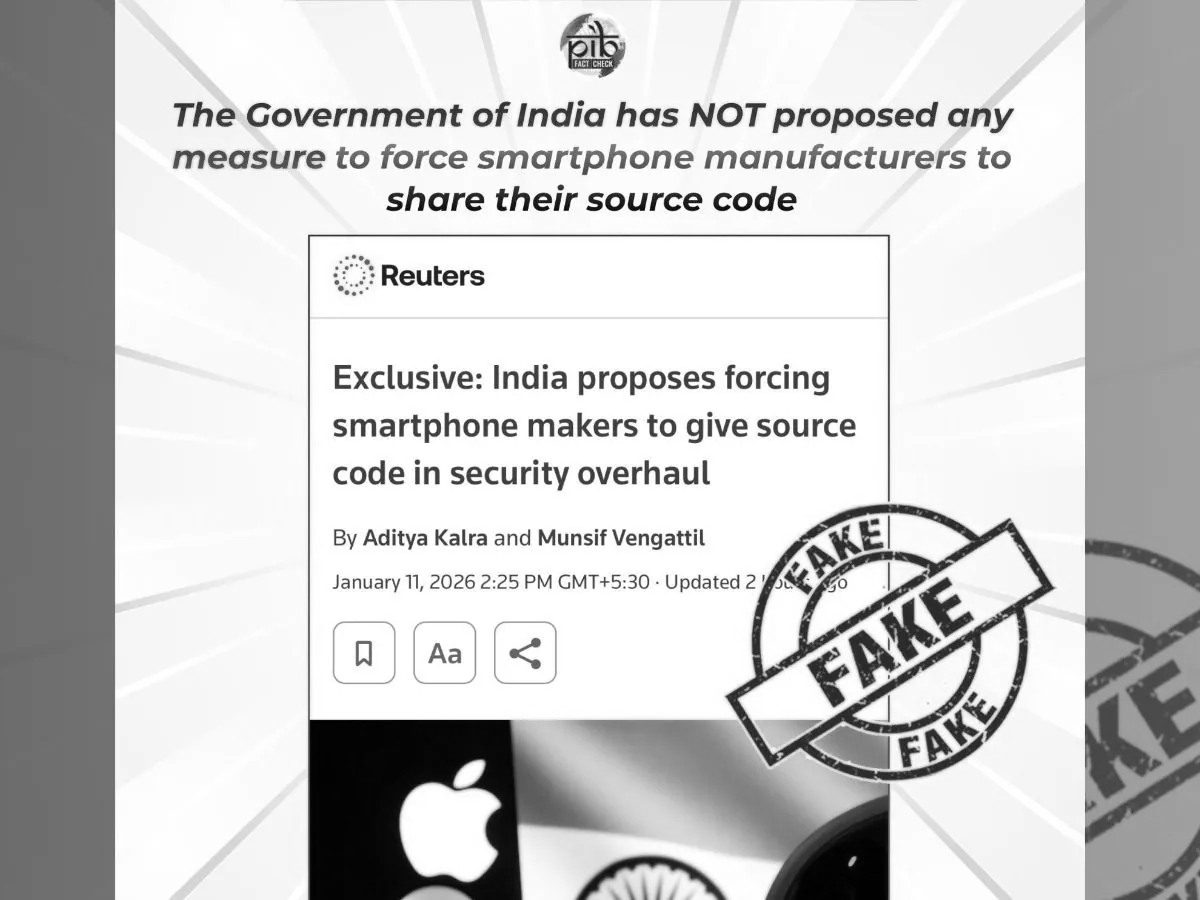
India calls Reuters report on smartphone source code access ‘fake’
The Government of India has denied reports claiming it plans to mandate smartphone manufacturers to share proprietary source code as part of security regulations. The Ministry of Electronics and Information Technology (MeitY) clarified that “there is no proposal to force smartphone manufacturers to share their source code with the government” and that ongoing discussions are routine stakeholder consultations, not enforceable rules.
MeitY stated that “a structured process of stakeholder consultations is going on to develop an appropriate and robust regulatory framework for mobile security” , and emphasised that these discussions are part of “continuous engagement with industry on safety and security standards.” The Ministry stressed that the consultations should not be interpreted as final or binding policy decisions.
Responding to reports suggesting opposition from companies like Apple and Samsung, MeitY said the report “has not quoted any statement from smartphone manufacturers or the industry associations which represent them” and “selectively ignored the comments of an industry association, clearly indicating an intent to sensationalise the issue.” On X (formerly Twitter), the government clarified: “A news report by Reuters claims that India proposes forcing smartphone manufacturers to share their source code as part of a security overhaul. This claim is Fake … The Government of India has NOT proposed any measure to force smartphone manufacturers to…”, making clear this is the official position.
Proprietary source code is the human-readable “blueprint” of software, owned and controlled by a company, defining how the software functions internally, including security, encryption, and user authentication. For smartphone makers like Apple and Samsung, it forms the core of operating systems such as iOS and One UI, and sharing it could risk intellectual property, reveal vulnerabilities, or disrupt global software updates. This explains why companies prefer security audits or controlled testing rather than exposing source code.
Mobile security is critical as smartphones are widely used for financial transactions, access to public services, and storage of sensitive personal data. India has over 1.1 billion mobile connections and more than one billion smartphone users . Compromised devices can lead to identity theft, financial losses, privacy violations, and unauthorised access, with millions of cyber fraud incidents reported annually.
MeitY said it “routinely conducts consultations on safety compliance, electromagnetic interference, Indian language support, interface requirements and security standards” , followed by detailed discussions with industry on technical feasibility and international best practices. The Ministry reaffirmed that it is “ fully committed to working closely with industry stakeholders and addressing their concerns in a constructive manner” and that “all legitimate concerns raised by the industry will be examined with an open mind , in the best interests of both the country and the industry .”