
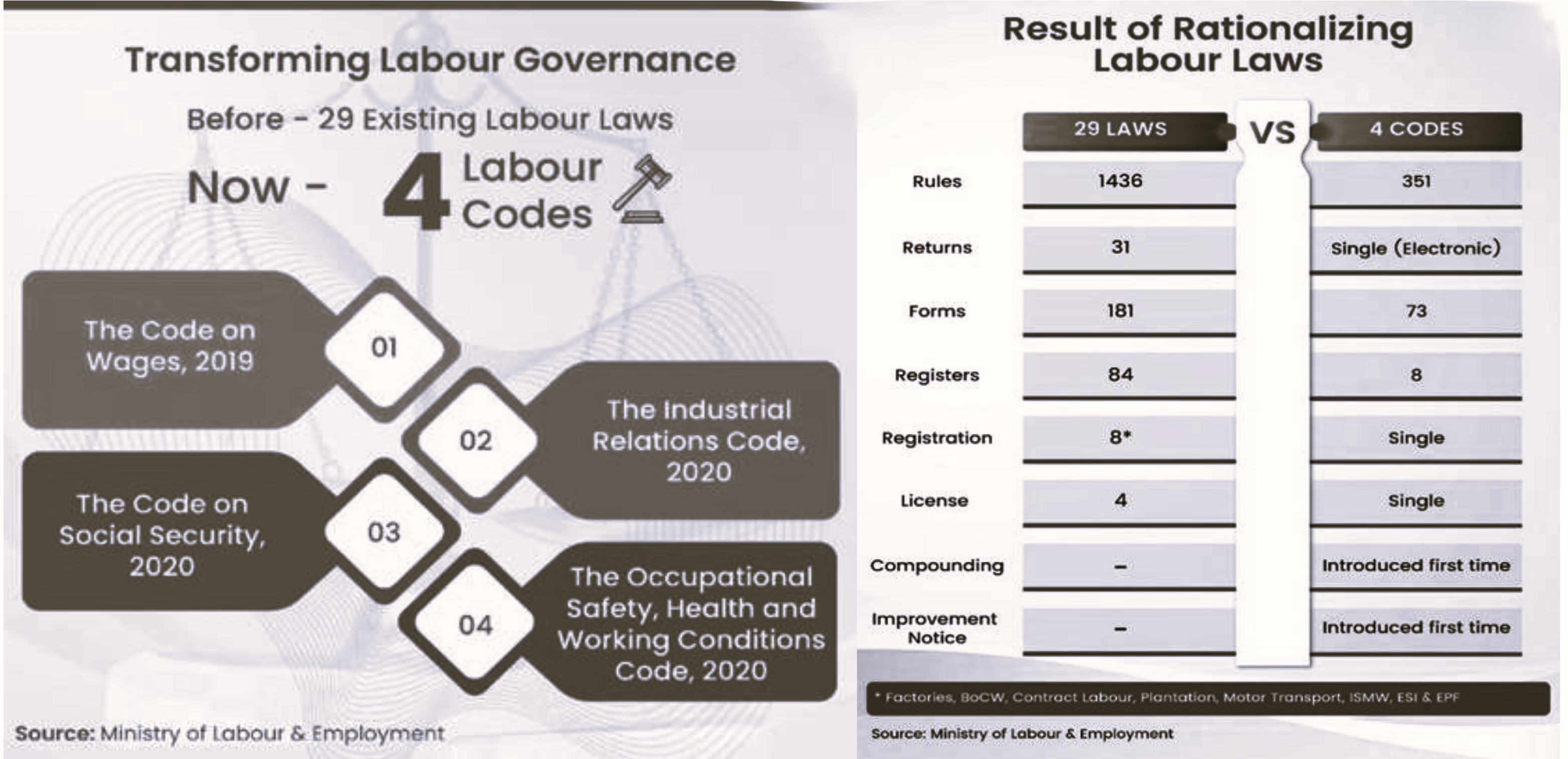
India begins nationwide rollout of four new labour codes
India has embarked on one of its most ambitious labor reforms since independence by enforcing four comprehensive Labour Codes, replacing 29 fragmented and often outdated labour laws. Implemented from November 21, 2025, this landmark policy move is projected to touch the lives of over 400 million workers and fundamentally reshape the country’s world of work, rights, and industrial relations.
The new codes the Code on Wages (2019), Industrial Relations Code (2020), Social Security Code (2020), and the Occupational Safety, Health & Working Conditions Code (2020) aim to modernize and simplify India’s labour regulations, aligning them with global best practices while addressing the unique realities of India’s vast, fast-evolving workforce. For the first time, there’s a guaranteed national minimum wage applicable to all categories of workers, including those in the gig and platform economy. Appointment letters are now mandatory for every employee, enhancing job formalization, transparency, and security across formal and informal sectors. The overhaul further mandates that benefits like Provident Fund, ESIC, insurance, maternity support, and annual health checkups become portable and accessible regardless of where or for whom a worker is employed, lifting a major barrier for India’s highly mobile and often migrant workforce.
Significantly, the reforms bring digital platform workers and gig economy participants—such as food delivery personnel and ride-share drivers under the social security net for the first time, with aggregators required to contribute towards their welfare. The rules also empower women by mandating equal pay for equal work, providing legal backing for night shifts (with necessary safeguards), and strengthening maternity entitlements. In the pursuit of “ease of doing business,” especially for MSMEs, companies now benefit from single licensing, reduced paperwork, and a streamlined compliance process. Dispute resolution is set to become swifter with newly-constituted tribunals aimed at expedited settlements, while mandatory health and safety standards are established for all, especially those engaged in hazardous industries.
Despite these sweeping reforms, several challenges loom large in the path of real-world implementation. Labour remains a concurrent subject, meaning both the central government and states must coordinate on rules and notification; many states are yet to finalize their own rules, leading to uncertainty and patchy rollout. The enforcement infrastructure, particularly the inspectorate responsible for monitoring compliance is currently insufficient in terms of manpower and technology, especially in India’s informal and rural sectors. Large swathes of the informal workforce, including micro and agricultural workers, still risk exclusion from new protections and entitlements, highlighting the need for further outreach.
Analysts and worker organizations have flagged several key risks: the codes make it easier for larger companies to hire and fire, limit the right to strike with stricter notice requirements, and potentially weaken collective bargaining power. The success of the new measures for gig and migrant workers will depend on the government’s ability to accurately identify, register, and continuously update massive, dynamic worker databases, no small logistical feat in a country as vast as India. Digital registration requirements could unwittingly exclude millions of digitally illiterate or unregistered individuals, deepening gaps rather than bridging them. Both employers and workers face a significant awareness gap and require substantial training on the new framework for benefits to trickle down to the ground level.
India’s Labour Codes undeniably launch the country on a bold journey towards fairer, more modern, and inclusive labour markets, a vision in line with the government’s ‘Atmanirbhar Bharat’ and ‘Developed India 2047’ goals. The reforms could trigger increased consumption, better incomes, and a safer, more dignified world for millions of workers. However, the true test lies in their careful, collaborative implementation balancing the flexibility and growth aspirations of business with the security and rights of workers. This delicate equilibrium will determine whether the codes become a foundation for shared prosperity, or yet another layer of regulatory promise challenged by the gap between policy and practice.