
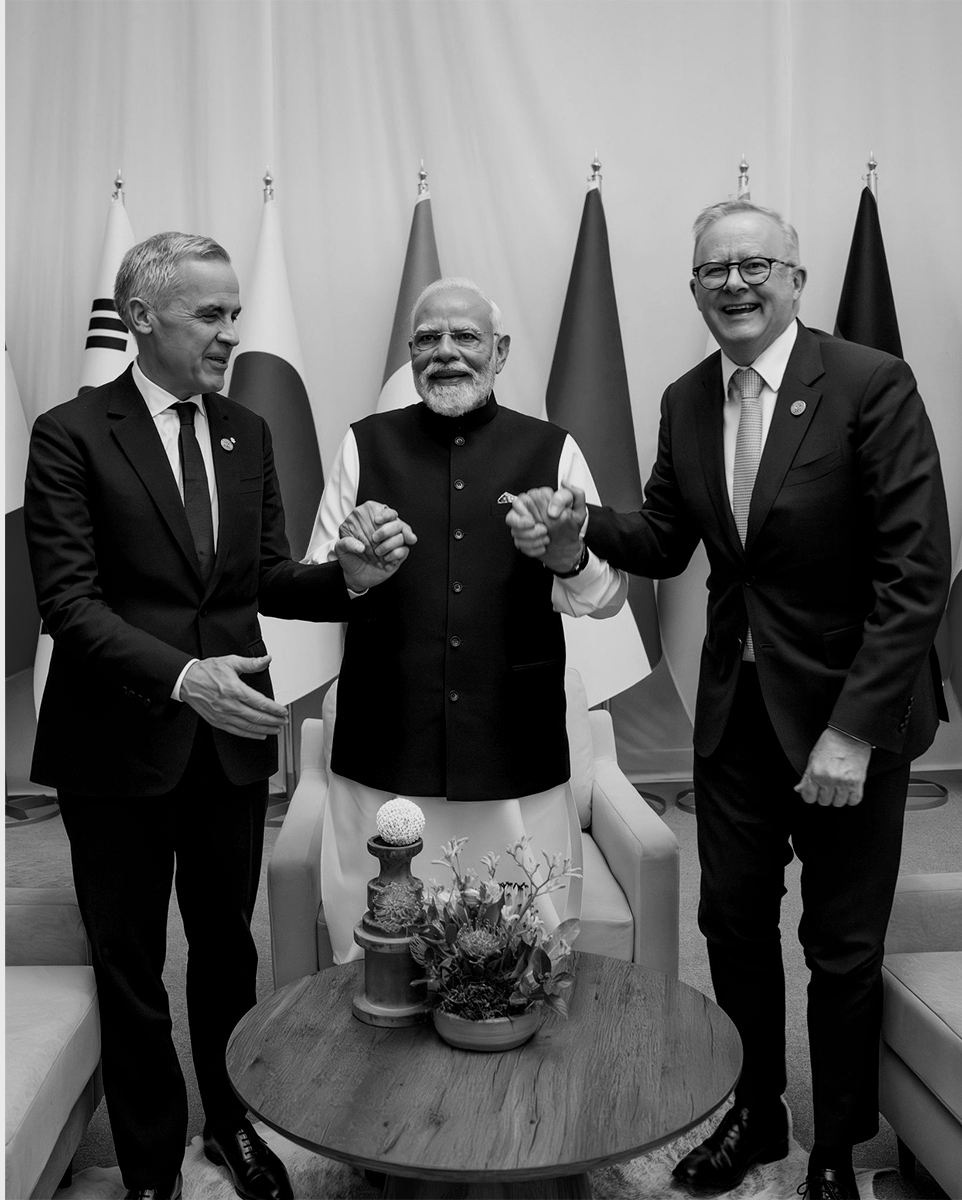
India, Australia, Canada seal ACITI pact for Green tech, Mineral security
In a major collaborative effort, India, Australia and Canada on Saturday agreed to launch a new trilateral technology and innovation platform the Australia-Canada-India Technology and Innovation (ACITI) Partnership. The announcement followed a meeting between Prime Minister Narendra Modi, Australian Prime Minister Anthony Albanese and Canadian Prime Minister Mark Carney at the G20 Summit in Johannesburg. According to the Ministry of External Affairs, the initiative will draw on the technological strengths and resource capabilities of the three countries, with a strong focus on green energy innovation, critical minerals and the creation of resilient, diversified supply chains. The partnership will also explore the development and mass-scale adoption of artificial intelligence to improve service delivery and citizen welfare. Officials from the three nations are expected to meet in the first quarter of 2026 to carry the initiative forward.
India is positioned to gain several strategic and economic advantages through the ACITI Partnership and the broader G20 discussions on critical minerals. With Australia and Canada being among the world’s biggest suppliers of lithium, cobalt, nickel and rare earth elements, India stands to secure strengthened access to essential resources required for its renewable energy, electric mobility and semiconductor ambitions. The collaboration is expected to accelerate India’s clean energy transition by supporting renewable targets, battery storage expansion and green hydrogen development. It will also help India diversify its supply chains and reduce dependence on single-source routes, thereby lowering vulnerability to geopolitical disruptions.
The partnership further opens opportunities for joint artificial intelligence research, which can advance India’s capabilities in governance, healthcare, agriculture and public service delivery. Additionally, increased cooperation is expected to attract investments in mineral exploration, processing and technology development, supporting India’s plans for domestic value addition under Make in India. Stable mineral supply chains will contribute to strengthening India’s EV, electronics, defence and clean-tech manufacturing sectors while enhancing its industrial resilience. The move also provides India a greater role in shaping global norms and standards in the critical minerals landscape, reinforcing its leadership in energy transition discussions.
At the G20 Summit, Prime Minister Modi highlighted six major initiatives, including the G20 Critical Minerals Circularity Initiative, aimed at easing supply chain pressures, boosting recycling and promoting collaborative research on critical minerals. The G20 Leaders’ Declaration underscored the rising global demand for these minerals as economies undergo sustainable transitions, rapid digitisation and industrial innovation. The declaration noted that despite abundant resources, many developing producer countries face persistent challenges such as under-investment, limited value addition, technological gaps and socio-environmental concerns. It welcomed the G20 Critical Minerals Framework, describing it as a voluntary and non-binding blueprint to build transparent, stable and resilient mineral value chains. The framework aims to unlock investments in mineral exploration, promote local beneficiation at source, and strengthen governance for sustainable mining practices. It also reaffirms the sovereign rights of mineral-rich nations to utilise their resources for inclusive growth while ensuring environmental stewardship and community participation.
The declaration further stressed that critical minerals should become a driver of broader development rather than being limited to raw material exports. It called for diversification of mineral sources, markets, processing hubs and supply routes, especially in developing countries, along with the adoption of robust and non-discriminatory economic, social and environmental standards. The G20 leaders also highlighted the need to shield critical mineral value chains from disruptions caused by geopolitical tensions, unilateral trade measures inconsistent with global norms, pandemics or natural disasters. They urged governments, the private sector, investors, financial institutions, development partners and local communities to collaborate closely in harnessing the full potential of critical minerals. The aim, they said, is to ensure that mineral-endowed regions benefit from their natural wealth and that global efforts towards sustainable and equitable development are strengthened.