
India at 79: How Indian Women Changed Their Place in Society and the Economy
When India became independent in 1947, the opportunities available to women were vastly different from those of today. Education for girls was limited, professional careers were largely inaccessible to most women, and social expectations often placed household and family responsibilities at the centre of a woman's life.
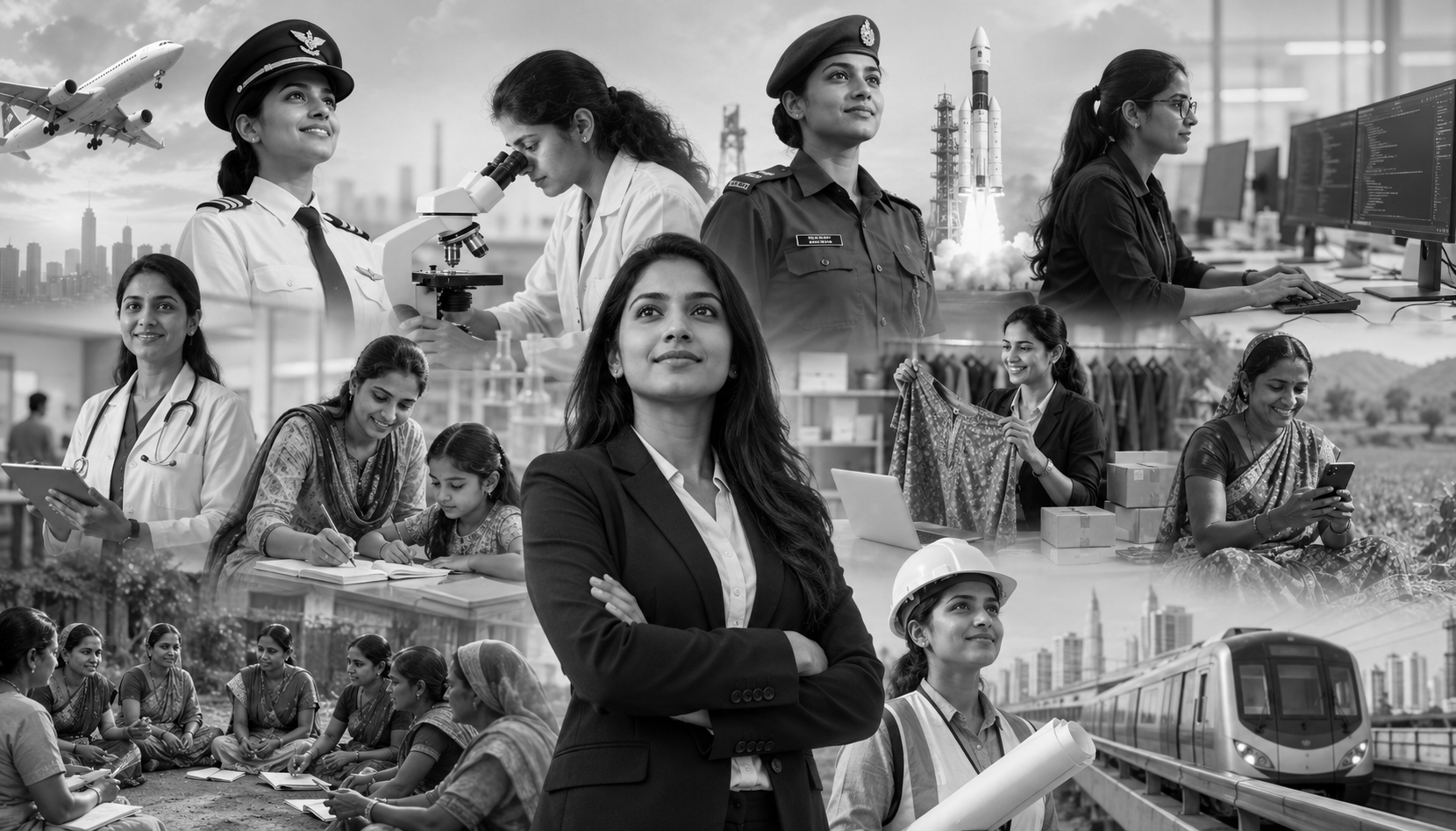
Seventy-nine years later, India's women are increasingly visible in classrooms, laboratories, offices, factories, farms, courts, boardrooms, armed forces, police departments, political institutions and entrepreneurial ventures. The transformation has not happened in one dramatic moment. It has been built over decades through education, economic development, legal and policy changes, urbanisation, technology and changing social attitudes. More than simply increasing the number of women in workplaces, this transformation has expanded what Indian society believes a woman can aspire to become.
Education was among the earliest and most powerful drivers of this change. At Independence, female literacy was extremely low and access to schools and higher education remained limited. Over subsequent decades, the expansion of primary schools, colleges, universities and professional institutions brought millions more girls into the education system. As education expanded, so did aspirations.
Women moved into medicine, engineering, law, teaching, banking, management, journalism, science and technology. Higher education increasingly gave women the opportunity to make independent career and financial decisions and opened doors to professions that had previously been dominated by men. Today, girls compete alongside boys for places in universities and professional courses across the country, while women are increasingly represented in disciplines that were once overwhelmingly male dominated.
Education has therefore done more than improve literacy. It has changed the question from whether a girl should study to what she wants to study and what career she wants to build.
That shift is visible across the workplace. Indian women are now pilots, engineers, scientists, police officers, soldiers, entrepreneurs, technology professionals, lawyers, administrators and corporate leaders. Their growing presence has gradually weakened the assumption that particular professions belong exclusively to men. The change is especially visible in cities, but smaller towns and rural areas are also witnessing new possibilities as education, banking, digital technology and access to markets expand.
The significance of women's employment goes far beyond receiving a salary. When women earn an income, they can gain greater influence over household spending, children's education, healthcare and other family decisions. Their earnings can strengthen the financial security of families while increasing their ability to make independent choices. Women's economic participation has increasingly become a question of household power as well as household income.
Employment, however, is only one part of the transformation. Indian women are also increasingly becoming entrepreneurs. They are establishing small businesses, running home-based enterprises, joining producer groups, building online businesses and creating startups. For rural women in particular, self-help groups have provided an important route to savings, credit and income-generating activities.
The importance of these initiatives cannot be measured only in rupees. Participation can bring greater financial awareness, confidence and a stronger voice in household and community decisions. A woman who once depended entirely on a local market can increasingly use a smartphone to communicate with customers, receive digital payments, promote products and access information. E-commerce and social media have enabled some small businesses to reach customers beyond their immediate neighbourhood, reducing one of the traditional barriers faced by women entrepreneurs: limited access to markets.
Technology is also changing the professional landscape for women. As India has emerged as a technology and services hub, women have increasingly entered information technology, software, research, biotechnology, engineering, data-related fields and other knowledge industries. Scientific institutions have also provided women with opportunities to contribute to major national projects.
India's space programme offers a powerful example. Women scientists and engineers have become increasingly visible in missions involving satellites, launch vehicles and planetary exploration. Their presence has significance beyond individual careers because representation can influence aspiration. A young girl who sees women contributing to science, technology or space is presented with possibilities that may have seemed unimaginable to earlier generations. Women are increasingly becoming participants in India's most ambitious scientific and technological projects.
The transformation, however, cannot be understood only through the experience of India's cities. Rural women have always played a central role in agriculture, livestock, household production and family businesses, although much of this work has traditionally been unpaid or poorly recognised.
That role is gradually becoming more organised and visible. Self-help groups, microfinance, banking access, mobile phones and government-linked programmes have helped more rural women participate in economic activity. Women are increasingly involved in small enterprises, food processing, handicrafts, retail, agriculture-related businesses and community organisations.
Technology has added another dimension. A smartphone can provide access to weather information, agricultural advice, digital payments, government information, online learning and markets. For women who face restrictions on physical mobility, digital access can be particularly valuable. The rural transformation remains uneven, but women are increasingly becoming not just workers within the household economy but economic decision-makers and entrepreneurs in their own right.
Perhaps the most profound change, however, has taken place inside the home.
For generations, household work and caregiving were overwhelmingly viewed as women's responsibilities. Even when women entered paid employment, they often continued to carry a disproportionate share of domestic duties. Modern households are gradually challenging this arrangement.
In many urban and middle-class families, dual-income households have become more common. Decisions about marriage, children, housing, careers and household spending increasingly involve women's professional aspirations. A woman's income can help families manage education expenses, housing costs, healthcare and other financial pressures. For younger generations, a woman's career is increasingly viewed as part of the family's economic future rather than simply an optional supplement to a man's earnings.
Yet this transition remains incomplete. Women continue to perform a large share of unpaid domestic and care work, and many leave employment because of marriage, childbirth, childcare or other family responsibilities. The challenge is therefore no longer simply getting women into the workplace. It is creating conditions that allow them to remain, progress and lead.
The changing role of women is equally visible in public life. Women have increasingly entered politics, administration, policing, the judiciary, armed forces and local governance. Their presence in decision-making institutions has expanded the range of voices involved in shaping public policy.
At the grassroots level, women's participation in local government has been particularly significant. Political representation can provide women with experience in public administration, budgeting and community decision-making while challenging traditional perceptions about women's leadership. For a young woman growing up in a village or small town, seeing another woman serve as a local representative, police officer, doctor, teacher or government official can change what she believes is achievable.
The smartphone may become one of the most important tools in the next stage of women's empowerment. Digital banking can give women greater control over financial transactions. Online education can provide access to courses without requiring relocation. Telemedicine can reduce the burden of travelling long distances for some healthcare services. Remote work can potentially create employment opportunities for women constrained by location or family responsibilities, while digital commerce can connect women entrepreneurs with customers.
But technology is not automatically empowering. A digital divide remains between those who have reliable devices, connectivity, digital skills and financial access and those who do not. Women's ability to benefit from technology can also be limited by household control over phones, internet access or financial decisions. The next challenge, therefore, is not merely connecting women to technology, but ensuring that they can use it independently and safely.
Despite enormous progress, India's gender transformation remains incomplete. Women continue to face barriers including lower workforce participation, unequal unpaid-care responsibilities, wage disparities, workplace discrimination, safety concerns and limited access to leadership opportunities. The experience also differs sharply across states, regions, income groups and rural and urban communities.
A woman in a major metropolitan city may have access to universities, corporate employment, digital banking and professional networks, while another woman in a remote rural area may still face basic barriers involving transport, education, internet access and healthcare. The next phase of India's development must therefore focus not only on creating opportunities but on making those opportunities more accessible, affordable and sustainable.
The biggest change may ultimately be psychological rather than statistical.
The India of 1947 largely operated within a social structure in which women's roles were narrowly defined. The India of 2026 increasingly recognises that a woman can be a daughter, wife or mother while also being a scientist, entrepreneur, soldier, doctor, engineer, farmer, artist, administrator or corporate professional.
Traditional family roles have not disappeared. Instead, their boundaries have expanded. A daughter can become the primary financial provider. A mother can return to a professional career. A rural woman can become an entrepreneur. A girl from a small town can aspire to work in a technology company or space programme.
The boundaries of possibility have moved.
As India marks 79 years of Independence, the story of Indian women is therefore not simply one of progress from one generation to another. It is a story about the transformation of India's society and economy itself.
Women's education has expanded the talent pool. Their participation in the workforce has strengthened household incomes and economic activity. Entrepreneurship has opened new routes to financial independence. Technology is reducing some barriers created by distance. Greater representation in public institutions is widening women's role in decision-making.
But the unfinished work is equally important. India's next challenge is to ensure that a woman does not have to choose between education and marriage, motherhood and a career, economic independence and family responsibility, or ambition and social acceptance.
The real measure of progress will be whether opportunities available today become accessible to women across India's cities, towns and villages.
The journey from 1947 to 2026 has already changed the question from “Can women do this?” to increasingly “Why shouldn't they?”
That may be one of the quietest and most consequential transformations in India's 79-year journey.