
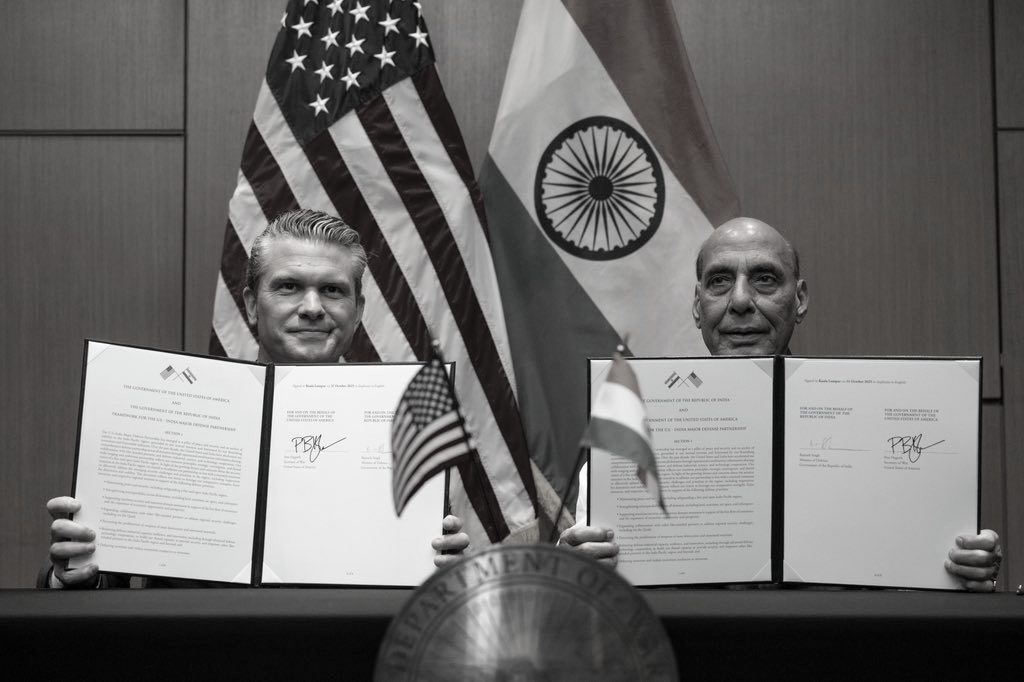
India and US seal 10-year defence framework, marking a new era of strategic partnership
In a major boost to India, US strategic partnership, Defence Minister Rajnath Singh and US Secretary of War Pete Hegseth signed a decade-long defence framework agreement in Kuala Lumpur on Friday, formalising a roadmap that will guide cooperation between the two countries until 2035.
The agreement, inked on the sidelines of the ASEAN Defence Ministers’ Meeting Plus (ADMM Plus), lays out a comprehensive plan for deeper collaboration in defence production, technology sharing, intelligence exchange, and security coordination across the Indo-Pacific.
A new chapter in defence ties Calling it the start of a new chapter in India, US defence relations, Rajnath Singh said the framework reflected the growing strategic convergence between New Delhi and Washington. “We have held telephonic conversations thrice. I am delighted to be meeting you in person on the sidelines of ADMM Plus. On this occasion, I feel a new chapter will begin today with the signing of the defence framework. I am confident that under your leadership, India US relations will further strengthen,” Singh said.
Hegseth, echoing the sentiment, described the framework as a defining moment for the two democracies. “Our strategic alignment is built on shared interests, mutual trust, and a commitment to a secure and prosperous Indo-Pacific. This 10-year framework is ambitious and underscores America’s long-term commitment to our shared security,” he said.
After the signing, Singh posted on X, calling the framework a signal of growing strategic convergence that will provide policy direction to the entire spectrum of India, US defence ties.
Building on two decades of cooperation This is not the first time India and the US have set a long-term roadmap for defence collaboration. The first defence framework agreement was signed in 2005, laying the foundation for joint exercises, counter-terror cooperation, and maritime security partnerships.It was renewed in 2015, expanding focus toward technology transfer, intelligence sharing, and maritime domain awareness.
The 2025 framework, the third in the series, builds on those earlier foundations but shifts emphasis to co-development, co-production, cybersecurity, space defence, and supply-chain resilience, areas that have gained urgency in today’s changing geopolitical environment.
Analysts say this version reflects India’s evolving priorities, pursuing strategic autonomy while strengthening alliances. For Washington, it reaffirms India’s role as a critical partner in ensuring a free, open, and secure Indo-Pacific, especially amid rising challenges from China’s expanding influence in the region.
Beyond defence, a strategic balancing act The meeting between Singh and Hegseth comes at a time when India and the US are also advancing bilateral trade negotiations, with both sides aiming to balance economic interests with strategic commitments. Officials say the defence deal complements ongoing discussions on technology and supply-chain cooperation, underscoring a holistic approach to partnership that spans security, economy, and innovation.
Union Commerce Minister Piyush Goyal recently reiterated that India would not rush into trade deals but focus on building trust and long-term partnerships, an approach mirrored in this new defence framework. Commerce Secretary Rajesh Agrawal also hinted that the two nations are close to finalising a broader trade agreement, reflecting a growing sense of convergence across multiple fronts.
Strengthening regional presence Rajnath Singh’s visit to Malaysia also included talks with Defence Minister Khaled Nordin and participation in sessions on regional peace and counter-terrorism. India and Malaysia currently co-chair the Experts’ Working Group on Counter Terrorism (2024-2027), signalling New Delhi’s expanding role in promoting regional stability and cooperation under the Indo-Pacific umbrella.
Looking ahead The new decade-long defence framework signals continuity, and evolution, in one of the world’s most consequential partnerships. By anchoring cooperation in technology, industry, and shared strategic goals, it promises to deepen trust and create new opportunities for both nations’ defence sectors.
For India, the agreement reaffirms its place as a key player in regional security and global supply chains. For the US, it strengthens a partnership central to its Indo-Pacific strategy. Together, the two nations are setting the stage for what could be the most integrated phase yet in their defence and strategic collaboration.