
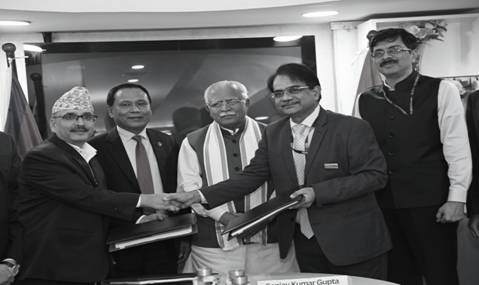
India and Nepal strengthen energy partnership with major cross-border power projects
India and Nepal on Wednesday took a significant step toward deepening their cooperation in the power sector with the signing of key agreements to enhance cross-border electricity connectivity. Nepal’s Minister for Energy, Water Resources and Irrigation, H.E. Kulman Ghising met with India’s Union Minister for Power and Housing & Urban Affairs, Shri Manohar Lal , in New Delhi to review progress on ongoing energy collaborations and discuss new projects aimed at regional energy integration.
During the meeting, both sides focused on the development of hydropower projects in Nepal, regional grid connectivity, and clean energy integration. The ministers emphasized the need for strengthening energy security in the region and promoting sustainable growth through renewable energy cooperation.
In the presence of both ministers, Joint Venture and Shareholders’ Agreements (JV&SHA) were signed between POWERGRID , India’s Maharatna public sector enterprise, and the Nepal Electricity Authority (NEA) . These agreements pave the way for setting up two joint venture entities, one each in India and Nepal, for the construction of major 400 kV cross-border transmission systems .
The new projects include the Inaruwa (Nepal) - New Purnea (India) 400 kV Double Circuit (Quad Moose) Transmission Link and the Lamki (Dododhara) (Nepal) - Bareilly (India) 400 kV Double Circuit (Quad Moose) Transmission Link. Once completed, these lines will significantly increase the electricity exchange between India and Nepal, improve grid resilience, and enhance cross-border energy trade.
Although the projects primarily connect through eastern and northern India, their impact will extend to the southern grid, which includes Andhra Pradesh and Telangana . The additional inflow of hydropower from Nepal is expected to help stabilize the national grid, improve power reliability, and assist southern states in balancing peak energy demand. Experts say this can also complement the large-scale solar and wind capacity being added in the Telugu states, helping to build a cleaner and more flexible power system.
Officials described the meeting as a milestone in India-Nepal energy diplomacy, reflecting decades of cooperation built on shared natural resources and regional interdependence. The latest agreements are expected to boost renewable energy adoption, strengthen the South Asian power grid, and open new avenues for sustainable economic growth in both nations.
The partnership between India and Nepal thus moves beyond borders, symbolizing not only shared energy but also a shared vision for a greener, interconnected South Asia.