
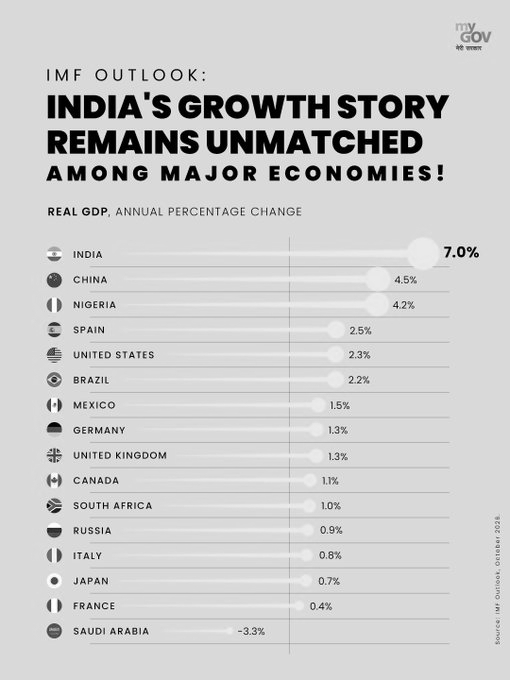
IMF Raises Global Growth Forecast for 2026 but Sees 2027 Slowdown as India Holds at 7%
The International Monetary Fund (IMF) has raised its global growth forecast for 2026 to 3.1% from 3% projected in July, but warned of an uneven economic outlook amid rising energy prices, geopolitical tensions and the disruptive effects of artificial intelligence (AI). India is projected to grow by 7% in both FY27 and FY28, retaining its position as the fastest-growing major economy.
In its October 2026 World Economic Outlook (WEO), the IMF said the global economy expanded by 3.5% in 2025 and is expected to grow by 3.4% in 2027, unchanged from its July forecast. The projections assume that oil and gas shipments through the Strait of Hormuz will resume by March and that demand driven by the AI boom will moderate.
The IMF raised India’s FY27 growth forecast to 7% from 6.4% projected in July and revised its FY28 estimate upwards to 7% from 6.7%. Resilient domestic demand, strong services activity, favourable demographic trends, an expanding domestic market and structural reforms support the outlook. The Reserve Bank of India (RBI) has projected FY27 growth of 7.1%.
However, rising energy costs remain a risk for India, which relies heavily on crude oil imports. The IMF expects average oil prices to rise nearly 41% in 2026 to $95.74 per barrel before easing to $87.39 in 2027. Higher prices could increase India’s import bill, widen its current account deficit, raise inflation and pressure household spending and businesses. India’s consumer inflation is projected at 5% in FY27 and 4.4% in FY28, while its current account deficit is expected to reach 1.5% of GDP in FY27.
Globally, inflation is forecast to rise to 4.7% in 2026 from 4.1% in 2025 before easing to 4.1% in 2027. The IMF said AI investment is helping offset damage from higher oil and gas prices, but its benefits remain concentrated. The United States and China account for more than three-quarters of net demand for imported computer chips and other AI-related equipment. IMF research director Silvana Tenreyro said the outlook was “highly uneven”, with 32 countries accounting for 95% of global growth, compared with 54 countries in April.
IMF Managing Director Kristalina Georgieva warned that AI could augment, downgrade or eliminate around 40% of jobs worldwide. Rising public debt and high borrowing costs also pose risks to financial stability.
Advanced economies are projected to grow by 2.1% in 2026 and 1.9% in 2027. The US is forecast to expand by 2.3% in both years, while the eurozone is expected to grow by 1.1% and 1.2%, respectively. China’s growth is projected to slow to 4.5% in 2026 from 5% in 2025.
Emerging and developing economies are expected to grow by 3.7% in 2026, down from 4.5% in 2025, before recovering to 4.4% in 2027. The Middle East and Central Asia are projected to contract this year before growing by 6.3% in 2027. The IMF and World Bank meetings in Bangkok are focusing on global economic conditions, financial stability and sustained growth.