
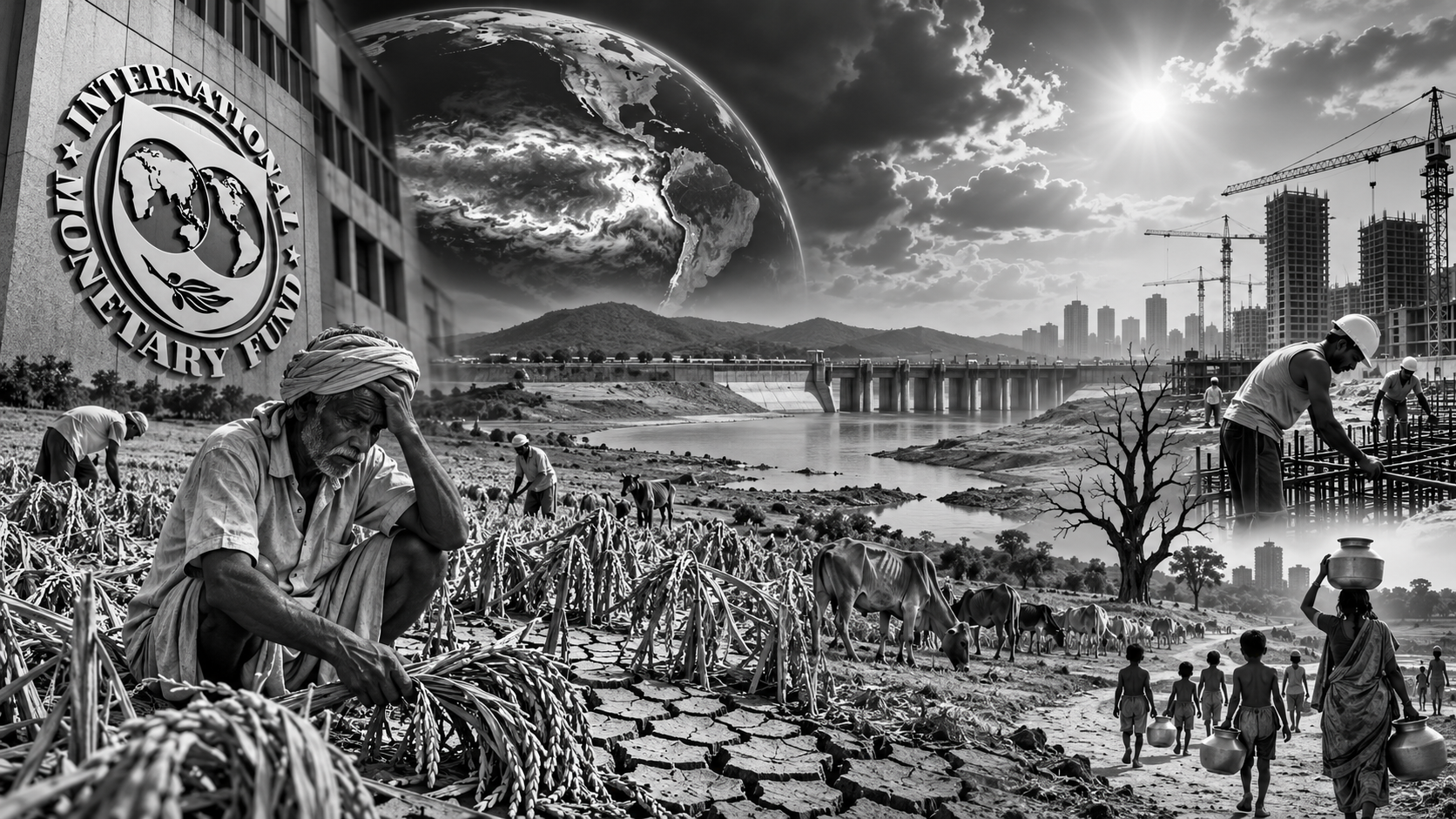
IMF Flags El Niño Risks to India's Growth Despite Strong Economic Momentum
The International Monetary Fund (IMF) has cautioned that the potential economic consequences of the strengthening El Niño phenomenon have not yet fully materialised in India, even as the country faces mounting concerns over agricultural production, food inflation, water availability and rural livelihoods. Although India's economic growth remains resilient, the global lender has identified declining crop yields, rising food prices and reduced household purchasing power as significant risks that could affect the country's economic outlook in the coming months. The warning assumes particular importance following a deficient southwest monsoon in 2026, raising concerns over agricultural losses and declining reservoir levels.
IMF Communications Director Julie Kozack said on October 29 that the weather-related risks had not yet translated into a measurable setback to India's economic performance. The organisation plans to reassess its projections in the January 2027 World Economic Outlook (WEO) update. Earlier this month, the IMF raised India's GDP growth forecasts for FY2026-27 and FY2027-28 to 7% for both years, from its earlier estimates of 6.4% and 6.7%, respectively, citing robust domestic demand and strong services activity.
El Niño, characterised by abnormal warming of surface waters in the central and eastern equatorial Pacific Ocean, can influence global rainfall and temperature patterns. Although it is generally associated with weaker Indian monsoon rainfall, its impact also depends on factors such as the Indian Ocean Dipole. The World Meteorological Organization has warned about strengthening conditions, while clarifying that 'Super El Niño' is not an officially defined meteorological classification.
India's 2026 southwest monsoon ended with approximately 759.4 mm of rainfall, against the normal 868.6 mm, representing a 13% deficit and the weakest monsoon since 2015. Southern India received around 76% of normal rainfall, while eastern India recorded approximately 74%. Kharif sowing remained 13.54 lakh hectares below the previous year's level, with paddy acreage declining by 16.32 lakh hectares.
Rice, maize, soybean, pulses, groundnut, cotton and sugarcane face potential production losses due to inadequate soil moisture and prolonged dry spells. The upcoming rabi season, particularly wheat, mustard and chickpea cultivation, could also face irrigation shortages. Historical evidence highlights the risks: a NITI Aayog study found that pulse production declined by 6-30% in affected El Niño years. During 2015-16, coarse cereal production fell by 4.92 million tonnes, while oilseeds declined by 2.21 million tonnes.
The consequences could extend to groundwater depletion, soil erosion, tree mortality, forest fires and livestock distress, alongside reduced milk production and fisheries-related disruptions. Lower reservoir storage of 132.73 billion cubic metres, against 166.86 BCM a year earlier, adds to water security concerns.
Historical experience illustrates the potential human and economic costs. The 2002 drought affected approximately 300 million people and 150 million cattle, causing estimated economic losses of USD 8.7 billion and reducing agricultural GDP by 3.1%. Heat stress and water shortages could also affect construction workers, rural employment, industrial activity and public health.