
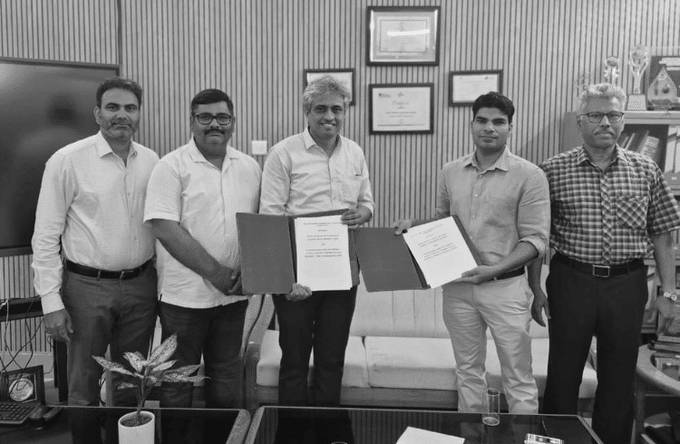
IIT Roorkee, Cathion Energy Ink Pact to Commercialise Battery Innovations
Indian Institute of Technology Roorkee has signed two technology transfer agreements with Cathion Energy Private Limited for the commercialisation of advanced lithium-ion battery electrode technologies aimed at improving battery performance and energy storage efficiency in India.
According to an official statement issued on Friday, the technologies were developed by Professor Anjan Sil and are expected to support the growing demand for high-performance rechargeable batteries across sectors such as electric mobility, portable electronics, and renewable energy storage .
The first technology transferred is titled “A Novel Electrode Composite for High Power and High Energy Application in Rechargeable Lithium-ion Battery” , while the second is “A High-Performance Composite Electrode for Li-ion Battery.” Both innovations focus on enhancing the electrochemical performance, energy density, charging capability, and operational efficiency of lithium-ion batteries.
The agreements mark a significant step in translating laboratory research into industrial-scale applications at a time when India is rapidly expanding its electric vehicle and clean energy ecosystem. Industry experts believe improved electrode materials can play a critical role in addressing key challenges such as faster charging, longer battery life, improved thermal stability, and higher energy retention .
India’s lithium-ion battery market is witnessing strong growth due to rising EV adoption, government-backed clean energy initiatives, and increasing investments in domestic battery manufacturing under schemes such as the Production Linked Incentive (PLI) programme for Advanced Chemistry Cells.
Professor Sil said the transfer of the technologies represents an important milestone in moving research innovations from the laboratory to real-world industrial applications.
Cathion Energy CEO Hari Raj said the technologies hold “strong potential” to improve battery performance and support the rapidly evolving energy storage and electric mobility sectors in the country.
The collaboration is also expected to strengthen India’s push towards building indigenous battery technologies and reducing dependence on imported energy storage solutions.