
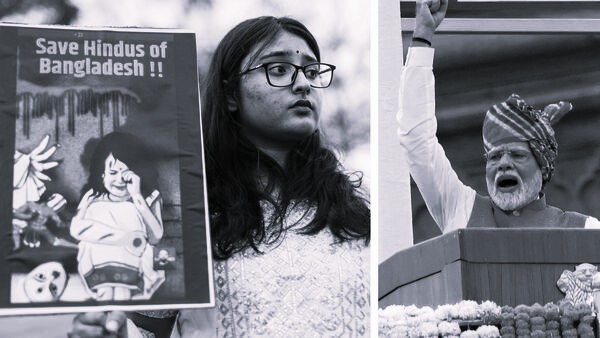
If Trump can act for Nigerian Christians, why can’t Modi for Bangladesh Hindus?
As U.S. President Donald Trump threatens military action against Nigeria over the killing of Christians, questions are rising closer to home: When will Indian Prime Minister Narendra Modi take a firm stand against the continuing persecution of Hindus in Bangladesh?
Trump’s warning to “strike hard and fast” against those attacking Christians in Africa has reignited debate over selective morality and double standards in global politics. His words - aimed at Nigeria’s government - could easily apply to the rising violence against Hindus in India’s own neighborhood.
“The United States will not watch while Christians are slaughtered,” Trump said.
“Freedom of religion means protecting the persecuted — everywhere.”
But as Washington threatens action, New Delhi remains notably quiet about the plight of Bangladeshi Hindus who, for decades, have faced discrimination, violence, and forced displacement.
Trump’s hard line vs Modi’s silence
While Trump’s statement may carry a political undertone, it also projects moral clarity, something critics say is missing from India’s response to Hindu persecution in Bangladesh.
President Trump’s directive to the Pentagon, warning Nigeria to act or face U.S. retaliation, was accompanied by a temporary freeze on aid. Defense Secretary Pete Hegseth reinforced it, declaring, “Either the Nigerian government protects Christians, or we will protect them ourselves.”
India’s approach: despite recurring temple desecrations, attacks on Hindu homes, and communal riots in Bangladesh, including during the Durga Puja violence of 2021 and Brahmanbaria riots of 2023 - New Delhi’s reactions have been muted, confined to diplomatic “concern” statements.
Hindu persecution in Bangladesh: A continuing crisis
Bangladesh’s Hindu population, once nearly a fifth of the country, has steadily declined to below 8%, according to multiple demographic studies. Over the past decade, human rights groups have reported:
• Hundreds of attacks on Hindu temples and homes, often following social media rumors.
• Targeted sexual violence and forced conversions.
• Widespread land grabs under the Vested Property Act, stripping Hindus of ancestral land.
• Religious exodus: lakhs of Hindus fleeing to India’s border states for safety.
And yet, India, the natural voice for Hindus in South Asia, has refrained from strong public condemnation or international lobbying, prioritizing political stability with Sheikh Hasina’s government over humanitarian protection.
A tale of two democracies
Trump’s move against Nigeria, though controversial, highlights the power of using diplomacy and threat as moral tools. In contrast, Modi’s government, which projects itself globally as the protector of Hindu interests, has avoided invoking religious persecution diplomatically, even as Hindus in Bangladesh face recurring violence.
Analysts note that this silence is strategic: Bangladesh is a key trade and security partner, and India fears destabilizing Dhaka could push it toward China. But the moral cost, they argue, is growing.
“The U.S. is ready to risk diplomatic backlash for Christian lives in Nigeria, but India is unwilling to risk trade or politics for Hindu lives in Bangladesh. That’s the moral gap the world is noticing.”
Trump’s interventionist tone has sparked criticism in Western media, but it also revives a global principle, that religious freedom must not be ignored across borders. If that standard is valid for Christians in Africa, many argue it should be equally valid for Hindus in South Asia.
For India, the question isn’t just about foreign policy, it’s about identity. The country has long styled itself as the “civilizational home” of Hindus worldwide, yet when atrocities occur just across the Padma River, the silence is deafening.
Bangladesh’s denials, India’s dilemma
Bangladesh’s government routinely denies accusations of targeted persecution, calling the incidents “isolated.” Dhaka insists minorities enjoy constitutional rights and cites joint celebrations of religious festivals as proof.
But rights activists and refugees tell a different story. In border states like West Bengal and Tripura, Hindu families continue to cross over, citing fear and lack of justice. Local NGOs have documented villages emptied of Hindus after mobs destroyed temples and homes.
Despite repeated pleas, India’s External Affairs Ministry has preferred private diplomacy to public pressure, a contrast to Trump’s open threats.
The global moral divide
Trump’s Nigeria ultimatum may be politically motivated, but it still forces a larger global reckoning: who deserves protection, and when?
If Washington can invoke faith as a cause for intervention thousands of miles away, shouldn’t India, with cultural and religious ties to Bangladesh’s Hindus, take at least diplomatic action to protect them?
As Trump claims moral high ground over Christian suffering in Nigeria, Modi’s inaction on Hindu persecution across his border is becoming harder to defend.