
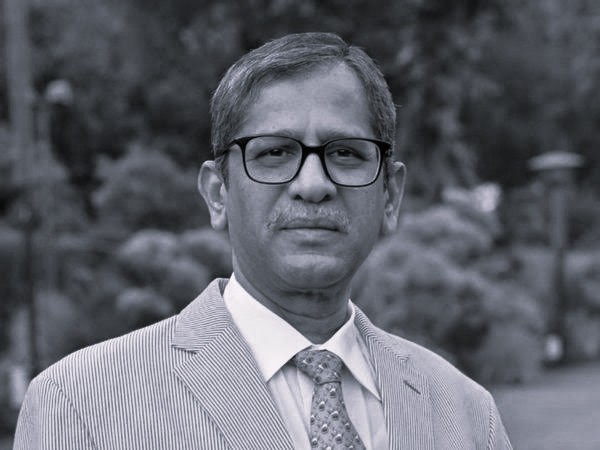
I was coerced through my family - Ex-CJI Ramana’s explosive charge
Former Chief Justice of India N V Ramana has openly stated that criminal cases were filed against members of his family with a deliberate intention to “coerce” him during one of the most politically turbulent phases Andhra Pradesh had witnessed in the last decade the capital controversy. Speaking at the 5th Convocation of VIT-AP University, the former CJI did not name the previous YSRCP regime directly, but he made it unequivocally clear that judicial independence was attempted to be weakened through personal and family-level targeting. His remarks yet again reignite a national debate around how political state power at times tries to influence constitutional institutions by indirect pressure mechanisms rather than direct confrontation.
The former CJI pointed out that the people present there knew very well about how his family was targeted. According to media reports summarising his speech, the alleged criminal case registrations happened during the tenure of the previous Y S Jagan Mohan Reddy-led government, before he took charge as CJI in April 2021. However, news agencies have not yet produced specific FIR numbers, case docket identities or official police stations from which the complaints emerged — indicating that while the allegation is at the public domain level, the documentary breakdown of those exact cases has not yet been disclosed in detail in the same reportage. But this allegation is consistent with a broader pattern what many in legal and political circles had claimed throughout the Amaravati dispute era: that multiple farmers, protestors, political supporters and public figures sympathetic to the Amaravati cause had to undergo intimidation, legal harassment and system-based coercive methods.
The background to this allegation cannot be separated from one of the longest agitation movements of independent India, the agitation by farmers of the Amaravati region, who had voluntarily given land to the State during the earlier Chandrababu Naidu government for developing Amaravati as the sole capital of Andhra Pradesh. The sudden reversal of this idea in December 2019, where the Jagan government introduced the “three capitals” formula Visakhapatnam as administrative capital, Amaravati as legislative capital and Kurnool as judicial capital triggered shockwaves across the region. The farmers felt betrayed, politically abandoned and economically at risk after parting with land which was given based on the promise of a single focused capital city that would generate infrastructure, value addition, growth and massive long-term development.
While the agitation spilled onto the streets, the legal fight simultaneously moved into courts. It was during this intense climate that Ramana was elevated as Chief Justice of India in 2021. The friction between judiciary and executive around the Amaravati issue became widely evident. In such a backdrop, Ramana’s statement now adds a retrospective insight suggesting that pressure was not only political or ideological, but extended into personal territory through legal case filing against his own family. He said that those who empathised with the Amaravati farmers, those who spoke against the administrative decisions of the time, those who stood for constitutional values and those who questioned the manner of governance faced systematic targeting and harassment.
Ramana said that when political leaders either remained silent or refused to take a position in fear of political consequences, it was the jurists, the lawyers and the courts that stood boldly in defence of the constitutional promise. He reminded that governments are temporary — they come and go but the rule of law and the judiciary are the real anchors of democratic stability. That stability is preserved only when citizens and constitutional protectors refuse to surrender their integrity for temporary comfort.
He offered praise and emotional tribute to the farmers of Amaravati who continued their protests for years. “I salute the spirit of Amaravati farmers,” he said. “They stood firm despite the use of government machinery against them. I draw inspiration from their struggle.” His words also carried a symbolic memory of his own long personal association with Amaravati as a place, a principle and an idea.
Now, with a change of government led by N Chandrababu Naidu, the Amaravati capital project has regained momentum. Works which were stalled for years are now said to be accelerating again across multiple core capital zones. The Naidu government has signalled complete rollback of the three-cities formula and returning to a single-capital Amaravati blueprint, which farmers have demanded consistently for years.
Ramana’s statement is more than a personal complaint it is a warning, and potentially a historic testimony, that political vendetta can attempt to strike at the independence of constitutional authorities not by direct legal reforms or direct confrontation, but by weaponising investigative agencies and indirect coercive cases against personal relatives. His words revive a crucial national democratic question: how robust and secure are constitutional institutions in India when they stand at odds with a powerful ruling government?