
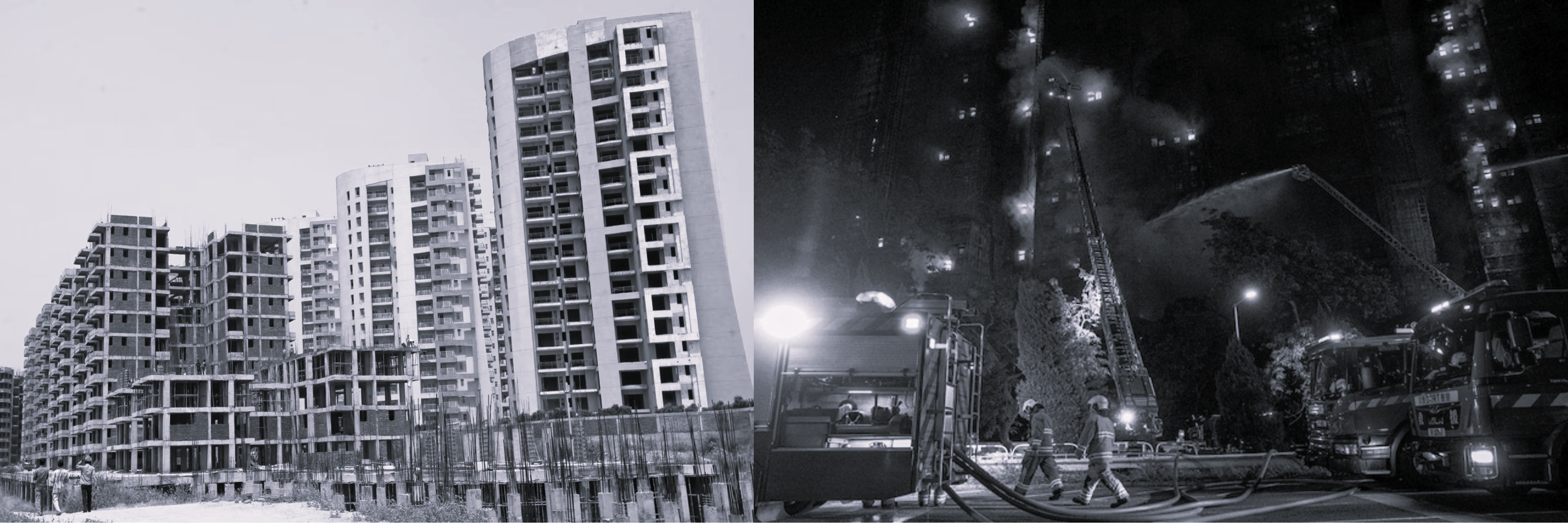
Hyderabad’s rapid vertical growth raises fire safety fears after Hong Kong high-rise tragedy
The devastating high-rise fire in Hong Kong that killed at least 44 people and left hundreds unaccounted for has triggered fresh concerns in Hyderabad, a city witnessing an unprecedented surge in skyscraper construction. As investigations in Hong Kong point to bamboo scaffolding and inadequate safety measures during maintenance work as key factors in the rapid spread of the fire, urban planners and citizens in Hyderabad warn that similar vulnerabilities may exist in the city’s growing skyline.
The fire in Hong Kong erupted across an eight-building residential complex containing nearly 2,000 apartments. The blaze spread swiftly through flammable bamboo scaffolding installed for renovation, aided by strong winds and limited vertical access for firefighters. The tragedy has become a grim reminder of how fire safety can collapse in densely packed high-rises when preventive systems fail or emergency access is restricted.
In Hyderabad, citizens and civic observers say the lessons are uncomfortably relevant. Over the last five years, the city has seen a dramatic rise in towers above 30 and even 50 floors, especially across Neopolis, Kokapet, Financial District, Raidurg and various HMDA auctioned layouts. With multiple land parcels now fetching record-breaking bids, developers are pushing vertical limits further, while residents fear the city’s firefighting capacity is lagging behind.
Local voices have amplified these concerns on social media. One Hyderabad resident highlighted that the city’s fire department, as of now, cannot effectively access or operate beyond the 30th floor. “This means, in a fire above that level, the flames often cannot be controlled unless they subside on their own,” he warned, stressing that safety equipment installed by builders is useful only for small, contained fires.
Another user expressed alarm after seeing visuals from Hong Kong, pointing out that Hyderabad lacks the infrastructure to tackle even moderate fires in 10-floor buildings. With 200–300 towers above 50 floors expected over the next decade, he urged the state government to establish new fire stations, equip them with state-of-the-art hydraulic platforms, and provide advanced training to firefighters. “In Neopolis alone, we will see 100+ high-rise buildings,” he wrote, questioning why land earmarked for essential civic infrastructure is being auctioned instead of being reserved for safety facilities.
Fire experts note that high-rise safety requires more than standard approvals. It demands wide access roads for fire engines, unobstructed refuge floors, regular evacuation drills, functional smoke extraction systems, and strict oversight during tower maintenance and facade works areas where lapses can turn deadly.
The Hong Kong tragedy has thus become a cautionary moment for Hyderabad. With thousands of families set to move into upcoming super-tall towers, the incident underscores the urgent need for fire-preparedness to keep pace with the city’s vertical ambition. Urban planners stress that every high-rise city must plan not just for construction, but for rescue because when a fire breaks out 40 or 50 floors above the ground, every second, and every metre of access, can decide the outcome.