
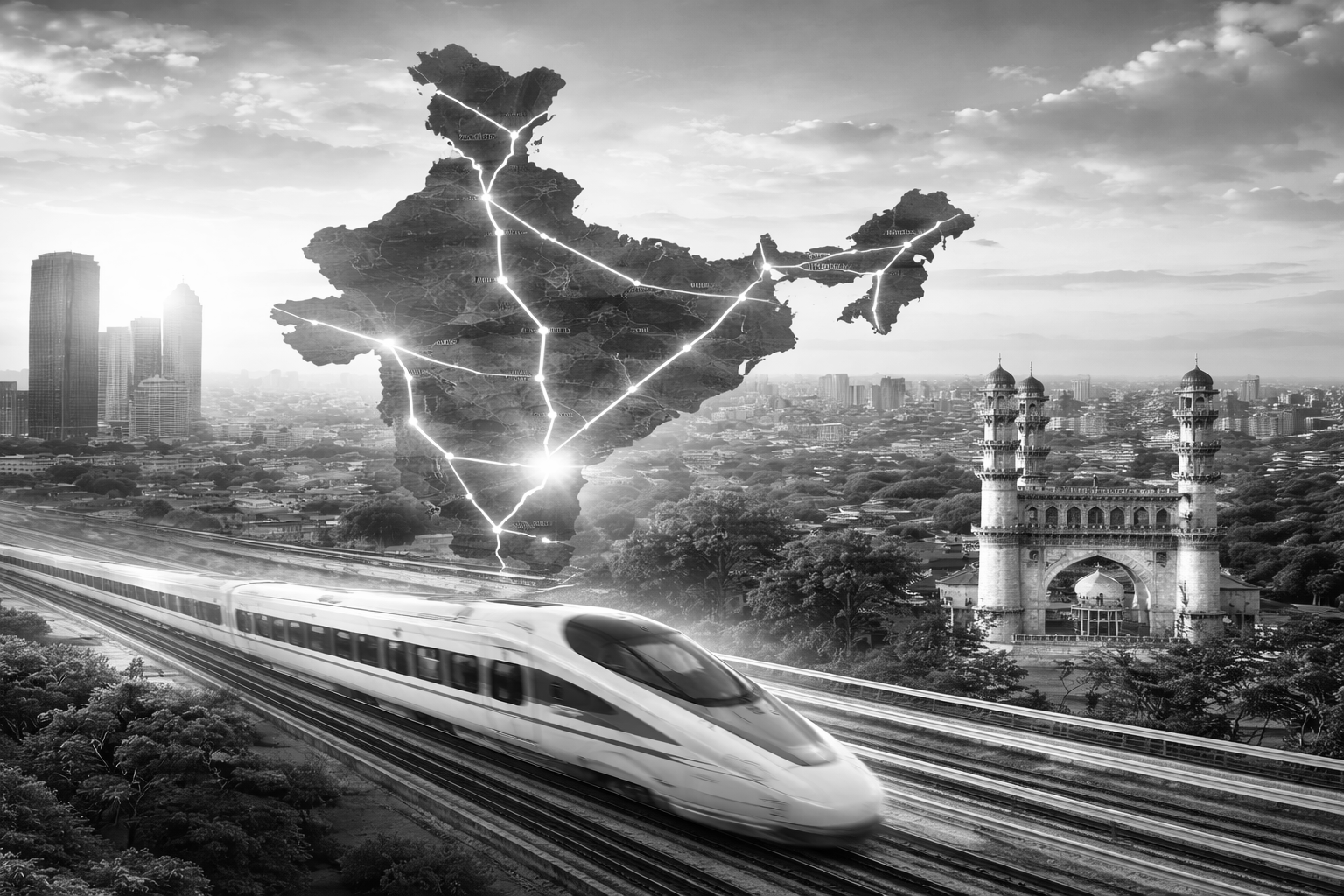
Hyderabad at the Heart of India’s 7 High-Speed Rail Corridors in Budget 2026
The Union Budget 2026 has placed Telangana prominently on India’s future transport map, with the Centre unveiling an ambitious plan to build seven high-speed rail corridors nationwide. Announced by Union Finance Minister Nirmala Sitharaman , the project is designed to transform inter-city mobility, promote green transport, and strengthen long-term economic capacity. A major highlight for Hyderabad is its inclusion in three strategic corridors Hyderabad–Bengaluru, Pune–Hyderabad, and Hyderabad–Chennai positioning the city as a central node in South India’s fast-rail network. The remaining corridors announced are Mumbai–Pune, Chennai–Bengaluru, Delhi–Varanasi, and Varanasi–Siliguri, linking financial centres, technology hubs, industrial regions, and emerging economic zones.
The initiative aligns with the Centre’s broader infrastructure-led growth strategy. Union Minister Bandi Sanjay Kumar noted that under Prime Minister Narendra Modi ’s leadership, infrastructure is being treated as an “economic multiplier,” capable of stimulating investment, employment, and regional development. The corridors aim not only to cut travel time but also to shift a portion of long-distance travel toward environment-friendly rail systems, reducing congestion and emissions. With proposed operational speeds of 250–300 kmph, these high-speed trains could significantly shrink travel durations between major southern cities, potentially making rail a competitive alternative to air travel on several routes.
Economically, the corridors are expected to function as growth engines rather than just transport upgrades. Large-scale rail infrastructure typically attracts logistics parks, industrial clusters, real estate expansion, and service-sector growth along routes. By improving accessibility, the network could integrate regional markets more closely and accelerate industrial diversification a key objective under the Viksit Bharat vision. Beyond mobility, the emphasis is on long-term national capacity building instead of short-term budget optics, with the government presenting the plan as part of a structural transformation of India’s transport backbone combining speed, sustainability, and scale.
While the announcement has sparked political debate in some regions over corridor distribution and prioritization, the broader narrative remains focused on modernizing India’s rail ecosystem and positioning high-speed rail as a cornerstone of future infrastructure. For Telangana, the message is clear: Hyderabad is set to evolve from a regional transport hub into a major high-speed rail junction, with far-reaching implications for trade, travel, and economic momentum in the coming decades.