
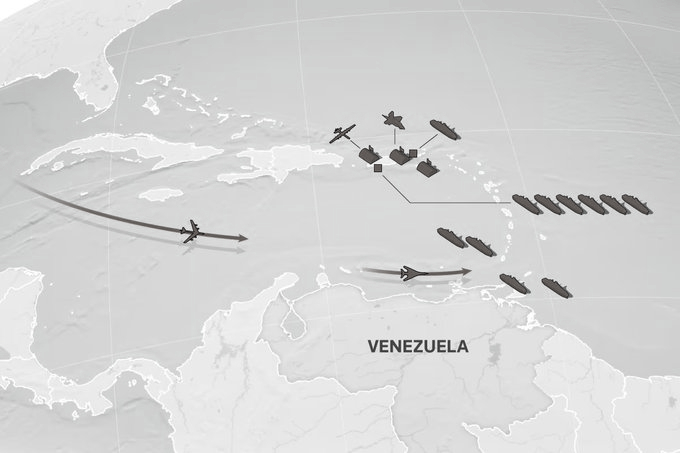
How the US is preparing a military staging ground near Venezuela
The U.S. has been fixing old bases, sending ships and planes, and moving supplies so everything needed for an invasion or big military action could be ready quickly. Think of it like a giant kitchen where all the pots, pans and ingredients are being put on the stove - if someone tells the cook to start, the meal could be made faster.
A secret base comes back to life
The United States is fixing up an old military base called Roosevelt Roads in Puerto Rico, about 800–900 km north of Venezuela. This base was once one of the biggest U.S. naval stations in the world during the Cold War but was closed in 2004. Now, after twenty years of silence, it is busy again.
In September, workers cleared and repaired taxiways that lead to the runway. New tents appeared near an old hangar, and satellite photos showed U.S. Marines parking their Osprey aircraft, F-35 fighter jets, and large C-17 cargo planes there. The base sits in a perfect spot-close enough to Venezuela and with enough space to hold a lot of equipment. A U.S. official said that it could be a place to gather weapons and supplies for future missions.
Other airports are also being upgraded. At Rafael Hernández Airport in Puerto Rico, the U.S. military brought in a mobile air traffic control tower and communication gear. Satellite pictures even showed MQ-9 Reaper drones sitting on the tarmac and what looks like a new ammunition storage building. Experts said that could mean the U.S. is preparing for operations nearby, perhaps even inside Venezuela.
Across the sea, on the island of St. Croix in the U.S. Virgin Islands about 850 to 900 kilometers (530 to 560 miles) north of Venezuela, construction crews are working at Henry E. Rohlsen Airport. New radar systems and construction near the airplane parking area are visible from space. The local governor, Albert Bryan Jr., said he coordinates with the military but doesn’t know its full plans. Still, he believes the U.S. presence helps stop drug and weapons smuggling through the islands.
Christopher Hernandez-Roy, a security expert from the Center for Strategic and International Studies, said these upgrades might be more than simple repairs. He thinks they could help the U.S. land and launch many planes quickly and fill radar gaps that drug traffickers use to fly undetected. He added that the area above Haiti is often a “black hole” for radar, which makes it easier for smugglers to escape detection.
The return of the U.S. warships
Since August, the United States has quietly brought at least thirteen warships, five support ships, and a nuclear submarine to the Caribbean. This includes the giant aircraft carrier USS Gerald Ford with about 10,000 troops and dozens of aircraft. It is confirmed that one of its destroyers passed Gibraltar on October 29 as it sailed toward the Caribbean.
Among the ships already nearby are the USS Gravely, USS Stockdale, USS Jason Dunham, USS Lake Erie, USS San Antonio, and USS Iwo Jima. Many of these ships were seen in or near Puerto Rico, Trinidad, and the Virgin Islands between September and October. The U.S. has also sent refueling tankers such as the USNS Kanawha and USNS Joshua Humphreys, a hospital ship called USNS Comfort, and a submarine test vessel named USNS Waters.
One unusual ship, the MV Ocean Trader, has been spotted moving between Puerto Rico, St. Croix, and waters near Venezuela. Experts say it likely supports U.S. Special Forces, as it can carry helicopters and small boats for secret missions. Satellite photos showed it just 78 miles from Venezuela on October 4 and later docked in Ponce, Puerto Rico, at the end of October.
This buildup of ships and aircraft is the biggest military movement in the region that is not related to disaster relief since 1994, when U.S. troops went to Haiti for “Operation Uphold Democracy.”
Since early September, the U.S. military has also carried out at least fourteen attacks on boats it claims were used by drug traffickers in the Caribbean and the Pacific, killing sixty-one people. The White House said President Donald Trump had promised to go after the region’s drug cartels, calling it a fight against “narcoterrorism.” A spokesperson said he had taken “unprecedented action” to protect Americans from the deadly drug trade.
The pilot who wouldn’t betray Maduro
Hidden alongside the military moves, there was a long secret effort to recruit President Maduro’s trusted pilot, General Bitner Villegas. According to reporting, the plan began with a tip to U.S. officials in April 2024. A Homeland Security Investigations agent named Edwin Lopez, then attached to the U.S. Embassy in the Dominican Republic, began trying secretly to persuade Villegas to divert Maduro’s plane to territory where U.S. authorities could capture him. Over about 16 months, Lopez used encrypted messages, meetings and offers of money, safety and a kind of hero status to try to win the pilot’s help. Despite talks and contact, Villegas refused to cooperate and stayed loyal to Maduro. The secrecy, messages and hangar meetings read like a spy story, and the failed attempt became another sign that the U.S. was using many methods to try to unsettle Maduro’s government.
Why does the pilot story matter? If someone who flies the president could be turned, it would make capturing or removing a leader much easier. The fact that the attempt was tried and failed shows how far some U.S. agents and officials went to pursue that goal, while the big military buildup shows the government was also preparing to use force if needed. Together these pieces make the “kitchen” fully ready: spies and secret plans, ships and planes, runways and storage, all in place.
A sky full of bombers and spy planes
The air above the Caribbean has also become crowded with American planes. Along with the F-35 jets already in Puerto Rico, the U.S. Air Force has been flying supersonic B-1B Lancer bombers and B-52 Stratofortresses off the coast of Venezuela. On October 15, three B-52s flew from Louisiana to circle the Venezuelan coast before returning home. On October 23 and 27, B-1B Lancers flew similar routes from bases in Texas and North Dakota.
Dozens of C-17 cargo planes have also been flying between the U.S. and the Caribbean from September 3 to October 27, carrying supplies and possibly drones or weapons systems. Satellite and drone photos from October 27 show cargo being loaded onto C-17s at Ponce, Puerto Rico, while the MV Ocean Trader was docked nearby.
At least a dozen U.S. Navy P-8 Poseidon spy planes from Florida have flown missions over the Bahamas, Puerto Rico, and further south to gather intelligence. Experts believe these aircraft are watching for drug smugglers and also tracking activity around Venezuela.
With new bases, radar systems, ships, bombers, and spy planes in place, the U.S. now has everything it needs to act quickly in the region. No one yet knows what the final goal is. The Pentagon and the governor of Puerto Rico did not respond to Reuters’ questions. But President Trump hinted at what might come next. Speaking last Thursday, he said, “The land is going to be next.”
No one can say for sure what will happen next. The U.S. Pentagon and some local officials did not answer reporters’ questions, and the U.S. government has described many actions as part of fighting drugs or enforcing sanctions. President Donald Trump has made comments suggesting land action could be next. Venezuelan leaders say the U.S. wants to remove Maduro. With upgraded bases, warships, bombers, spy flights and even covert recruitment plots now part of the story, the region is tense and prepared for many outcomes. That is why the first line of this story matters: all the ingredients are on the stove, and if someone orders them to be cooked, the U.S. has the means to act quickly.