
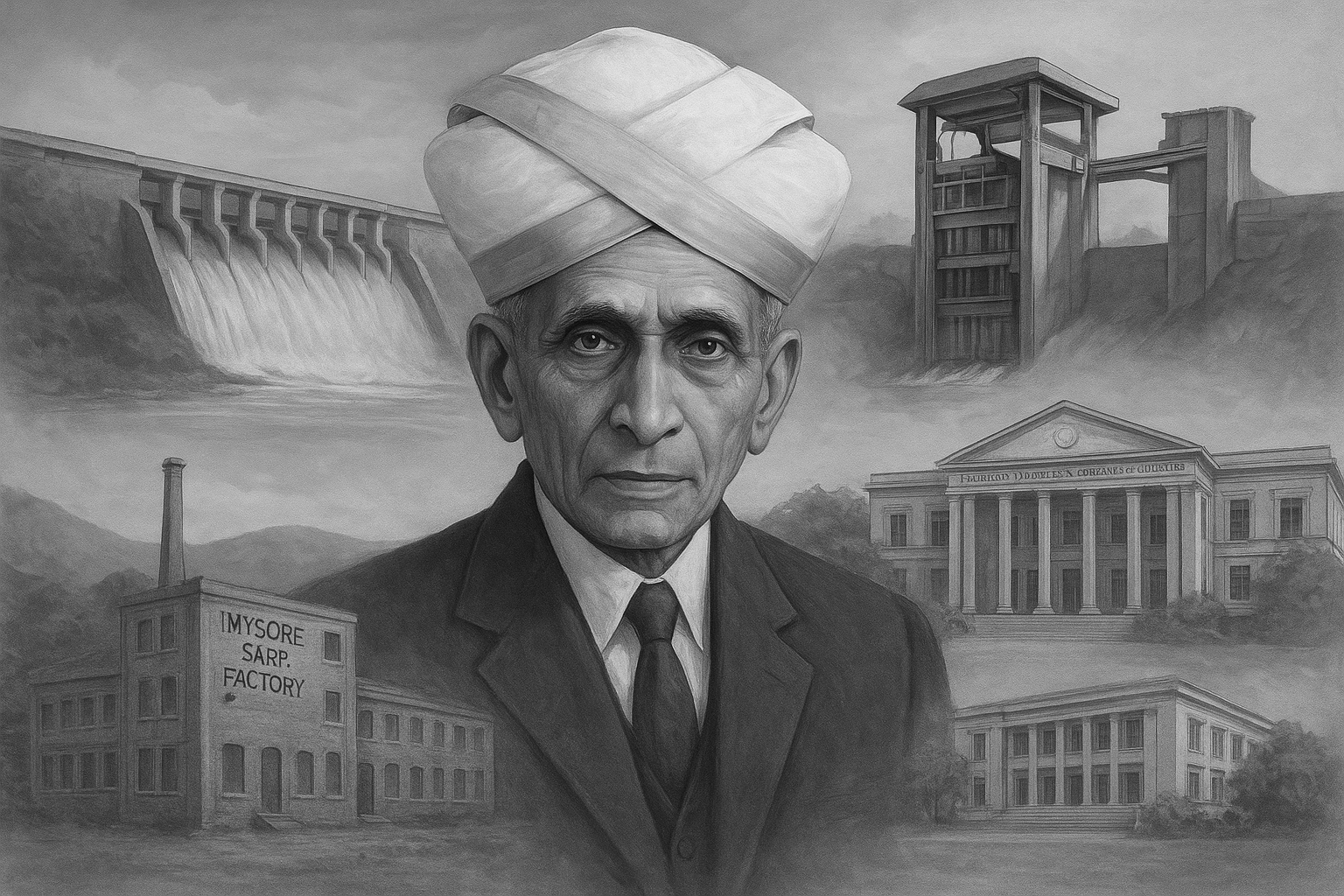
How one Engineer changed India forever with innovation
Sir Mokshagundam Visvesvaraya (1861–1962), widely known as Sir M. Visvesvaraya, remains one of India’s most distinguished engineers, administrators, and nation-builders. Revered as the Father of Modern Mysore, his contributions to irrigation, water management, economic planning, and industrial development have left a lasting imprint on India’s infrastructure, public administration, and technological advancement. His innovations and visionary leadership continue to serve as a benchmark for modern engineering and governance in the country.
Early life and education
Visvesvaraya was born on 15 September 1861 in Muddenahalli village, Karnataka, into a Tamil Brahmin family with ancestral roots in Mokshagundam, present-day Andhra Pradesh. Despite limited resources, he demonstrated extraordinary academic aptitude. He completed his Bachelor of Arts (B.A.) from the University of Madras and subsequently pursued civil engineering at the College of Science in Pune, one of the premier engineering institutions of the time. His rigorous academic training laid the foundation for a career marked by innovation, technical excellence, and public service.
Engineering career and innovations
Visvesvaraya began his professional journey in 1885 as an assistant engineer in the Public Works Department of the Bombay Presidency. Over the next few decades, he undertook significant engineering projects both in India and abroad, establishing himself as a visionary in irrigation, water supply, and flood control.
In 1899, he introduced the block system of irrigation under the Indian Irrigation Commission. This innovative approach ensured equitable water distribution across the Deccan Canals, benefiting thousands of villages and agricultural communities.
In 1903, he designed and patented the automatic water floodgates, which were first deployed at the Khadakwasla reservoir in Pune. These floodgates were a landmark in water management, allowing controlled release of excess water during floods and preventing inundation of surrounding areas.
Another notable contribution was his work in Sukkur, Sindh, where he solved the problem of discoloured and muddy water, providing a clean and reliable water supply to the region. Internationally, his expertise was sought in Aden (now Yemen), where he developed modern water supply and drainage systems. Domestically, he also implemented flood protection systems in Hyderabad and Visakhapatnam, highlighting his technical versatility and problem-solving abilities.
As the Chief Engineer of Mysore State in 1909, Visvesvaraya led the construction of the Krishna Raja Sagar (KRS) Dam, one of the largest reservoirs in Asia at the time. The dam, which continues to provide irrigation and drinking water, exemplified his vision for large-scale infrastructure projects that combined engineering innovation with public utility.
Administrative leadership as Dewan of Mysore
In 1912, Visvesvaraya was appointed Dewan of Mysore, a position he held until 1918. His administration was marked by rapid industrialization, infrastructural development, and institutional growth. He established key institutions including the Mysore Soap Factory, Bangalore Polytechnic, and the State Bank of Mysore, fostering economic growth and modernisation.
In 1917, he founded the Government Engineering College, Bengaluru, later renamed University Visvesvaraya College of Engineering (UVCE), a premier institution producing generations of engineers who contributed to India’s development. Visvesvaraya’s policies encouraged private investment and laid the foundation for Mysore’s transformation into a model state with efficient governance and a modern industrial base.
Economic vision and later contributions
A pioneer of planned economic development, Visvesvaraya authored “Planned Economy in India”, outlining the Visvesvaraya Plan. This blueprint emphasized industrialization, infrastructural growth, and strategic economic planning as critical drivers of national prosperity. Even after his retirement in 1918, he continued advising on major infrastructure projects, including the location of the Mokama Bridge over the Ganga River, demonstrating his lifelong commitment to nation-building.
Awards and recognition
Visvesvaraya’s contributions earned him numerous accolades. In 1911, he was appointed Companion of the Order of the Indian Empire (CIE) by King Edward VII, and in 1915, he was knighted as Knight Commander of the Order of the Indian Empire (KCIE). In 1955, the Government of India awarded him the Bharat Ratna, the country’s highest civilian honour.
He also received honorary degrees, including D.Sc., LL.D., and D.Litt., from eight Indian universities, and was an honorary member of the Institution of Civil Engineers, London. In 1923, he served as President of the Indian Science Congress, reflecting his stature in the scientific and engineering community.
Legacy and Engineer’s day
Sir M. Visvesvaraya passed away on 14 April 1962 at the age of 100, leaving behind an unparalleled legacy of service, innovation, and vision. His birth anniversary, 15 September, is celebrated annually as Engineer’s Day in India, Sri Lanka, and Tanzania to honour his pioneering contributions.
Every year, institutions, industries, and governments pay tribute to engineers who continue to shape the nation’s progress in fields ranging from infrastructure and manufacturing to information technology, space exploration, and renewable energy. Just as Visvesvaraya laid the foundation for modern irrigation and industrial growth, today’s engineers are driving India’s transformation through innovations in artificial intelligence, smart cities, green technologies, and digital economy.
From pioneering irrigation techniques to shaping modern economic policies, Sir M. Visvesvaraya stands as a symbol of excellence in engineering and governance. His work continues to inspire generations of engineers, policymakers, and administrators in India and beyond.