
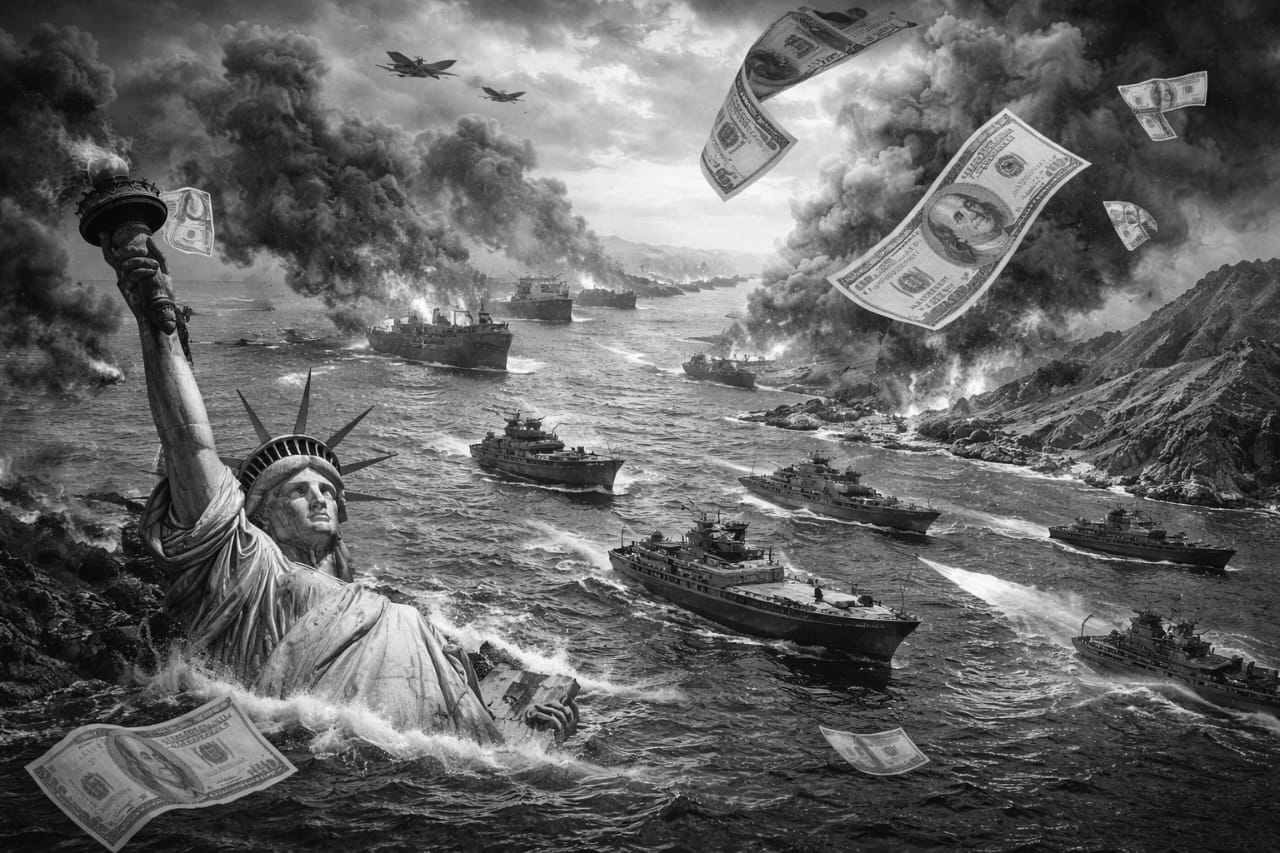
Hormuz, Empires, and a Warning from History - Echoes of Nostradamus?
In times of global uncertainty, people often turn to history and sometimes even prophecy to interpret unfolding events. Recently, some commentators have drawn attention to the centuries-old writings of Nostradamus, the 16th-century French seer whose cryptic verses are often linked, rightly or wrongly, to major world events. While his prophecies are famously ambiguous, a few interpreters believe that some verses referring to great powers declining amid conflict in the East could symbolically echo current geopolitical tensions.
Against this backdrop, a more grounded and analytical warning has come from Ray Dalio, the billionaire investor and historian of empires. Dalio, who has studied the rise and fall of global powers over the past 500 years, argues that the current tensions around the Strait of Hormuz could represent a defining moment for the United States similar to what the Suez Canal crisis of 1956 was for Britain.
Dalio summarized the idea with a striking comparison:
“Losing control of the Strait of Hormuz may be, for America, like Britain losing control of the Suez Canal in 1956.” To understand why this comparison matters, it helps to revisit the historical moment that marked the beginning of Britain’s decline as a global superpower.
The Suez Crisis: When Britain’s Empire Began to Fade
For nearly two centuries, Britain dominated the global order. The British pound was one of the world’s most powerful currencies, and the Royal Navy ensured control over critical sea routes.
At the heart of this network was the Suez Canal, a narrow but vital waterway in Egypt connecting the Mediterranean Sea to the Red Sea. A huge share of global trade passed through this route, making it strategically invaluable.
In 1956, Egyptian President Gamal Abdel Nasser nationalized the canal, declaring that it belonged to Egypt. Britain reacted strongly and, together with France and Israel, launched a military operation to regain control.
But events quickly took an unexpected turn.
The United States, the Soviet Union, and the United Nations pressured Britain to withdraw. Under intense diplomatic pressure, Britain eventually backed down.
The crisis had profound consequences. The British pound weakened, investors began losing confidence, and many allies reassessed Britain’s global role. Over the following years, colonies across the empire accelerated their independence movements.
Historians often point out that the Suez crisis marked the moment when the world realized something important: Britain was no longer the dominant global power it once was.
It wasn’t just about the canal it was about perception. Once the belief in Britain’s strength began to fade, the geopolitical and financial consequences followed.
Why the Strait of Hormuz Is So Crucial
Today, many analysts see parallels with another strategic chokepoint: the Strait of Hormuz.
Located between Iran and Oman, this narrow passage is one of the most important energy routes in the world. Around 20 percent of global oil supplies pass through it.
Oil exports from Saudi Arabia, the United Arab Emirates, Kuwait, and Iraq depend heavily on this route. Tankers carrying energy to Europe and Asia must pass through the strait.
If the passage were blocked or severely disrupted, the effects would be immediate.
Oil prices would surge. Energy supplies to major economies could be threatened. European markets could face another energy shock, while Asian manufacturing hubs might struggle with rising costs and supply disruptions.
A simple analogy illustrates the point: imagine a busy highway with only one tunnel, through which all trucks carrying fuel, food, and raw materials must pass. Whoever controls that tunnel effectively controls the flow of goods.
That is the strategic importance of the Strait of Hormuz.
Dalio’s Study of 500 Years of Empires
Dalio’s research into the past five centuries suggests that the rise and fall of empires often follows recognizable patterns. At their peak, dominant nations control global trade routes, command powerful militaries, and enjoy widespread financial trust. Their currencies often become the backbone of international commerce.
But eventually, challengers emerge. Conflicts over strategic trade routes can become turning points. If the dominant power maintains control, its influence continues and global confidence remains intact.
However, if it fails or even appears weak the consequences can be dramatic.
Allies begin to hedge their positions. Investors move capital elsewhere. Debt pressures intensify. Over time, the empire’s dominance fades.
Dalio notes that similar patterns can be observed in the decline of Portugal, the Netherlands, and Britain.
As he puts it:
When major powers accumulate large debts and begin to lose military or financial control, they risk losing the trust of allies and creditors. Eventually their currencies weaken and their global influence declines.
America’s Current Position
The United States today faces several structural challenges. The country’s national debt has crossed $38 trillion, with annual interest payments exceeding $1 trillion. A significant portion of federal revenue now goes toward servicing that debt.
At the same time, America’s recent military history from Vietnam to Afghanistan and Iraq has shaped global perceptions about the limits of prolonged intervention.
Against this backdrop, tensions involving Iran and the Strait of Hormuz have gained increasing attention among strategic analysts.
The Strategic Debate
Former U.S. President Donald Trump has previously warned that any attempt to disrupt shipping routes in the region would trigger severe consequences.
At the same time, Dalio notes that some international leaders privately question whether the United States would be willing to sustain a long and costly conflict if such a crisis escalated.
His broader point is that the ability to endure prolonged pressure can be as important as military strength.
Countries that view a conflict as existential may be willing to endure significant hardship, while democratic societies can face domestic pressures related to economic costs, elections, and public opinion.
Global Implications
Any serious disruption in the Strait of Hormuz would affect far more than the Middle East.
Energy markets, global shipping routes, and financial flows could all be impacted.
Major powers including China, Russia, European nations, India, and Japan—depend heavily on stable energy supplies moving through the region.
If tensions escalate significantly, the ripple effects could reshape geopolitical alliances and economic strategies worldwide.
Two Possible Paths
According to Dalio’s broader historical analysis, outcomes in such geopolitical tests often influence the global balance of power.
If the United States maintains stability and ensures the security of key trade routes, confidence in the U.S. dollar and American financial leadership could remain strong.
But if disruptions significantly undermine confidence in U.S. leadership, alternative economic blocs and currencies could gain traction.
Such shifts have occurred before during periods when dominant powers began to lose influence.
A Moment History May Remember
Whether one looks at Nostradamus’ cryptic verses or the far more concrete patterns of history studied by scholars like Ray Dalio, one idea remains clear: strategic chokepoints often become turning points in global power struggles.
The Strait of Hormuz is not just a narrow waterway it is a critical artery of the global economy.
How the current tensions around it unfold may not only shape the future of the Middle East but could also influence the trajectory of global power in the decades ahead.
For now, the world is watching closely.