
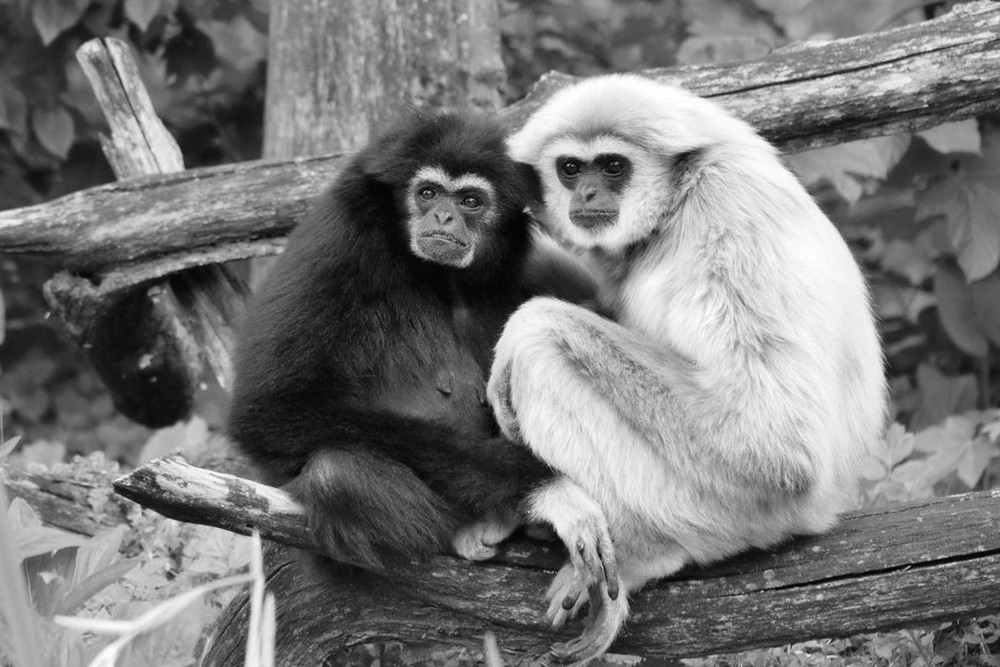
Hoolock gibbon family rescued after four-day operation in Arunachal Pradesh
A family of Hoolock gibbons, stranded on a single ficus tree in Arunachal Pradesh’s Lower Dibang Valley, has been rescued after a painstaking four-day operation, officials said on Saturday.
The rescued group, consisting of an adult male, an adult female, and a juvenile, was released into the Mehao Wildlife Sanctuary, where they are now under close monitoring. “We spotted all three individuals near the release site on Friday morning, and they appear to be in stable condition,” said Mito Rumi, Divisional Forest Officer of Mehao Wildlife Sanctuary.
The gibbons had been trapped on a 45-metre-high tree after humans destroyed large parts of their forest habitat through agricultural expansion and deforestation. The fragmented canopy forced the gibbons to remain isolated on a single tree, and with no connected treetops, they were at great risk on the ground. Experts note the bitter reality: humans destroyed the gibbons’ natural home, encroached on their land, and now call it a “rescue.”
Veterinary assessment by Wildlife Trust of India (WTI) experts revealed that the gibbons were underweight and nutritionally stressed. “These animals had been isolated for a long time. Without timely intervention, their chances of survival would have dropped sharply,” said Dr Bhaskar Choudhury, who led the veterinary team.
The operation required technical precision. WTI Director Sunil Kyarong explained, “Extracting gibbons from such heights demands careful coordination and deep understanding of their behaviour. Any misstep could have been fatal.” Mountaineering volunteers Amaro Meto and Hachu Lombo trained forest personnel in modern rope-climbing techniques, enabling safe extraction.
Officials added that more gibbon families have been identified in Denlo village, stranded due to human encroachment. “Rescue operations will continue in staggered phases over the next three months,” an official said.
Hoolock gibbons, India’s only apes, are classified as Endangered on the IUCN Red List and are Schedule I species under the Indian Wildlife (Protection) Act, 1972. These arboreal primates rely on continuous forest canopy for movement, foraging, and raising young. Deforestation, agricultural expansion, and habitat fragmentation caused by humans have pushed these populations to the brink.
Dr Choudhury stressed the ecological and moral significance: “Humans destroyed their habitat, encroached on their territory, and now intervene to save them. Protecting Hoolock gibbons safeguards the forest ecosystem and highlights the need for responsible coexistence.”
The state forest department reaffirmed its commitment to conservation, and with strong community support, officials hope to secure a future for these endangered primates. The operation, conducted jointly by Mehao Wildlife Sanctuary and WTI, underscores the urgent need for sustainable land use that respects wildlife habitats.