
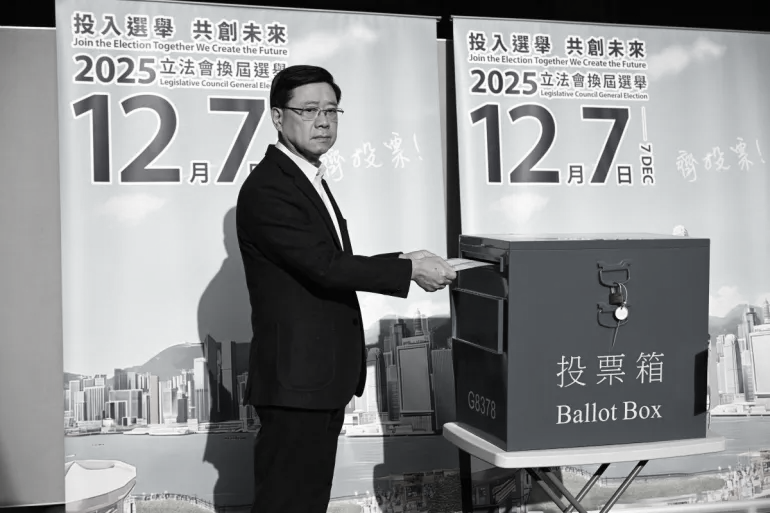
Hong Kong votes in legislative election after deadly fire
Hong Kong voters are casting ballots Sunday in the territory’s second legislative election since a 2021 overhaul of the system effectively eliminated the pro‑democracy opposition. The vote comes less than two weeks after a devastating apartment fire at Wang Fuk Court that killed at least 159 people - a tragedy that has heightened public anger and raised serious questions about government oversight and building safety. Analysts believe turnout is likely to remain low, perhaps around 20 to 25 percent of eligible voters, as many remain disillusioned or mistrustful in the wake of the disaster.
A retiree outside a polling station summed up the ambivalence of many voters: “I’m performing my civic duty as a citizen to vote, but I’m not certain which candidate is hardworking … I chose the one who cares for the elderly.” Meanwhile, city leader John Lee urged citizens to vote as a sign of support for reforms, promising legislation to aid fire survivors many of whom are now homeless. At the same time, Chinese authorities called a rare meeting with foreign media and warned them to comply with the city’s national‑security laws.
Campaigning had been effectively suspended after the fire out of respect for the victims. Prior to the tragedy, the government had extended voting hours, increased polling stations, offered support for elderly and disabled voters, and used banners and forums to boost turnout. But authorities also cracked down on what they considered attempts to disrupt the election. For instance, a man was reportedly arrested for distributing pamphlets encouraging others not to vote or to cast invalid ballots seen as an attempt to undermine the poll’s legitimacy.
Beyond election‑related arrests, officials have also taken action against those they deem responsible for the fire and alleged renovation‑related negligence at Wang Fuk Court. So far, authorities have arrested at least 21 individuals in connection with the blaze: some on suspicion of manslaughter, others in corruption and negligence investigations tied to the renovation work.
Among those detained since the fire are a student named Miles Kwan, reportedly arrested for circulating a petition calling for accountability, and a former district councillor Kenneth Cheung, who was detained for questioning, had his passport and ID seized, and is barred from leaving Hong Kong while under investigation.
The fire which that swept through seven of the estate’s eight towers has been blamed on a combination of substandard building materials (including non-fire‑retardant netting and foam insulation used during renovation) and malfunctioning fire alarms.
Under the city’s reformed electoral system, only 20 of the 90 legislative seats are directly elected, with the remainder filled by pro‑Beijing committees or representatives of business and professional sectors and all candidates vetted for loyalty to Beijing.
Observers say that if turnout remains low, it could reflect not just grief and distrust after the fire, but also a broader sentiment of disillusionment even among those who might otherwise support the government.