
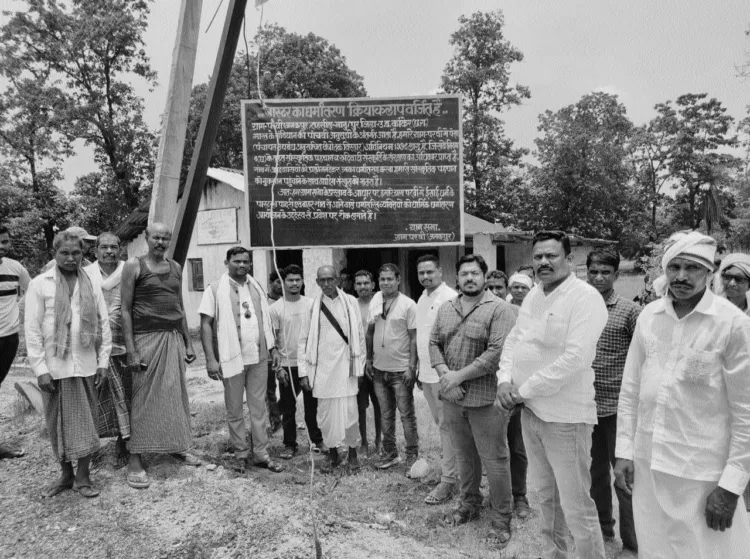
Hoardings barring entry to pastors, converted Christians not unconstitutional: Chhattisgarh high court
The Chhattisgarh High Court has dismissed two petitions challenging the installation of hoardings in eight tribal villages that prohibit the entry of pastors and “converted Christians,” ruling that the boards were meant to prevent forced conversions through allurement or fraudulent means and do not violate the Constitution.
A division bench comprising Chief Justice Ramesh Sinha and Justice Bibhu Datta Guru passed the order on October 28, while hearing petitions filed by Digbal Tandi of Kanker and Narendra Bhavani of Bastar districts.
Petitions and allegations
The petitioners alleged that the Panchayat Department had directed local bodies — zilla, janpad, and gram panchayats — to pass resolutions under the slogan “Hamari Parampara, Hamari Virasat” (“Our Tradition, Our Heritage”), effectively instructing gram sabhas to ban the entry of pastors and “converted Christians.”
They cited the Ghotiya Gram Panchayat in Bhanupratappur tehsil of Kanker district, which had erected a board stating that the village lies in a Fifth Schedule Area, governed by the Panchayat (Extension to Scheduled Areas) Act, 1996 (PESA). The gram sabha, they said, used its powers under PESA to bar outsiders from conducting religious programmes or conversions, instilling fear among members of minority communities.
Similar hoardings were reported from Kudal, Parvi, Junwani, Ghota, Havechur, Musurputta, and Sulangi villages. The petitioners argued that these actions violated their freedom of religion (Article 25) and freedom of movement (Article 19(1)(d)).
Arguments in court
Counsel for the petitioners contended that gram sabhas lacked the authority to pass resolutions contrary to the Constitution. They claimed that restrictions based on religion amounted to segregation and infringed upon fundamental rights.
Additional Advocate General Y. S. Thakur, representing the State, countered that the hoardings were lawful under the PESA Rules, which empower gram sabhas in Scheduled Areas to protect local cultural heritage, including places of worship, traditional institutions like Gotul and Dhumkudia , and social customs.
Thakur stressed that the measures targeted only those engaging in illegal or coerced conversions, not ordinary Christians. He cited Article 19(5) of the Constitution, which allows reasonable restrictions on movement to safeguard public interest or the interests of Scheduled Tribes, arguing that the gram sabhas acted within their constitutional powers.
He further noted that any aggrieved person could appeal before the Sub-Divisional Officer (Revenue), but the petitioners bypassed this statutory remedy and directly approached the court.
Court’s* *f* *indings
The bench observed that the hoardings were precautionary steps taken by gram sabhas to protect indigenous tribal identity and cultural heritage. Referring to Supreme Court precedents on conversions, the judges held that preventing conversions by “allurement or fraud” does not contravene the Constitution.
“The installation of the hoardings for preventing forcible conversion by way of allurement or fraudulent means cannot be termed as unconstitutional,” the bench said.
The court also found that the petitions were procedurally defective, as the petitioners had not exhausted available remedies under PESA. However, it clarified that if any individual faced a genuine threat or obstruction, they were entitled to seek police protection.
Cultural and legal context
The ruling comes amid ongoing debates over religious conversions in tribal regions of Chhattisgarh, Jharkhand, and Odisha, where Scheduled Tribes often practise indigenous faiths. State authorities have long expressed concern over induced conversions that may erode tribal traditions, language, and community cohesion.
Under the Fifth Schedule and PESA Act, gram sabhas in Scheduled Areas are constitutionally mandated to preserve local customs, social institutions, and cultural practices. The High Court reiterated that such measures fall within reasonable restrictions under Article 19(5) when aimed at protecting tribal interests.
National* *i* *mplications
While the ruling applies primarily within Chhattisgarh’s jurisdiction, legal experts say it may influence similar disputes nationwide. The judgment reinforces that the right to propagate religion does not extend to conversions by coercion or inducement and that tribal autonomy under PESA carries constitutional protection.
Other High Courts may look to this decision when balancing religious freedom against cultural preservation, though only a Supreme Court ruling can make it a binding national precedent.
By upholding the gram sabhas’ authority, the court has reaffirmed a delicate constitutional balance — one that safeguards tribal identity while preserving the right to faith, provided it is exercised voluntarily and within the law.