
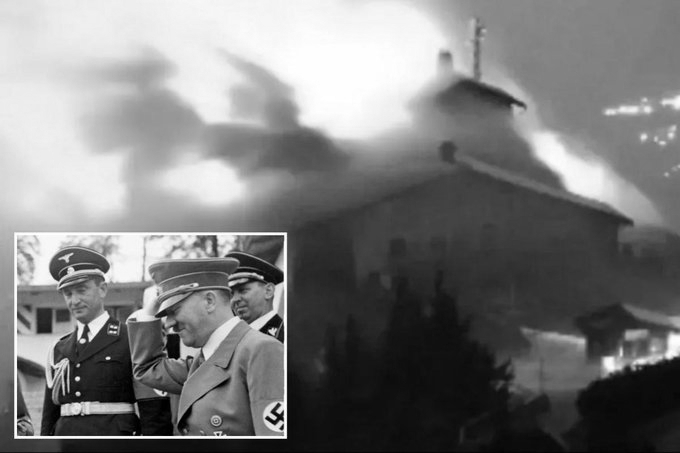


Hitler’s Infamous Mountain Retreat, 'Eagle’s Nest', Set Ablaze, Suspect Arrested
Adolf Hitler’s infamous Eagle’s Nest mountain retreat in southern Germany was almost completely destroyed by a major fire on Friday night, October 23. German police have detained a suspect as investigators probe the cause of the blaze, which engulfed the historic building in Bavaria. No injuries have been reported, and authorities have yet to establish whether the detained person was involved in the incident.
Around 200 firefighters and emergency personnel were deployed to tackle the fire at the Kehlsteinhaus, as the landmark is locally known. According to police, a smoke detector triggered the fire alarm at around 9:15 pm local time. When firefighters reached the site at approximately 9:50 pm, they found the building completely engulfed in flames.
The operation was complicated by the retreat’s remote location at an altitude of 1,834 metres (6,017 feet) above sea level on the Obersalzberg mountain near Berchtesgaden. Emergency personnel faced difficulties accessing the site, and the building and its immediate surroundings could only be entered using respiratory protective equipment. Firefighters found no one inside the building.
The fire appeared to have been brought under control by Saturday morning, October 24, although smoke continued to rise from the damaged structure. According to reports by German media, investigators suspect arson, but police have not officially confirmed the cause. A police spokesperson said the criminal investigation was ongoing, while a local report identified the detained individual as a motorcyclist encountered by officers travelling to the scene. Authorities have not established a connection between the suspect and the fire.
Built between 1937 and 1938, the Eagle’s Nest was constructed during the Nazi era as a mountain guesthouse for Hitler and other senior Nazi officials. Formally inaugurated in 1939, it was intended to impress foreign diplomats and serve as a symbol of Hitler’s rule, although the dictator visited the site only occasionally. The building is separate from the nearby Berghof, Hitler’s former residence in the Obersalzberg area.
The stone-and-granite structure survived World War II largely undamaged, despite Allied bombing campaigns that affected other buildings in the region. Its distinctive access route includes a mountain road, a tunnel and a brass elevator built inside the rock.
Since 1952, the historic landmark has operated as a mountain restaurant and housed an exhibition documenting its Nazi-era history. It became a popular tourist destination, offering views of the Bavarian Alps while preserving reminders of Germany’s past.
The Eagle’s Nest is also a reminder of the crimes committed under Hitler’s regime, which was responsible for the Holocaust and the persecution and murder of millions of people, including six million Jews and other targeted groups. Its official website describes the site as a reminder of the inhumanity of the Nazi dictatorship.
The extent of the damage has raised questions about the future of the historic building. German media reports indicated that it may be beyond saving, although authorities have not confirmed whether any part of the structure can be salvaged. The investigation into the fire and the detained suspect remains ongoing.