
Hindu man in Bangladesh allegedly beaten to death, body tied to tree and set on fire
A brutal incident of mob violence in Bangladesh that has triggered outrage among human rights observers came to light on December 19, though the killing itself occurred on the night of December 18. Dipu Chandra Das , a 28 year old Hindu garment worker , was lynched by a mob in the Dubalia Para area of Bhaluka Upazila in Mymensingh district after allegations spread that he had made derogatory remarks about Prophet Muhammad. Authorities have stated that the allegation was never formally verified before the violence erupted.
According to police and eyewitness accounts, Dipu was confronted by local residents near the garment factory where he worked and lived as a tenant. The confrontation escalated rapidly into extreme violence, with the mob beating him repeatedly until he collapsed and died. After his death, the attackers tied his body to a tree and set it on fire. Reports further indicate that his partially burnt body was later dragged to the Dhaka Mymensingh highway and set ablaze again, spreading fear among commuters and residents. Police recovered the remains later that night and sent them to Mymensingh Medical College Hospital for a post mortem examination.
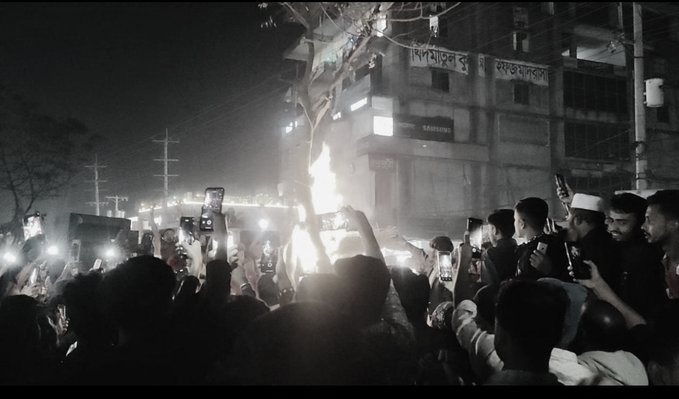
Videos of the incident that surfaced on social media after the killing came to light show large numbers of people recording the violence on their mobile phones instead of intervening. In several clips, voices can be heard chanting slogans, including anti India slogans, while the body burns. The footage has fuelled anger and disbelief, with many questioning how such extreme violence unfolded in public view without immediate restraint, and how bystanders appeared emboldened rather than fearful.
The victim was identified as Dipu Chandra Das, son of Ravi Chandra Das, a resident of Tarakanda Upazila in Mymensingh. He was employed at Pioneer Knitwears BD Ltd and was the sole earning member of his family. His wife Meghna Rani and other relatives have said that even if accusations were made, Dipu should have been handed over to the authorities. His father has demanded justice, stating that the family has been left shattered and living in fear.
The interim government led by Chief Adviser Muhammad Yunus condemned the killing after it became public on December 19, stating that there is no place for mob violence in Bangladesh and that those responsible would face legal consequences. Officials said action would be taken once a formal complaint is registered , though as of the latest updates, no official case had been filed. Law enforcement agencies have said efforts are ongoing to identify the perpetrators seen in the videos and trace witnesses.
The lynching occurred amid widespread unrest across Bangladesh following the death of Sharif Osman Hadi , a leader associated with the July Uprising movement. His death triggered protests across Dhaka and other cities, with attacks on political party offices, media houses, and government linked institutions, further weakening law and order during an already volatile period.
The killing of Dipu Chandra Das has also reignited a broader debate about selective global outrage. Activists and commentators have pointed out that incidents involving Muslim victims often prompt swift international condemnation, statements from global leaders, and diplomatic pressure, while brutal violence against Hindus and other minorities frequently receives limited attention and delayed responses. Many have questioned why the lynching, the burning of the body, and the slogans heard in the videos have not prompted strong international reactions or decisive policy responses.
Human rights observers have warned that the incident reflects a dangerous normalisation of mob vigilantism, communal polarisation, and public spectacle violence. They have urged Bangladeshi authorities and the international community to treat the killing with the seriousness it demands, ensure swift justice, protect vulnerable minorities, and reaffirm that human rights violations warrant equal attention regardless of the victim’s religion.