
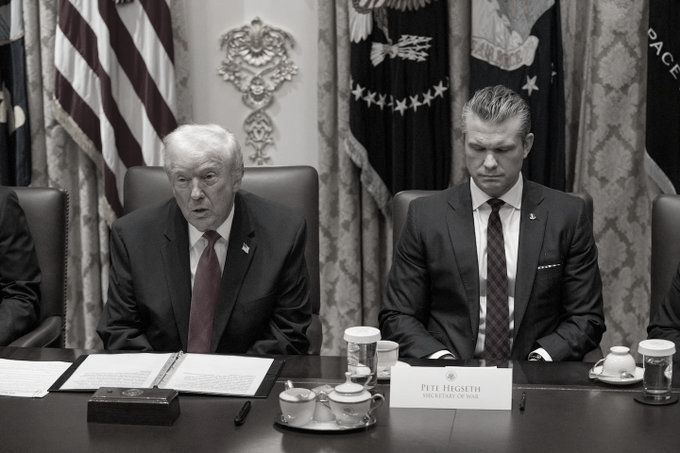
Hegseth defends strikes on alleged cartel boats, says Trump can order use of force ‘as he sees fit’
US Secretary of War Pete Hegseth defended the recent military strikes on boats linked to alleged drug cartels, stating that President Donald Trump’s power to take action “as he sees fit” was being used to safeguard the nation. He suggests that Trump has broad discretion to employ military force whenever he personally judges it necessary, even without additional congressional or international approval, and that such authority allows him to decide the timing, scale and nature of military action based solely on his own assessment of national interests.
Speaking at the Ronald Reagan Presidential Library, Hegseth’s comments were delivered amid growing criticism of the strikes, which have reportedly resulted in at least eighty-seven deaths and raised concerns over potential violations of international law. It was insisted by him that the operations were justified to protect American citizens, and the situation was likened to the sweeping security response following the September 11, 2001 attacks. His declaration that those working for a designated terrorist organisation who bring drugs into the country by sea “will be found and will be sunk” was presented as a warning rooted in his belief that no hesitation should be shown in confronting such threats.
The strikes have prompted lawmakers to seek clear legal justification, including whether a second strike in a September incident was ordered even after officials knew survivors remained. Hegseth also compared suspected narcotics traffickers to Al-Qaeda, although analysts have cautioned that the fundamental differences in structure, motivation and threat level make the comparison misleading.
His remarks were delivered shortly after the administration published its new National Security Strategy, a document that significantly reshapes US geopolitical priorities. The document invokes the spirit of the Monroe Doctrine, reframing Latin America as a region in which external powers must no longer be permitted to gain strategic influence. It suggests that the United States intends to reverse decades of diffuse foreign engagement by re-concentrating power and attention on its immediate neighbourhood, with an emphasis on dominance rather than partnership. This shift marks a departure from recent administrations that focused on global democracy promotion and long-term stability efforts abroad, and signals a reassertion of older hemispheric principles now adapted to counter China’s growing presence in the region.
In his address, Hegseth emphasised the necessity of countering China through displays of American strength rather than direct confrontation. It was reiterated by him that Trump’s pledge to resume nuclear testing at levels comparable to China and Russia would be fulfilled, a position that has surprised nuclear experts who fear renewed escalation. The event at the Ronald Reagan Presidential Foundation and Institute gathered senior national security officials from across the country, offering Hegseth a platform to describe Trump as the “true and rightful heir” to Reagan’s foreign policy legacy. He contrasted this with Republican leaders after Reagan, whom he criticised for supporting prolonged Middle East wars and unsuccessful democracy-building missions.
Climate change concerns were dismissed, and it was stated that the War Department “will not be distracted by democracy building, interventionism, undefined wars, regime change, climate change, woke moralising and feckless nation building.” His remarks underscored an approach that rejects broad global commitments in favour of unilateral action, hemispheric dominance and the President’s sole discretion in matters of war.