
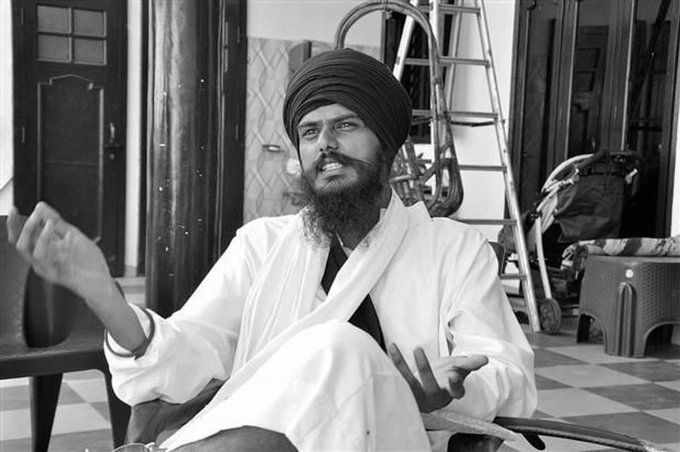
HC allows Amritpal Singh’s virtual appearance in Ajnala case, cites public order risks
The Punjab and Haryana High Court has directed that Khadoor Sahib MP Amritpal Singh will appear virtually before a trial court in Amritsar in connection with the 2023 Ajnala police station attack case , citing concerns over a possible breach of public order.
In an interim order dated April 17, a division bench headed by Chief Justice Sheel Nagu permitted all pre-trial and post-trial proceedings , including remand hearings, to be conducted via videoconferencing. The court observed that “exceptional circumstances” exist and that Amritpal’s physical presence in Punjab could potentially disrupt law and order .
The order came in response to a plea by the Punjab government, which sought directions to keep Amritpal lodged in Dibrugarh Jail even after his detention under the National Security Act ends on April 22. The state submitted that intelligence inputs indicate a risk of unrest if he is brought to Amritsar for trial proceedings.
The High Court also directed authorities in Assam to ensure that Amritpal is provided access to legal counsel through virtual means , enabling him to prepare his defence during the trial.
Amritpal Singh, the chief of Waris Punjab De, was arrested in April 2023 after a month-long manhunt . His arrest followed the February 23, 2023 Ajnala incident , during which he and his supporters allegedly stormed a police station , broke barricades, and clashed with police to secure the release of an associate.
He faces multiple cases, including charges of rioting, attempt to murder, obstruction of public servants, and promoting enmity , along with detention under the NSA. Authorities have also raised security concerns , noting that Amritpal has styled himself after Jarnail Singh Bhindranwale, making the case particularly sensitive.
Despite being in custody, he contested and won the 2024 Lok Sabha election as an Independent candidate from Khadoor Sahib, adding a significant political dimension to the case.
The High Court’s decision reflects an attempt to balance the right to a fair trial with security considerations , while highlighting the growing use of virtual hearings in sensitive cases.