
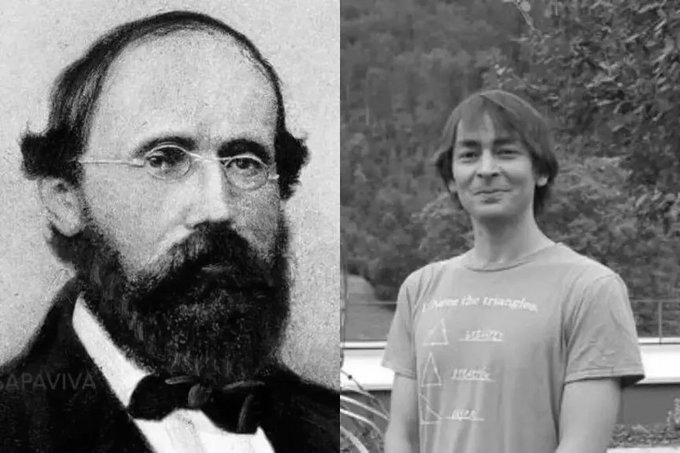
Has Claude Solved The 167-Year-Old Riemann Hypothesis? Anthropic Mathematician Makes Claim
An Anthropic mathematician has claimed that the company's artificial intelligence model, Claude, has helped solve the 167-year-old Riemann Hypothesis, widely regarded as mathematics' most famous unsolved problem. However, the proposed proof is yet to be independently verified.
On Friday, November 20, Levent Alpöge, a mathematician on Anthropic's technical staff, announced that he believed he had discovered a proof while working with Claude. In a four-page note, he credited the AI model with making rapid progress during the final stages of the research. His claim extends beyond the original hypothesis to the Generalised Riemann Hypothesis (GRH), which covers related mathematical functions known as Dirichlet L-functions.
Instead of a conventional research paper, Alpöge released an archive containing approximately 239 megabytes of data and 175,187 source files written in Lean, a programming language used to verify mathematical proofs step by step. His proposed approach involves weighted prime sums, known as von Mangoldt sums, and mathematical constructions called theta lifts.
First proposed by German mathematician Bernhard Riemann in 1859, the hypothesis concerns the distribution of prime numbers such as 2, 3, 5, 7 and 11. It suggests that every non-trivial zero of the Riemann zeta function lies on a specific vertical line where the real part equals one-half. Although computers have verified the first 10 trillion non-trivial zeros, only a mathematical proof can establish that the pattern holds universally.
Despite Lean's verification capabilities, mathematicians are examining whether the code proves the standard hypothesis, uses accurate definitions and contains no hidden assumptions. An initial independent check confirmed that the archive matched Alpöge's release and that its main theorem statements were compiled, but the complete verification was still running.
The Clay Mathematics Institute continues to list the hypothesis as unsolved. It is one of seven Millennium Prize Problems, each carrying a $1 million reward. Under its rules, a solution must appear in a qualifying peer-reviewed publication, remain under scrutiny for at least two years and gain broad acceptance among mathematicians.
Alpöge, who studied at Harvard and Cambridge and earned his PhD from Princeton in 2020 under Fields Medal winner Manjul Bhargava, previously attracted attention with a Claude-assisted Jacobian conjecture solution in July. Anthropic reported another advance in August, showing that at least 67.25 per cent of non-trivial zeta-function zeros lie on the critical line, up from roughly 41 per cent. In October, OpenAI released 722 AI-generated mathematical manuscripts, including a claimed proof of a weaker quasi-Riemann hypothesis.
On the same day as Friday's announcement, Alpöge and mathematician Tristan Buckmaster also released a separate 79-page Claude-assisted paper claiming progress on the Navier-Stokes equations, another Millennium Prize Problem. Its supporting numerical certificate has not yet been publicly released.