
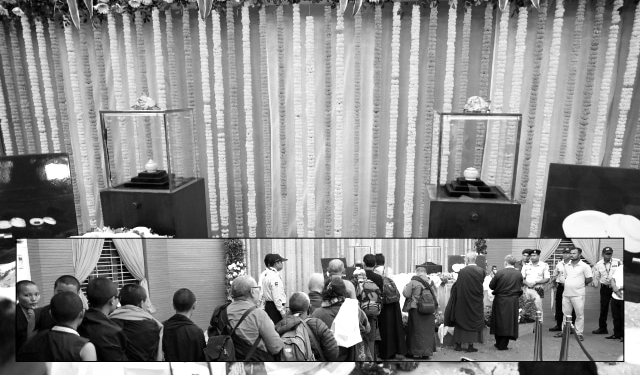
Guru Padmasambhava ceremony sees 3rd century BC Buddhist Relic display at Lalitgiri
A rare Buddhist relic dating back to the 3rd century BC was taken out of its protected enclosure and placed on public display at Lalitgiri in Odisha’s Jajpur district, offering monks, scholars and devotees a rare opportunity to pay homage during a major religious observance.
The relic was displayed on January 16 to mark the second Guru Padmasambhava ceremony held at Lalitgiri, one of India’s oldest and most significant Buddhist sites. The sacred hill complex witnessed special rituals, prayers and meditation sessions commemorating Guru Padmasambhava, the revered Buddhist master credited with spreading Vajrayana Buddhism across the Himalayan region.
According to officials, the relic identified by the Archaeological Survey of India (ASI) as dating back to the Mauryan period was ceremonially brought out from the ASI Lalitgiri Museum under strict supervision. Typically preserved under stringent conservation protocols, it was made accessible to the public as part of the religious observance, allowing devotees a deeply reverential experience.
Guru Padmasambhava, also known as Guru Rinpoche , played a pivotal role in the transmission of Vajrayana Buddhism from India to Tibet, Bhutan and other parts of East and Southeast Asia in the 8th century . Vajrayana, often referred to as the “Diamond Vehicle,” is a major Buddhist tradition that emphasises meditation, rituals, mantras and esoteric practices aimed at achieving enlightenment in a single lifetime. It remains influential across the Himalayan belt and parts of East Asia.
Speaking on the occasion, Odisha’s Minister for Odia Language, Literature and Culture, Suryabanshi Suraj , said the observance reaffirmed Lalitgiri’s position on the global Buddhist map and strengthened Odisha’s identity as a custodian of ancient Buddhist civilisation, heritage and living traditions.
Beyond its religious significance, officials noted that Buddhism continues to serve as a powerful instrument of cultural diplomacy for India. Shared Buddhist heritage has long acted as a bridge connecting India with countries across Asia, including Sri Lanka, Thailand, Myanmar, Japan, Bhutan and Tibet , fostering people-to-people ties, tourism and scholarly exchanges. Events such as the Lalitgiri observance reinforce India’s soft power outreach by reviving ancient civilisational links rooted in shared spiritual traditions.
The public display of the relic was organised by the ASI in collaboration with the state’s Department of Tourism and the Department of Odia Language, Literature and Culture. Authorities said the event was conducted with careful coordination among religious leaders and archaeological custodians to ensure the dignity, security and preservation of the relic at all times.