
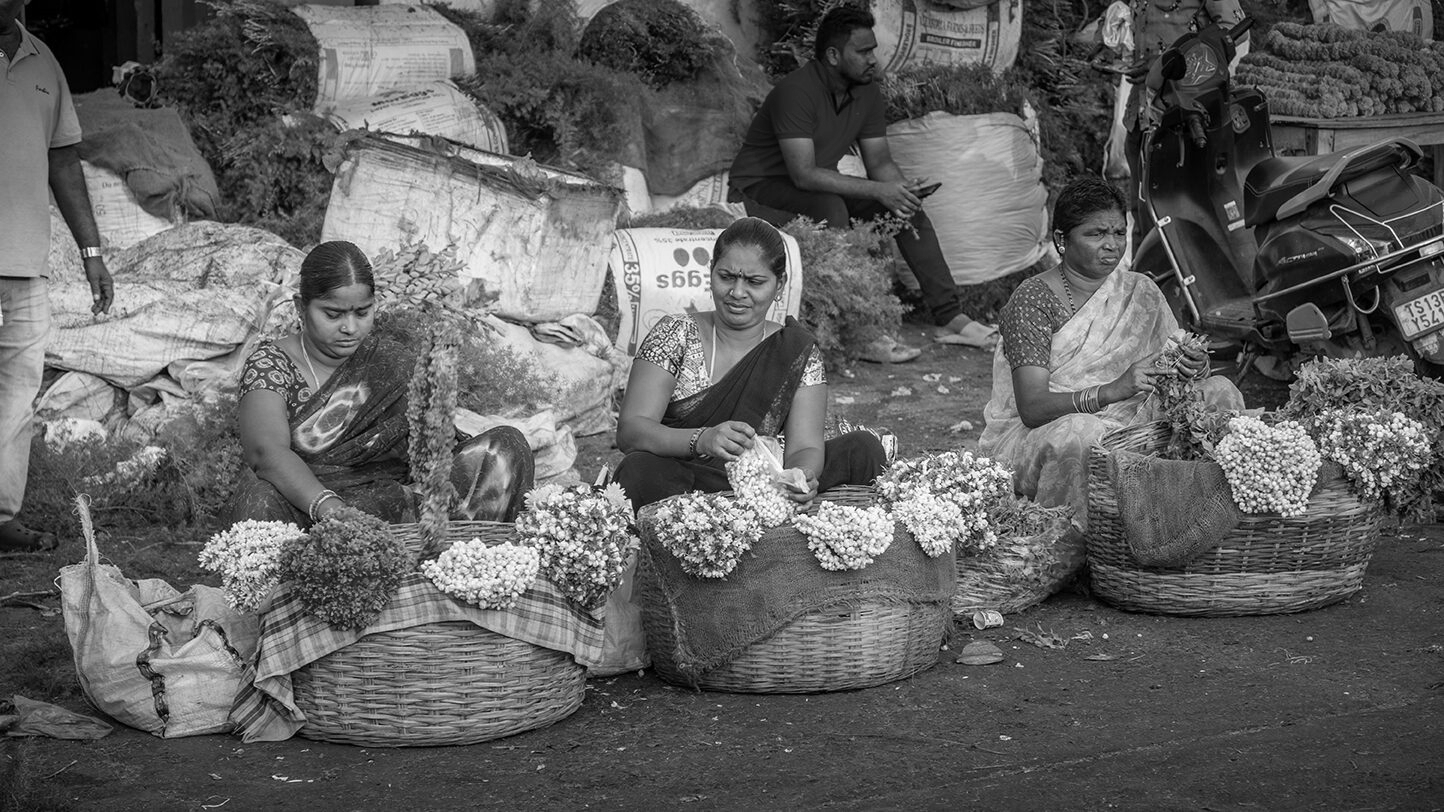
Gudimalkapur: The Market That Keeps Hyderabad in Bloom
Gudimalkapur Wholesale Market begins its day long before Hyderabad stirs awake. By the early hours of the morning, when the city’s streets are still quiet, the market is already alive with movement. Trucks roll in , headlights slicing through the darkness as sacks of jasmine, chrysanthemum, marigold, rose and tuberose are unloaded in a practiced rush. Prices are called out, bargains are struck, and garlands are stitched before dawn . By the time Hyderabad wakes up, most of its temples, wedding halls, neighbourhood flower vendors and street-side sellers are already stocked their supply traced back to Gudimalkapur .
Today, Gudimalkapur is recognised as Telangana’s largest wholesale flower market , but its story is deeply intertwined with Hyderabad’s urban history . The roots of the city’s organised flower trade date back to 1935 , during the Nizam era , when wholesale activity was centred around Jambagh near Mozzam Jahi Market . For decades, this location functioned as the heart of Hyderabad’s flower commerce, serving a much smaller city with limited volumes and manageable traffic .
As Hyderabad expanded rapidly in the late 20th and early 21st centuries , the old location began to buckle under pressure. The narrow roads around Jambagh could no longer handle the increasing number of trucks bringing flowers from across the region . Loading and unloading spilled onto public streets , causing congestion and safety concerns. Storage space was limited , and the absence of organised infrastructure made large-scale handling difficult. It became clear that the traditional market could not keep pace with the city’s growth.
The decision to shift the wholesale flower market was shaped by multiple factors. Severe space constraints , rising traffic congestion in the city core , and the need for a planned and regulated wholesale yard under the Agricultural Market Committee (APMC) framework drove the move. Authorities identified Gudimalkapur , on the western side of Hyderabad , as a suitable alternative. In 2009 , the wholesale flower trade was officially relocated, marking a decisive turning point in the city’s flower economy.
The new market offered what the old location could not. Spread across nearly eight acres , Gudimalkapur Wholesale Flower Market provided wider access roads , designated wholesale stalls , multiple market halls , and space to handle large daily volumes . The relocation did not merely change geography; it ensured the survival and expansion of a legacy trade in a rapidly modernising city.
Over the years, Gudimalkapur has evolved into a multi-commodity wholesale hub . While flowers remain its core identity, the market also accommodates nearly 500 retail vegetable stalls along with ancillary trades. Around 195 wholesale flower stalls operate within the premises, supported by 13 market halls serving farmers, commission agents and traders . Seasonal vendors add to the daily bustle, particularly during festival periods and wedding seasons .
Although official agencies do not publish a consolidated daily turnover figure , the scale of trade is evident. During peak periods, more than 200 vehicles reportedly enter the market daily from different states. Individual flower varieties arrive in massive quantities. During festivals, the market is known to receive over 13,000 kilograms of chrysanthemum alone , highlighting the enormous volume handled each day.
The nature of the flower trade makes Gudimalkapur especially sensitive to disruption. Flowers are highly perishable and cannot be stored long-term. Heavy rains, transport delays, or crop damage in source regions are immediately reflected in shortages and price spikes . Even a single day of reduced arrivals can affect prices across the city, impacting temples, wedding planners, retailers and street vendors . In this sense, Gudimalkapur functions as a price barometer for Hyderabad’s ritual and social economy .
The market’s wider importance lies in its position within a multi-state supply chain . Gudimalkapur receives flowers from major production belts in Andhra Pradesh, Karnataka, Tamil Nadu and Maharashtra . Different regions dominate different varieties and seasons , making the market closely tied to climate patterns and agricultural cycles across southern and western India.
Once traded at Gudimalkapur, flowers move outward primarily to meet Hyderabad’s vast daily demand . Retail flower markets , religious institutions , wedding decorators , event planners , and neighbourhood vendors across Telangana depend heavily on this hub. While Gudimalkapur is best described as a multi-state inbound market , bulk buyers also procure consignments based on specific event-driven demand.
Beyond trade, Gudimalkapur is a space layered with livelihoods . Thousands depend on its daily rhythm farmers , transport workers , commission agents , porters , garland makers , cleaning staff , and security personnel . Many families associated with the flower trade trace their involvement back several generations , having adapted to the shift from Jambagh while preserving long-standing commercial networks.
Gudimalkapur reflects a larger truth about Indian cities. Urban modernisation does not erase traditional economies ; it relocates and reshapes them. The market’s growth demonstrates how legacy trades adapt to new urban geographies while continuing to support vast informal and semi-formal workforces.
Adding a layer of historical depth is the presence of the Kumandan Bowli , a 19th-century stepwell located within the market precinct. Once buried and forgotten, the structure has been taken up for restoration through CSR-supported conservation efforts . Its revival is part of a broader initiative to reclaim Hyderabad’s water heritage .
The contrast is striking a historic water structure rooted in sustainability standing amid a fast-paced 21st-century wholesale market . It highlights how Hyderabad’s everyday spaces often carry hidden layers of history beneath modern activity.
Ultimately, Gudimalkapur is more than a flower market. It is a logistics solution shaped by urban congestion , a multi-state agricultural junction , a price-setting nerve centre , and a rare space where commerce and heritage coexist . In a city often defined by technology parks and high-rises , Gudimalkapur tells a quieter but vital story of early mornings , inherited skills , and the unseen labour that keeps Hyderabad in bloom .