
Guatemala mourns 10 police officers as state of emergency continues after gang attacks
Guatemala is grappling with an escalating security crisis as the death toll from gang-related attacks on police rose to 10 on Monday. The country remains on high alert after President Bernardo Arevalo’s 30-day state of emergency was approved by Congress, giving authorities sweeping powers to combat the violence. Streets in Guatemala City remained unusually quiet under heavy security , and many residents stayed home in fear of further attacks.
The unrest began Saturday when inmates seized control of three prisons in coordinated riots , taking 43 guards hostage . Authorities say the gangs, including Barrio 18 and Mara Salvatrucha (MS‑13) , were demanding special privileges for their members and leaders . After police liberated one prison on Sunday morning, suspected gang members launched attacks across the capital, targeting officers and civilian authorities.
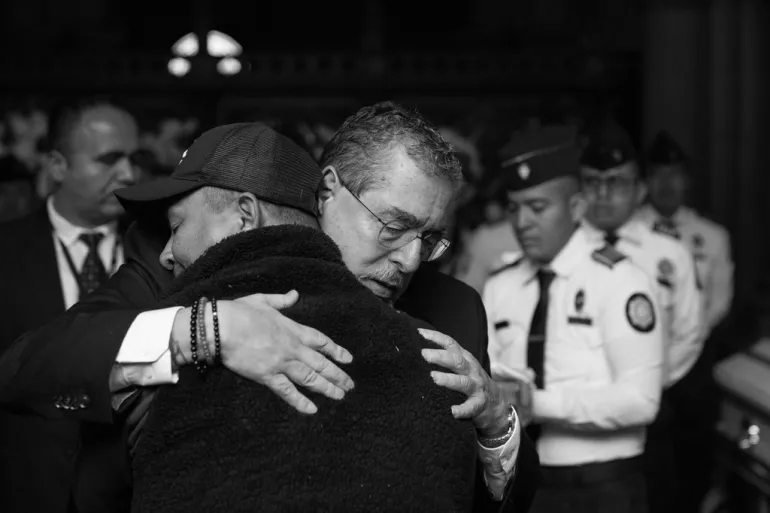
National Civil Police Director David Custodio Boteo confirmed that a tenth officer succumbed to injuries Monday, while several others remain in critical condition , some with amputations . Police honored the fallen officers in a ceremony at the interior ministry, where flag-draped coffins symbolized the nation’s mourning.
“Today it pains me to give each one of the families this flag , a symbol of the nation that will not forget the sacrifice and commitment of their police fallen in the fulfillment of their duty,” President Arevalo said. Outside the ministry, Jose Antonio Revolorio, father of officer Jose Efraín Revolorio Barrera, 25, called for justice. “I hope that the criminals who did this to my son will one day pay for it , and that the law will pursue them. My son was an honest man, competent at his work.”
The state of emergency was declared due to what the government described as “coordinated actions by self-named maras or gangs against state security forces, including armed attacks against civilian authorities.” The decree limits rights such as freedom of movement, demonstrations, and carrying weapons, allows police to arrest people without just cause, and authorizes authorities to restrict vehicle movements or conduct searches.
Residents reported widespread fear across the capital. Traffic was lighter than usual, and many avoided leaving home. “This situation is a shame . It affects people psychologically: they don’t want to go out,” said Oscar Lopez, 68, a radio technician. Ileana Melgar, 64, said she called a friend for company to go to a government office, fearing blocked transportation. Schools were suspended nationwide as a safety measure.
The US Embassy in Guatemala initially ordered American personnel to shelter in place Sunday, later lifting the order but advising caution while traveling. On Monday, the embassy condemned the attacks, stating, “These terrorists, as well as those who cooperate with them or are linked to them, have no place in our hemisphere. The security of the Guatemalan people and the stability of our hemisphere must prevail. We reaffirm our support for Guatemala’s security forces to curb the violence.”
The unrest comes amid ongoing gang pressure in Guatemala. In October 2025, Congress declared Barrio 18 and Mara Salvatrucha members as terrorists , lengthening prison sentences for gang-related crimes, and the United States labeled the groups foreign terrorist organizations last year. Some gang leaders who escaped prison in recent months remain at large, highlighting the entrenched influence of organized crime.
This sequence of prison riots and coordinated attacks underscores Guatemala’s continuing struggle against gang violence and the government’s efforts to balance civil liberties with public safety in a nation on high alert.