
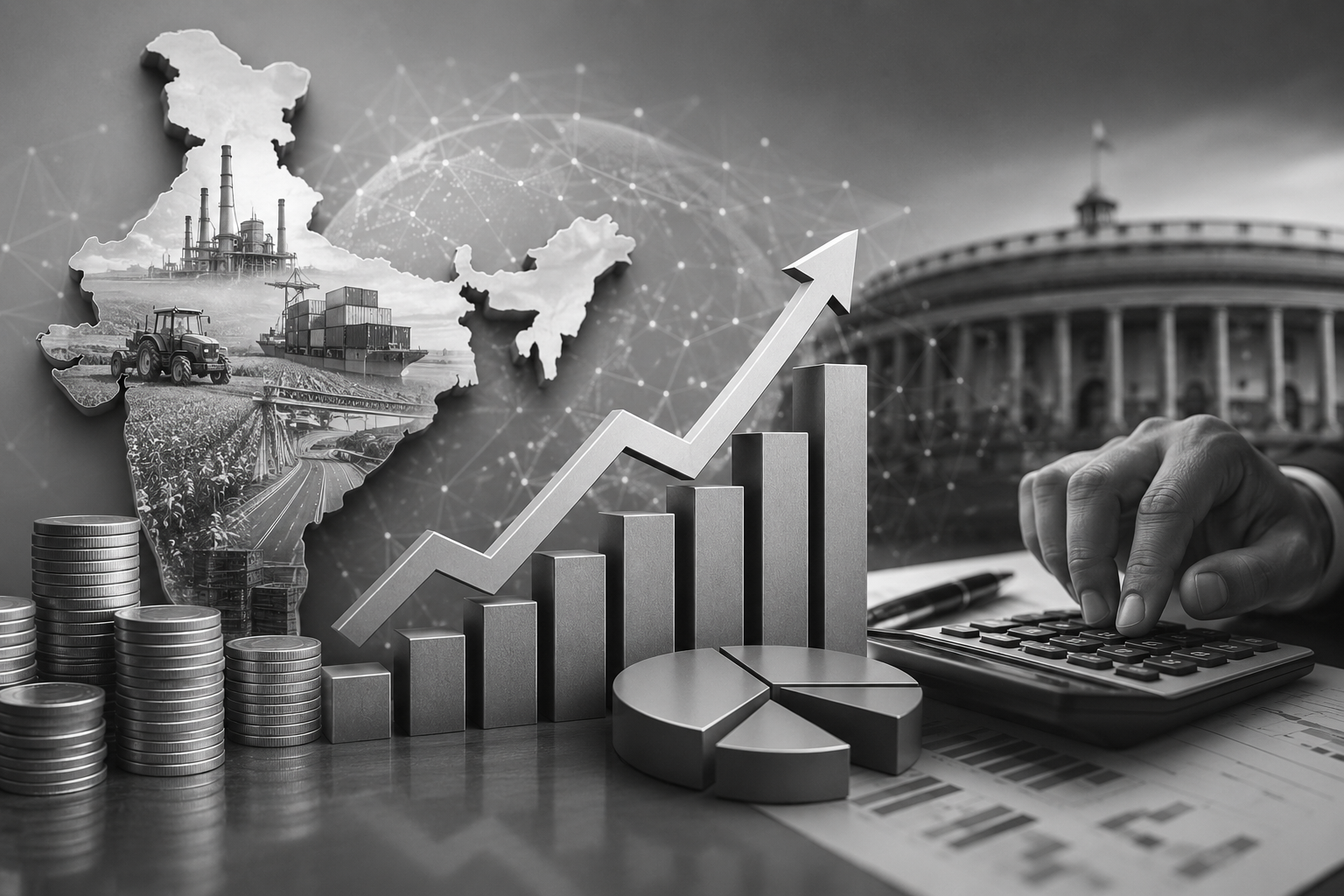
GST, Tax Data and GDP: Inside India’s New Economic Measurement
India’s latest revision of its national accounts is about much more than a marginal change in GDP growth rates.
The Ministry of Statistics and Programme Implementation (MoSPI) has released National Accounts Statistics – 2026, offering a revised statistical picture of the Indian economy based on 2022–23 as the new base year. Behind the updated numbers is a much bigger story: India is attempting to redesign the way it measures an economy that has become more digital, more formal and increasingly visible through tax and administrative records.
The latest publication presents 60 detailed statements based on updated Final Estimates for 2022–23 and 2023–24, and First Revised Estimates for 2024–25. It covers national income, GDP, per-capita income, production, consumption, savings, capital formation, public-sector activity and external transactions. It also includes updated provisional estimates for 2025–26 and quarterly GDP estimates stretching from 2022–23 to 2025–26.
The immediate headline is the revision in growth numbers. But the more important question is: what has changed - the economy or the way it is being measured?
The economy did not suddenly change. The measurement did.
GDP revisions can often be misunderstood. When growth estimates are revised upward or downward, it does not necessarily mean that factories suddenly produced more goods or consumers spent more money after the earlier figures were released.
Much of that economic activity had already happened.
What changes is the statistical picture. New data becomes available, more complete administrative information is incorporated, price indicators are updated and methodologies are refined. The result can be a more accurate estimate of economic activity that has already taken place.
That is what makes the latest National Accounts Statistics – 2026 exercise significant.
For 2023–24, real GDP growth has been revised from 7.2% to 7.3%. The estimate for 2024–25 has risen from 7.1% to 7.2%, while provisional real GDP growth for 2025–26 has been revised from 7.7% to 7.8%.
At the same time, the nominal picture moved differently. GDP growth at current prices for 2025–26 was revised downward from 8.9% to 8.6%, illustrating why nominal and inflation-adjusted GDP can tell different stories.
New indicators are reshaping the numbers
The revisions stem largely from the incorporation of updated series of the Producer Price Index (PPI), Index of Industrial Production (IIP) and Banking Services Price Index (BkSPI), all based on 2022–23, along with updated administrative data.
The new PPI expands the commodity basket, includes emerging products and removes obsolete items that belonged to the older series. The revised IIP broadens coverage and uses PPI as an important price-related input, while the BkSPI helps track changes in the volume and transactional activity of banking services.
The impact is not uniform across the economy.
Mining and quarrying revisions are linked to the new IIP and updated mineral production data. In manufacturing, wider PPI coverage improves the matching of price movements with economic activity. Trade services have also been revised through the use of PPI in place of the older WPI framework.
Changes in estimates of public administration, ownership of dwellings, government activity, net fixed capital stock and consumption of fixed capital have also influenced the final national accounts numbers.
Why 2022–23 became the new benchmark
The choice of 2022–23 as the new GDP base year carries its own economic history.
Several earlier years were difficult to use as a representative benchmark. 2017–18 was marked by the adjustment to the introduction of GST. The following years were disrupted by the COVID-19 pandemic, while the recovery period produced unusually sharp base effects.
By 2022–23, economic activity had largely stabilised and a broader range of updated data was available. The year therefore offered a more suitable benchmark for measuring the structure of the contemporary Indian economy.
GST and the growing administrative footprint
This is where the story becomes larger than GDP.
India’s economy now generates an enormous amount of digital and administrative information. GST data, corporate records, tax filings, government financial data and other high-frequency indicators increasingly provide statistical agencies with additional tools to understand economic activity.
The significance of GST, therefore, goes beyond tax collection.
Its nationwide digital architecture creates a growing record of business activity, supplies and transactions. MoSPI’s broader base-year revision exercise has explored the use of newer administrative datasets, allowing official statistics to increasingly combine traditional surveys with information generated by the formal economy.
But an important distinction must be maintained: GST collections are not GST turnover, and neither is the same as GDP.
India has multiple tax rates, exemptions, zero-rated supplies and input-tax credits. A GST collection figure cannot simply be converted into total business turnover using one formula. Its greater value for national accounting lies in the detailed information it can provide about the formal economy.
The same caution applies to income-tax filings.
A growing number of people filing income-tax returns does not automatically translate into higher GDP. But an expanding taxpayer base creates a broader administrative record that can potentially help improve the coverage, validation and cross-checking of economic data.
From surveys to a hybrid data economy
India is not abandoning traditional surveys. Far from it.
Household and enterprise surveys remain essential, particularly for measuring parts of the economy that administrative records may not fully capture. The real transformation is the move towards a hybrid statistical system —one that combines surveys with tax records, corporate information and high-frequency administrative datasets.
The updated Supply and Use Tables for 2022–23 and 2023–24 are another important part of this exercise. They help statisticians trace how goods and services are produced, used as inputs and eventually consumed, invested or exported, ensuring consistency across different parts of the national accounts.
That may be the most important takeaway from National Accounts Statistics – 2026.
The revised GDP numbers will attract immediate attention. A change from 7.7% to 7.8%, or from 7.1% to 7.2%, makes for a clear headline.
But the deeper story is more consequential.
India is trying to build a statistical system capable of keeping pace with an economy that has changed fundamentally.
The India of 2022–23 is not the India represented by the old 2011–12 base year. It has a mature GST system, a much larger digital economy, expanding formal records and growing volumes of administrative data.
National Accounts Statistics - 2026 is therefore not simply a revision of GDP. It is part of India’s larger effort to ensure that the way it measures its economy evolves alongside the economy itself.