
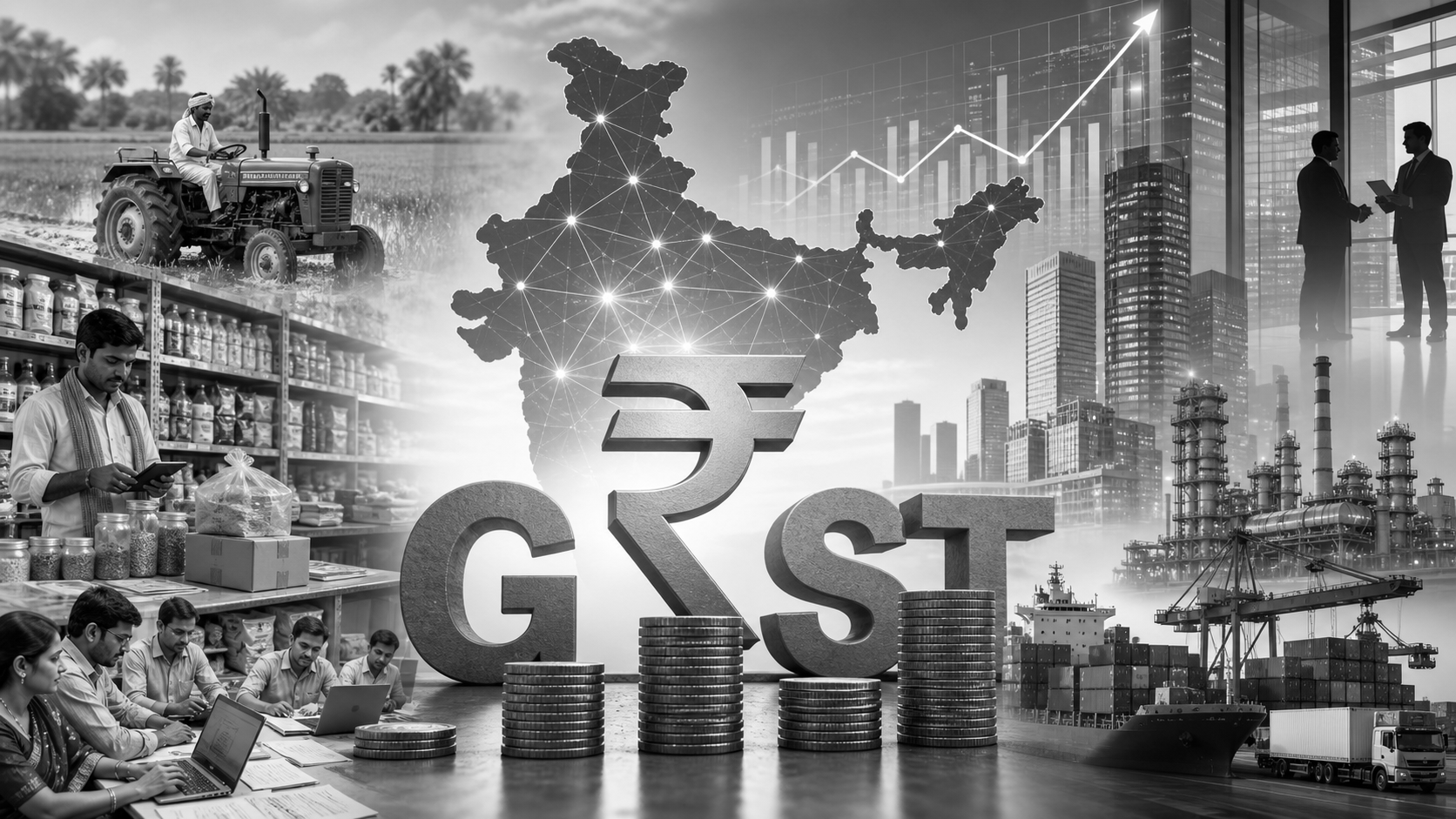
GST Hits ₹2.43 Lakh Crore: Rising Compliance, Structural Gaps Remain
India’s Goods and Services Tax (GST) collections surged to a record ₹2.43 lakh crore in April 2026 , marking an 8.7% year-on-year increase and surpassing the previous high of ₹2.23 lakh crore recorded last year. The latest data underscores the resilience of India’s consumption-driven economy , backed by improved compliance and expanding formalisation nearly nine years after GST’s rollout.
Introduced on July 1, 2017 , following the 101st Constitutional Amendment Act, GST replaced a fragmented indirect tax regime with a unified national system. Since then, collections have steadily risen from ₹7.4 lakh crore in 2017–18 (partial year) to ₹11.77 lakh crore in 2018–19 , ₹12.22 lakh crore in 2019–20 , before dipping to ₹11.36 lakh crore in 2020–21 due to COVID-19 . The recovery has been sharp, with revenues climbing to ₹14.83 lakh crore in 2021–22 , ₹18.07 lakh crore in 2022–23 , ₹20.18 lakh crore in 2023–24 , and an estimated ₹22.08 lakh crore in 2024–25 . In cumulative terms, GST has generated over ₹115 lakh crore since inception , highlighting its growing role in India’s fiscal framework.
The April 2026 surge was broad-based. Domestic transactions contributed over ₹1.85 lakh crore , growing 4.3% , while GST from imports jumped 25.8% to ₹57,580 crore , reflecting strong trade activity. Refunds rose 19.3% to ₹31,793 crore , and after adjustments, net GST collections stood at ₹2.11 lakh crore , up 7.3% year-on-year .
State-wise trends reveal a diverse economic contribution rather than a regional skew. Maharashtra remains the top contributor , driven by its financial and industrial base, followed by Uttar Pradesh, Karnataka, Gujarat, and Tamil Nadu . However, experts caution that GST collections reflect where taxes are paid often company headquarters rather than where economic activity originates , limiting direct regional comparisons.
Sectorally, the system remains top-heavy . Public limited companies contribute about 34.8% of GST revenues , followed by private companies at 27.9% , while proprietorships account for roughly 13% . Small businesses under the composition scheme many of them rural traders form nearly 30–40% of taxpayers but contribute only about 6–7% of total GST revenue , underscoring the dominance of large corporates. Key contributing sectors include manufacturing (automobiles, steel, cement), trade and retail consumption, services such as IT and finance, and increasingly imports , which have emerged as a major driver of recent growth.
Since its launch, the GST rate structure 0%, 5%, 12%, 18%, and 28% has remained broadly intact, but the GST Council has undertaken dozens of rate rationalisations , shifting hundreds of goods and services across slabs. The initial years saw sharp reductions from the 28% bracket, followed by a stabilisation phase and, more recently, efforts to widen the tax base. Discussions are ongoing to simplify the system into fewer slabs.
Despite record GST growth, structural challenges persist , with heavy reliance on large firms and limited inclusion of the informal economy . Experts stress simplification and inclusion through slab rationalisation , easier composition schemes , and digital compliance tools . Strengthening invoice matching and easing MSME burdens remain key. While GST has improved transparency and revenues , its future success depends on broadening the tax base , reducing complexity, and integrating small businesses into the formal economy .