
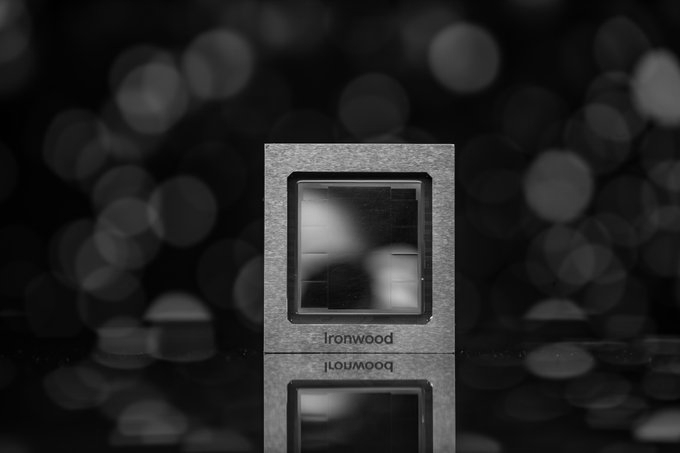
Google’s Ironwood TPU set to reshape competition in AI hardware race
Google has announced that Ironwood, its most powerful and energy-efficient Tensor Processing Unit (TPU) yet, will become generally available in the coming weeks, marking a major step in the company’s custom silicon strategy. TPUs are specialised chips built from the ground up to handle artificial intelligence (AI) and machine learning (ML) workloads. Unlike general-purpose CPUs or GPUs, they are optimised for matrix and tensor operations that power large language and generative AI models.
Google’s TPUs currently power frontier models such as Gemini, Veo, and Imagen, as well as scientific systems like AlphaFold. The latest generation, Ironwood, delivers up to 4,614 teraflops of peak compute, features 192 GB of high-bandwidth memory, and offers nearly double the performance per watt compared to its predecessor, Trillium. With improved inter-chip connectivity and scalability of up to 9,000+ chips per pod, Ironwood is designed for the age of inference, where AI systems are deployed to serve millions of real-time user requests efficiently.
The launch strengthens Google’s position in the AI infrastructure market, giving its cloud customers access to the same chips that power its own models. By vertically integrating hardware and software, Google aims to cut costs, lower latency, and deliver faster, more sustainable AI performance.
Ironwood also intensifies competition with NVIDIA and AMD, long-time leaders in AI computers. While NVIDIA’s GPUs dominate large-scale training today, Google’s TPUs are becoming equally capable, especially for inference workloads, where power efficiency and cost are critical.
Industry analysts say Ironwood underscores a wider trend of custom silicon development among major players. Amazon (Inferentia and Trainium), Microsoft (Maia and Cobalt), and Apple (Neural Engine) are all developing in-house chips to reduce dependence on external suppliers.
With Ironwood’s advances in performance, scalability, and energy efficiency, Google not only pushes the boundaries of AI computing but also raises the stakes in the global race to build faster, greener, and more intelligent hardware for the next generation of AI systems.