
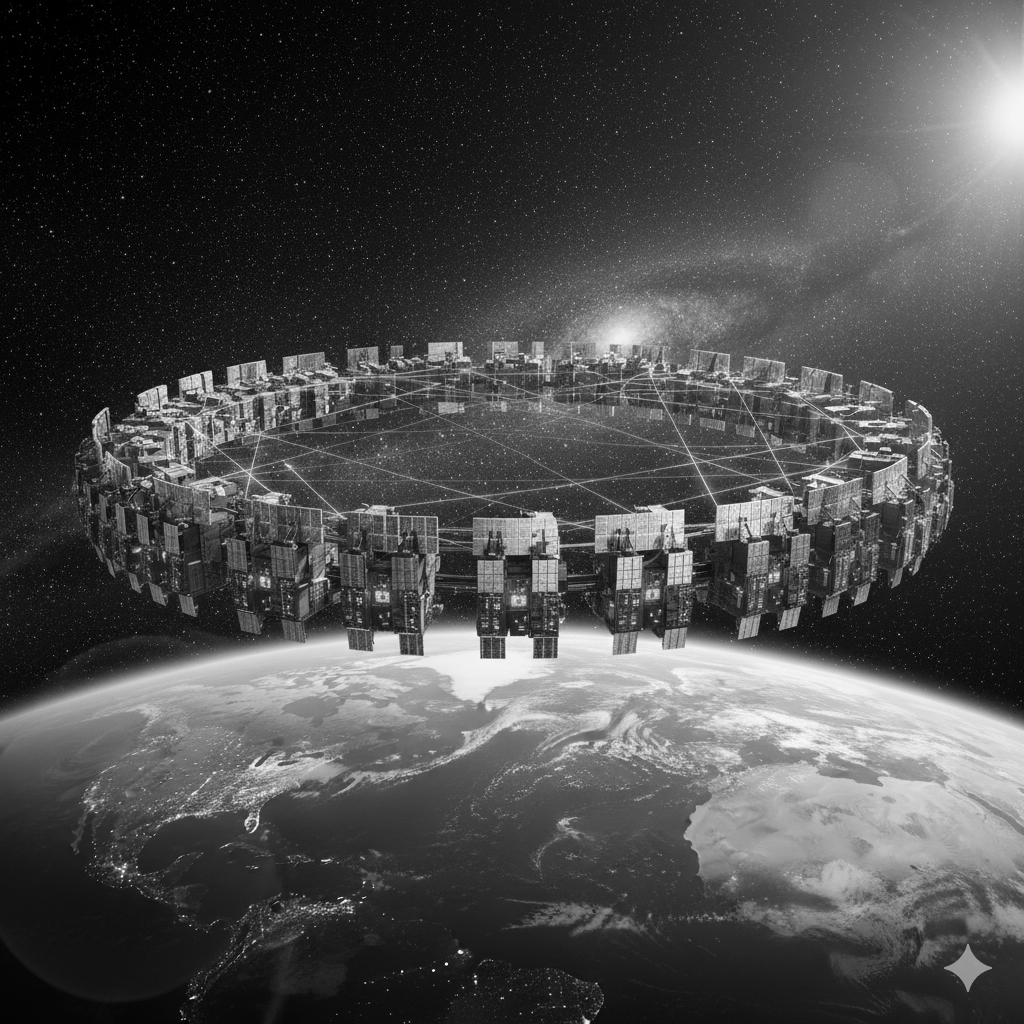
Google Data Centers No Longer on Earth, But Into Space!
Can you imagine a world powered by Artificial Intelligence (AI) so vast, so powerful, that Earth itself might not be enough to contain it? Have you ever thought about the massive amount of electricity and water needed to cool the colossal data centers that train and run AI models like Gemini and ChatGPT? It’s a staggering amount, leading to major concerns about resource depletion and carbon emissions.
What if the answer to Earth's energy crisis for AI wasn't on the ground, but 400 miles above it? In a stunning, epoch-making development, the tech giant Google has unveiled a radical, ambitious plan: Project Suncatcher, to build and operate AI data centers in low-Earth orbit (LEO)!
Yes, you read that right. The AI race is now truly a space race.
Google's Cosmic Blueprint: Project Suncatcher
Google is proposing to launch tightly packed constellations of around 80 solar-powered satellites into orbit, approximately 400 miles (640 km) above the Earth's surface. These orbital units will be equipped with Google's powerful, specialized AI processors, known as Tensor Processing Units (TPUs).
This isn't just a distant dream; the timeline is aggressive. Google plans to launch its first prototype satellites carrying the trial equipment by early 2027. This is the first critical step toward what the company believes is the future of scaling AI.
How Will it Work?
The core technology relies on two major factors: Solar Power and Optical Links.
Unlimited, Clean Energy
Once in orbit, the satellites will be powered by solar panels. Google estimates these panels can be up to eight times more productive than their terrestrial counterparts because they are not hampered by the atmosphere or weather.
High-Speed Communication
The completed AI models and data processing results will be beamed back to Earth using free-space optical links, a technology that uses light or laser beams to transmit information at high speeds.
The Logic: Why Abandon Earth?
The decision to move AI data centers into the cosmos is fundamentally driven by a global sustainability and resource crisis.
The Earthbound Problem
Major technology companies are projected to spend a staggering $3 trillion on new, Earthbound data centers across the globe. This spending fuels rising concerns about:
Water Consumption:
Current data centers use billions of gallons of water annually for cooling. Moving them to space minimizes this impact.
Land Use
Satellites require virtually no terrestrial land footprint, unlike massive, sprawling data center complexes.
Carbon Emissions
Even with efforts toward clean energy, the sheer scale of energy required raises alarms about future carbon emissions.
The Space Solution
As Google puts it: "In the future, space may be the best place to scale AI computers." Their research suggests that by the middle of the 2030s, the running costs of a space-based data center could be comparable to one on Earth, offering a clean, scalable alternative.
The Dark Side of the Moonshot
While Project Suncatcher is a technological marvel, it is not without its significant hurdles and criticisms.
Launch Pollution
The most immediate concern is the environmental cost of getting the satellites into orbit. Launching a single rocket emits hundreds of tonnes of CO2. Critics argue that the initial carbon outlay could undermine the long-term environmental benefits.
Astronomical Interference
Astronomers are worried that the rising numbers of satellites in LEO are like "bugs on a windshield" when they try to peer into the universe. Google's constellation of 80 satellites will only add to this visual clutter, potentially disrupting crucial scientific research.
Engineering Hurdles
Google itself has sounded a cautionary note, highlighting major engineering challenges that remain:
Thermal Management is how to effectively cool the powerful TPUs in the vacuum of space. High-Bandwidth Ground Communications ensures reliable, extremely fast data transfer back to Earth. On-Orbit System Reliability is the durability and maintenance of complex hardware in the harsh space environment.
The New Space Race - Competition Heats Up
Google is not alone in looking toward the stars for compute power. The AI space race is intensifying, with multiple players exploring this new frontier. The visionary behind Starlink and SpaceX recently indicated that his companies would also start scaling up to create data centers in space. The chip giant Nvidia, whose GPUs power the majority of current AI, will be launching its AI chips into space later this month in partnership with the startup Starcloud. Experts believe that this competition will drive innovation forward at an unprecedented pace.
A Future Forged in Orbit
Project Suncatcher represents a gigantic leap of faith, a belief that the sustainability of the AI revolution depends on transcending terrestrial boundaries. While the initial costs and technical problems are immense, the promise of unlimited, clean solar energy and minimized environmental impact is simply too compelling to ignore.
The global technology landscape is officially shifting from the data center parks of Earth to the satellites of LEO. Prepare yourselves, for the future of computing is now orbiting over our heads!