
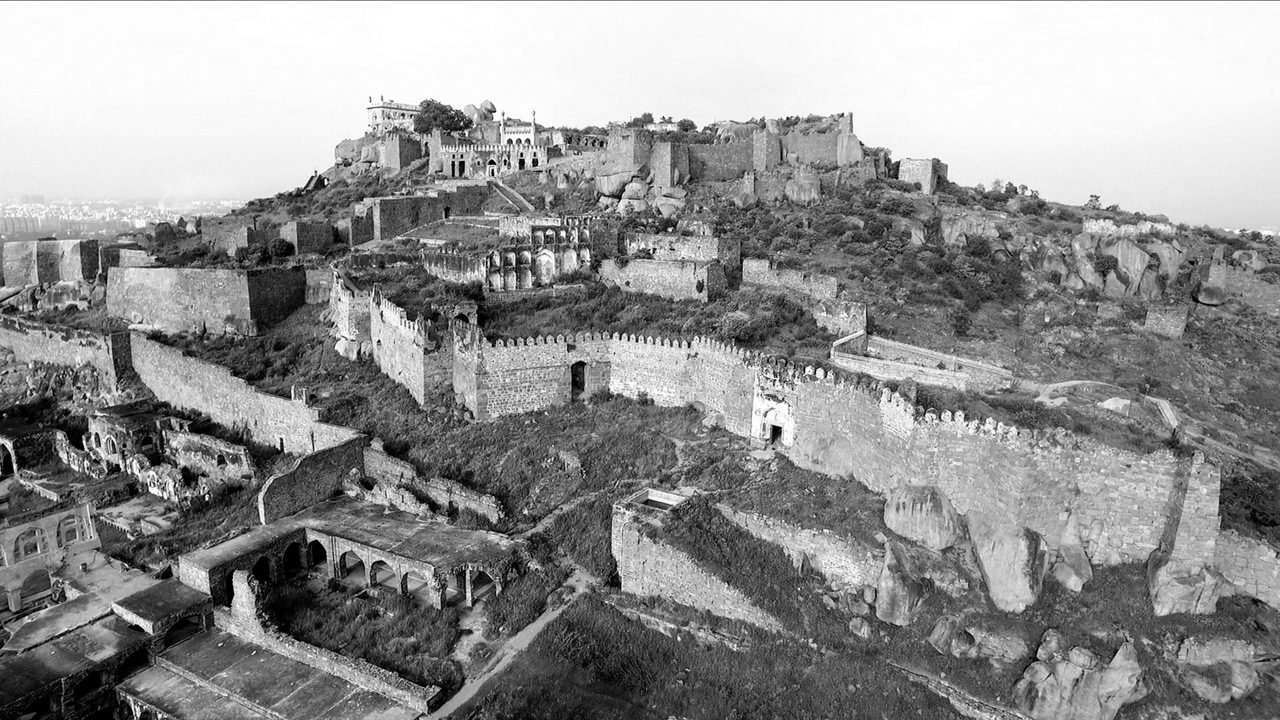
Golconda: Echoes of Wealth and Warfare
Standing tall and solemn, away from the modern bustle of Hyderabad, these stone walls feel like more than just structures. They are silent witnesses, cradling centuries of history within their hearts. This fort, which once bestowed the brilliance of diamonds upon the entire world, may lie in ruins today, but every stone tells a story. It is fascinating to recall how a small mud hill once known as ‘Golla Konda’ transformed into the heartbeat of an empire. The echoes at the fort’s gates still resonate with the roar of ancient battles and the valor of soldiers.
Golconda is not merely about wealth; it is a culture. The presence of the Jagadamba Temple and the royal mosques side-by-side stands as a testament to the Hindu-Muslim unity of that era. However, the heart grows heavy reflecting on how a fortress that resisted the enemy for eight months finally crumbled due to a single act of betrayal. Behind these ruined walls lie the laughter of queens, the verses of poets, the shimmer of diamonds, and the profound grief of a falling kingdom. Though kings have passed and empires have shifted in the flow of time, Golconda remains a proud memory of the Telugu land, reminding us of its former glory.
From a Shepherd’s Hill to an Imperial Hub
The story of Golconda began humbly in the 11th century. Legend says a shepherd boy found an idol on a hill then known as "Mangalavaram." When the Kakatiya King was informed, he ordered a mud fort to be built around the sacred site. This origin gave the hill its name "Golla Konda" (Shepherd’s Hill in Telugu).
Golconda is an ancient fortified city located 10 km from Hyderabad. The entire city and fort were built on a 120-meter-high black granite hill. Massive bastions were constructed for defense. The Kakatiyas ruled Golconda from 1083 to 1323 AD. In 1343, Musunuri Kapaya Nayaka reclaimed Golconda by defeating the forces of Muhammad bin Tughluq. Later, as part of a treaty, he ceded it to the Bahmani Sultan, Muhammad Shah.
By the 14th century, the fort’s landscape changed. Under the Bahmani Sultans, it became the seat of Governor Sultan Quli Qutb-ul-Mulk. As the Bahmani Empire weakened, Sultan Quli declared independence in 1518, founding the Qutb Shahi dynasty. Over the next 62 years, mud walls were replaced with massive granite blocks, turning Golconda into one of the most impregnable fortresses in the world.
Engineering Marvels: Acoustics and Hydraulics
Golconda is a masterpiece of engineering, particularly for its advanced acoustic signaling system. The Fateh Darwaza (Victory Gate) is the starting point of this ingenious security system. A clap at a specific point under the dome can be heard clearly at the Bala Hissar pavilion, the highest point of the fort nearly a kilometer away. This was a "high-tech" alert system designed to warn royalty of approaching enemies.
Furthermore, in an era without electricity, Qutb Shahi engineers developed complex hydraulic systems. Using Persian wheels and a series of tanks, they lifted water hundreds of feet to the palaces atop the hill. This ensured the royalty had water and lush gardens even during a siege. The fort was protected by three concentric walls; the outermost wall is 7 km long with 87 semi-circular bastions. The gates, like Fateh Darwaza, were studded with giant iron spikes to prevent enemy elephants from battering them down.
Water Management: Defying Gravity
The water supply system of Golconda is perhaps its most astonishing feat. Engineers planned meticulously to ensure a constant water supply to palaces 400 feet high. Water was pumped from reservoirs at the base using oxen-driven Persian wheels, moving it level by level. Baked clay pipes were embedded deep within the walls and floors to carry water to baths, kitchens, and fountains. Even today, remains of these pipes can be seen. Huge tanks at the top used gravity to distribute water throughout the fort, ensuring no shortage during wartime.
Intriguing Secrets of the Fort
• The Mysterious Tunnel: There is a persistent legend of a secret underground tunnel connecting Golconda to the Charminar. It was supposedly built as an escape route for the royal family, though no physical evidence has been found to date.
• The Baobab Tree: In the nearby Naya Qilla stands a massive Baobab tree (Hathiyan ka Jhad) with a hollow trunk. Legend says thieves used to hide inside it.
• The Nine Gates: The fort has nine gates, including Fateh, Moti, Banjara, and Mecca gates. To protect against elephant charges, a "curtain wall" was built in front of the Bala Hissar gate, and holes were placed above the gates to pour boiling oil or molten metal on invaders.
• Nagina Bagh: This "Garden of Jewels" was where world-renowned diamond auctions took place in the presence of foreign merchants.
• Natural Air Conditioning: The palaces were designed with such precision that the placement of windows and wall thickness allowed for natural cooling, keeping the interiors pleasant even in scorching summers.
The Diamond Capital of the World
For centuries, the name "Golconda" was synonymous with "unfathomable wealth." This reputation came from the Kollur mines and the diamond trade that flourished within its walls. During the Renaissance, India was the world’s only source of diamonds, and Golconda was its primary trading hub.
Famous diamonds from this treasury include:
• Koh-i-Noor: Currently part of the British Crown Jewels.
• Hope Diamond: The rare blue diamond.
• Daria-i-Noor: One of the largest in the world, now in Iran.
• Regent Diamond: A centerpiece of the French Crown Jewels.
• Modern gemologists still use the term "Golconda Grade" to denote diamonds of the highest purity and quality.
A Blend of Cultures and Faiths
Despite being ruled by Muslim Sultans, Golconda’s architecture and social life reflected "Unity in Diversity." The Qutb Shahis were known for patronizing the local Telugu language and culture.
• Jagadamba Temple: Located near the Royal Mosque at the top of the fort, this Kakatiya-era temple was respected by the Sultans for centuries. Even today, the fort comes alive with spiritual fervor during the Bonalu festival.
• Bhakt Ramadasu: The fort also bears witness to the unwavering faith of Kancharla Gopanna (Ramadasu). He was imprisoned in a dark cell for 12 years by Tanisha for using state funds to build the Bhadrachalam Rama temple. Visitors can still see the deities of Rama and Hanuman he carved into the prison walls with his bare hands.
• Divine Intervention: Legend says Lord Rama and Lakshmana appeared as servants to pay the ransom to the Sultan to free Ramadasu, adding a layer of spiritual mystique to the fort’s history.
• Qutb Shahi Tombs: Located just outside the walls, these tombs are a stunning blend of Persian, Pathan, and Hindu architectural styles, a "City of the Dead" that remains one of India’s most beautiful monuments.
The Fall: An Eight-Month Siege
The splendor of Golconda eventually drew the envy of the Mughal Emperor Aurangzeb. In 1687, he marched to the Deccan to end the Qutb Shahi rule. Despite the massive Mughal army, the fort did not surrender for eight months. It fell not to military might, but to treachery. A traitor opened the Fateh Darwaza in the dead of night, allowing the Mughal forces to swarm in. With the capture of the last king, Abul Hasan Tana Shah, the dynasty came to an end.
Golconda Today: A Living Legacy
Today, Golconda is a major destination for historians and tourists alike. Every evening, a Sound and Light Show (narrated by icons like Amitabh Bachchan) brings the fort’s history to life.
Traveler’s Tips:
• Timing: Start early to avoid the heat.
• The Climb: Be prepared to climb 300, 400 steps, wear comfortable shoes.
• Food: Visit Toli Chowki for authentic Hyderabadi Biryani at Shah Ghouse or Mehfil.
• Nearby: Don't miss the Qutb Shahi Tombs (1-2 km away).
Golconda is not just a pile of stones. It is the pinnacle of human ingenuity, where science (acoustics and hydraulics), commerce (diamonds), and art converged. The diamonds may have moved to foreign museums and the royal courts may have fallen silent, but the "Echo of Golconda" continues to resonate through time.