
Goa Statehood Day: Celebrating a Legacy of Freedom, Identity and Democracy
As Prime Minister Narendra Modi greeted the people of Goa on the occasion of Goa Statehood Day , the celebrations served as a reminder of the state's remarkable journey from a Portuguese colony to becoming an integral part of the Indian Union. Unlike most parts of India that attained independence in 1947, Goa remained under foreign rule for another 14 years, making its liberation and eventual statehood one of the most unique chapters in the country's post-independence history.
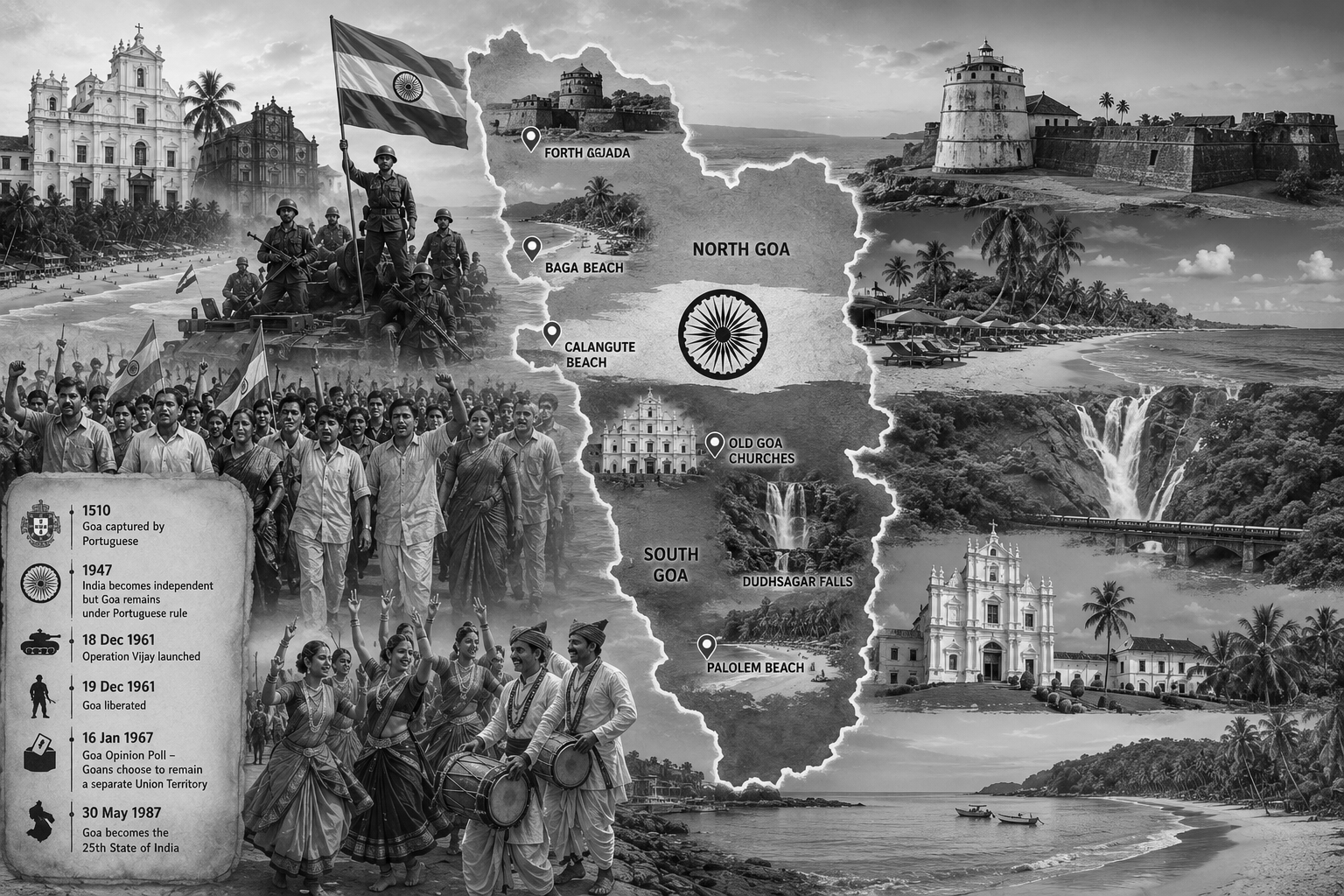
Goa's colonial era began in 1510 , when Portuguese commander Afonso de Albuquerque captured the territory from the Bijapur Sultanate. Over the next 451 years , Goa emerged as the capital of Portuguese India and a major trading hub linking Europe and Asia. The long colonial period left a lasting imprint on Goa's architecture, cuisine, language, music and religious traditions, creating a distinctive cultural identity that continues to define the state.
When India gained independence from British rule in 1947, New Delhi expected all colonial powers to relinquish their territories on the subcontinent. However, Portuguese dictator António de Oliveira Salazar refused to surrender Goa, Daman and Diu, claiming they were integral provinces of Portugal rather than colonies. Despite repeated diplomatic efforts by the government led by Jawaharlal Nehru , Portugal remained unwilling to negotiate.
The refusal sparked a growing liberation movement within Goa. Freedom fighters, activists and political leaders intensified their campaign against Portuguese rule, with Tristão de Bragança Cunha , widely regarded as the father of Goan nationalism, emerging as one of the most influential voices. Protests, underground resistance networks and satyagraha movements gradually transformed Goa's freedom struggle into a national cause.
After years of failed negotiations, India launched Operation Vijay on December 18, 1961. The military campaign involved the Army, Navy and Air Force, making it independent India's first major tri-service operation. Nearly 45,000 Indian troops entered Goa, Daman and Diu, overwhelming Portuguese forces within about 40 hours. On December 19, 1961 , Portuguese Governor-General Manuel António Vassalo e Silva surrendered, bringing an end to more than four centuries of colonial rule. The event is widely regarded as the final step in India's territorial integration after independence.
However, Goa's future remained uncertain even after liberation. A political debate emerged over whether the territory should merge with Maharashtra or retain a separate identity. To settle the issue, the Government of India held the historic Goa Opinion Poll on January 16, 1967 — one of the very few referendums conducted in independent India. Voters decisively rejected the merger proposal, choosing instead to preserve Goa's unique cultural and political identity. The day is still commemorated as Asmitai Dis , or Identity Day.
The movement for greater autonomy continued over the next two decades, accompanied by efforts to secure recognition for the Konkani language . The struggle culminated on May 30, 1987 , when Goa was granted full statehood and became the 25th state of India , while Daman and Diu continued as a separate Union Territory.
Today, Goa is celebrated worldwide for its beaches, heritage sites and vibrant culture. Yet behind that image lies a powerful story of colonial resistance, democratic choice and cultural self-assertion . From enduring 451 years of Portuguese rule to achieving liberation, preserving its identity through a historic referendum and ultimately securing statehood, Goa's journey remains one of the most distinctive and inspiring chapters in modern Indian history.