
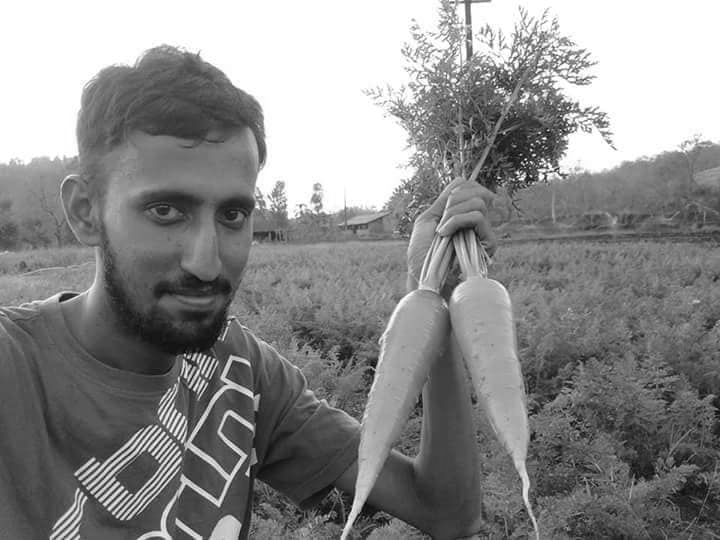
Goa names young Farmer Varad Samant as Agriculture brand ambassador to inspire youth
Goa has appointed 32-year-old farmer Varad Samant as its agriculture brand ambassador, highlighting his transformation from a reluctant cultivator into a large-scale vegetable producer to encourage young Goans to view farming as a profitable and sustainable career.
Chief Minister Pramod Sawant said Samant’s journey demonstrates the economic potential of horticulture when supported by innovation, mechanisation and assured government procurement. “For three consecutive years, the state paid him Rs 65 lakh, Rs 60 lakh and Rs 58 lakh not for sourcing vegetables from outside, but for produce cultivated entirely in Goa,” the chief minister said, referring to purchases made by the horticulture department.
Despite growing up in a farming household, Samant did not initially plan a career in agriculture after completing his B.Com in 2012. His family was involved in sugarcane cultivation between 2010 and 2014, but it was only later that he began exploring vegetable farming as a viable alternative to traditional staple crops.
After travelling to Karnataka and Maharashtra to study modern farming practices, Samant returned to Goa and began cultivating bhindi (lady’s finger) on about 2,000 square metres. The success of the initial crop encouraged him to diversify into cucumbers, carrots, cabbage and other vegetables.
“That was when I realised vegetable farming is very much possible in Goa,” said Samant, a resident of Dharbandora.
Today, he cultivates vegetables across nearly 10 acres , blending traditional knowledge with mechanised farming, efficient irrigation, and scientific crop cycles. During the zaid season , he grows quick-yield crops such as carrots, ready in about 20 days, watermelons harvested in roughly 60 days, and cabbage, which matures in around 70 days, optimising land use and ensuring steady production throughout the year.
Samant said horticulture offers faster returns and higher incomes compared to traditional staple crops. “If watermelon sells at Rs 30 per kg, a farmer can earn nearly Rs 6 lakh from 20 tonnes in just 60 days,” he said, underlining how modern horticulture can significantly improve farm incomes.
He supplies 70-80 tonnes of cabbage annually to the Goa State Horticulture Corporation, along with 4-5 tonnes of carrots, sometimes up to 10 tonnes, besides bhindi and other vegetables. The corporation distributes fresh produce to consumers across the state.
According to Samant, his annual turnover ranges between Rs 50 lakh and Rs 60 lakh, with profit margins of around 25-30 per cent after labour and operational costs. The chief minister, however, said Samant informed him that his net profit from vegetable cultivation alone stood at around Rs 30 lakh annually.
Sawant added that Samant employs 20-22 workers and farms on less than 60,000 square metres, demonstrating how horticulture not only increases income for farmers but also generates rural employment.
Agriculture Director Sandeep Phaldesai said Samant’s appointment aligns with the government’s vision of making Goa ‘Swayampurna’ (self-reliant) in vegetable production. “Under the Promotion of Vegetables with Assured Market scheme, we are encouraging farmers to shift towards high-value horticulture using modern technology. This approach helps young farmers earn more than traditional crops while creating jobs locally,” he said.
Officials said the chief minister recently visited Samant’s fields and was impressed by the use of mechanisation, crop management techniques and efficient land utilisation.
Samant said he was honoured by the appointment and will conduct awareness sessions, demonstrations, and lectures across all talukas to inspire youth to take up horticulture. He credited government initiatives, such as the National Horticulture Mission , the Promotion of Vegetables with Assured Market scheme , and other state-supported programs, for his success. “For bhindi, farmers receive Rs 50 per kg throughout the year. Such assured pricing and government support make farming financially secure and encourage more young people to enter the sector,” he said.
Challenging the perception that agriculture is unviable in Goa, Samant said modern technology, mechanisation and market assurance can transform farming into an aspirational profession. “Anyone with land and water can take up farming, earn well and provide employment to others,” he said.
With Samant as its brand ambassador, the Goa government aims to convey that agriculture, particularly horticulture, can be modern, profitable and attractive to the state’s younger generation.