
Goa Cabinet Approves AI Policy, Targets 50,000 Skilled Graduates by 2030
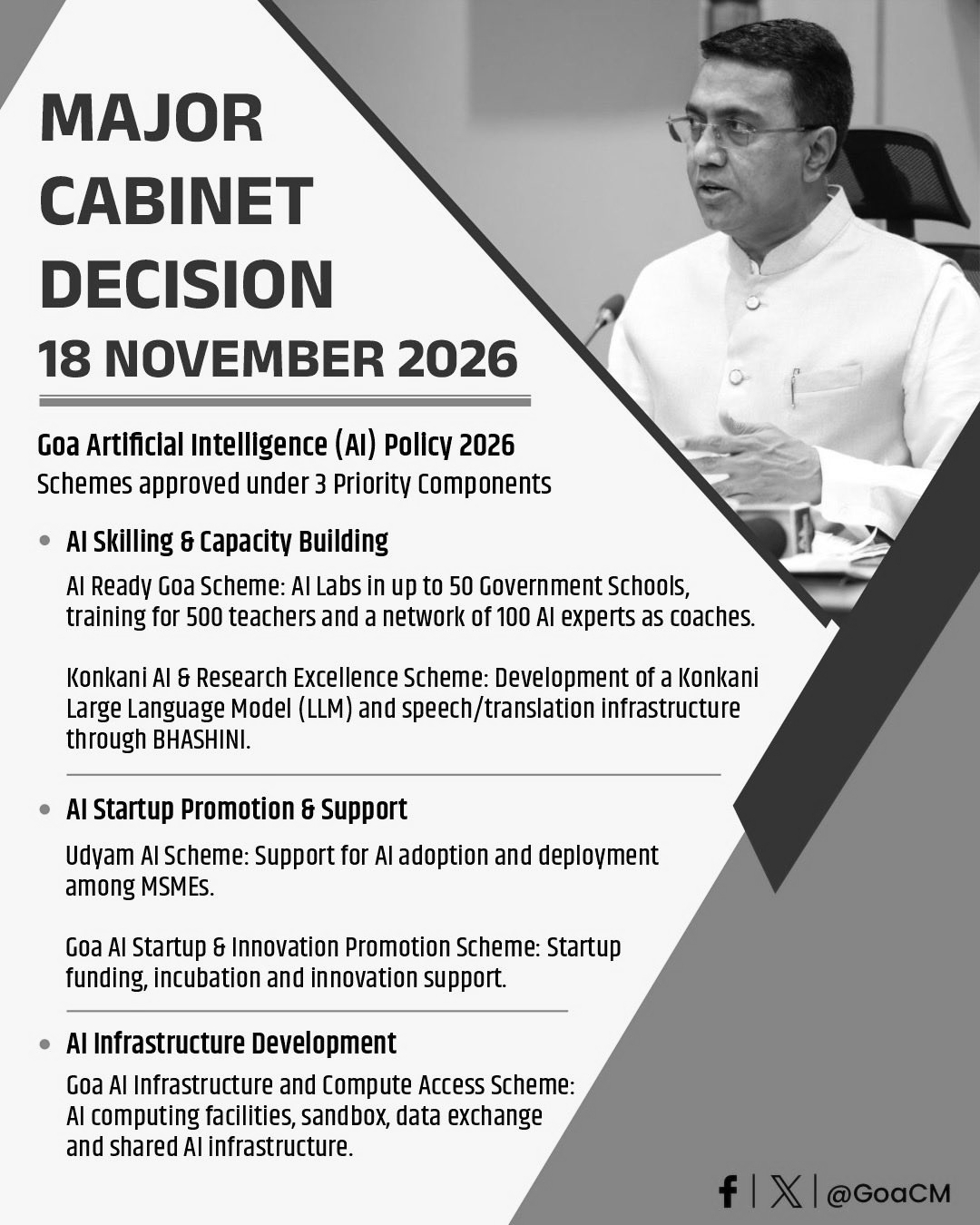
The Goa Cabinet has approved the Goa Artificial Intelligence Policy 2026, along with five flagship schemes, setting an ambitious target of training and certifying 50,000 AI-skilled graduates by 2030. The policy aims to build a responsible AI ecosystem by strengthening education and workforce skills, supporting startups and businesses, and expanding access to computing infrastructure. The government has allocated 60% of the policy outlay to skilling and capacity building, 20% to startups and innovation, and the remaining 20% to infrastructure.
Chief Minister Pramod Sawant announced the Cabinet’s decision, while IT Minister Rohan Khaunte said the initiatives would be implemented under the Goa AI Mission 2027. The government has proposed an Innovation Fund of ₹250 crore over three years, with ₹10 crore sanctioned for the 2026–27 financial year.
Under the AI Ready Goa scheme, artificial intelligence fundamentals will be introduced in schools from the 2027–28 academic year. The government plans to establish AI laboratories in up to 50 government schools, beginning with 20 rural schools before expanding to 30 urban and semi-urban institutions. It will also train 500 teachers and establish a 100-member AI Coach Network. The larger skilling programme will offer foundational, practitioner and specialist-level certifications, with inclusion targets of at least 25% women, 30% candidates below 30 years and 15% participants from Tier-2 and Tier-3 talukas.
The Konkani AI and Research Excellence Scheme will focus on developing a large language model for Konkani, along with speech and translation tools linked to the Centre’s BHASHINI platform. The initiative will use community-validated language data collected with consent to strengthen regional-language technology.
The Udyam AI scheme aims to support at least 200 micro, small and medium enterprises annually through AI-readiness assessments, advisory services, data-protection compliance guidance, access to tools and computing resources, and deployment support. A separate startup promotion scheme will provide incubation, mentoring, prototyping opportunities and support for research-led enterprises. The proposed Goa AI Lab will serve as a co-working and innovation hub.
To address computing requirements, the government plans to provide access to capacity equivalent to around 100 GPUs, through national and approved cloud infrastructure. Up to 10% of this capacity will be reserved for priority public-sector applications.
The policy also builds on Goa’s Startup Policy 2025, which targets 1,000 startups, 10,000 local jobs, 100 venture-funded startups and collaboration with 50 startups. Existing support measures include assistance for patents, trademarks, research and eligible local employment.
The government has begun identifying practical applications through its AI initiatives. At the Goa AI Tech Conclave, departments presented around 100 problem statements across 35 departments, while startups showcased solutions. Proposed applications include improving public services, tourism and other government functions. A 24-hour AI chatbot is also planned for the Goa Online Portal to help citizens access information and track applications.
The policy follows the launch of the Goa AI Mission in July 2025 and a public consultation on the draft policy in April 2026. With partnerships involving institutions such as IIT Goa, NPTEL and the State Institute of Education, the government intends to expand AI training while emphasising ethical use, data protection and responsible deployment. The success of the programme will depend on translating its targets into accessible training, industry opportunities and sustainable employment for Goan youth.