
Global Market Volatility Deepens, FM Sitharaman Flags AI Threats and Investor Risks
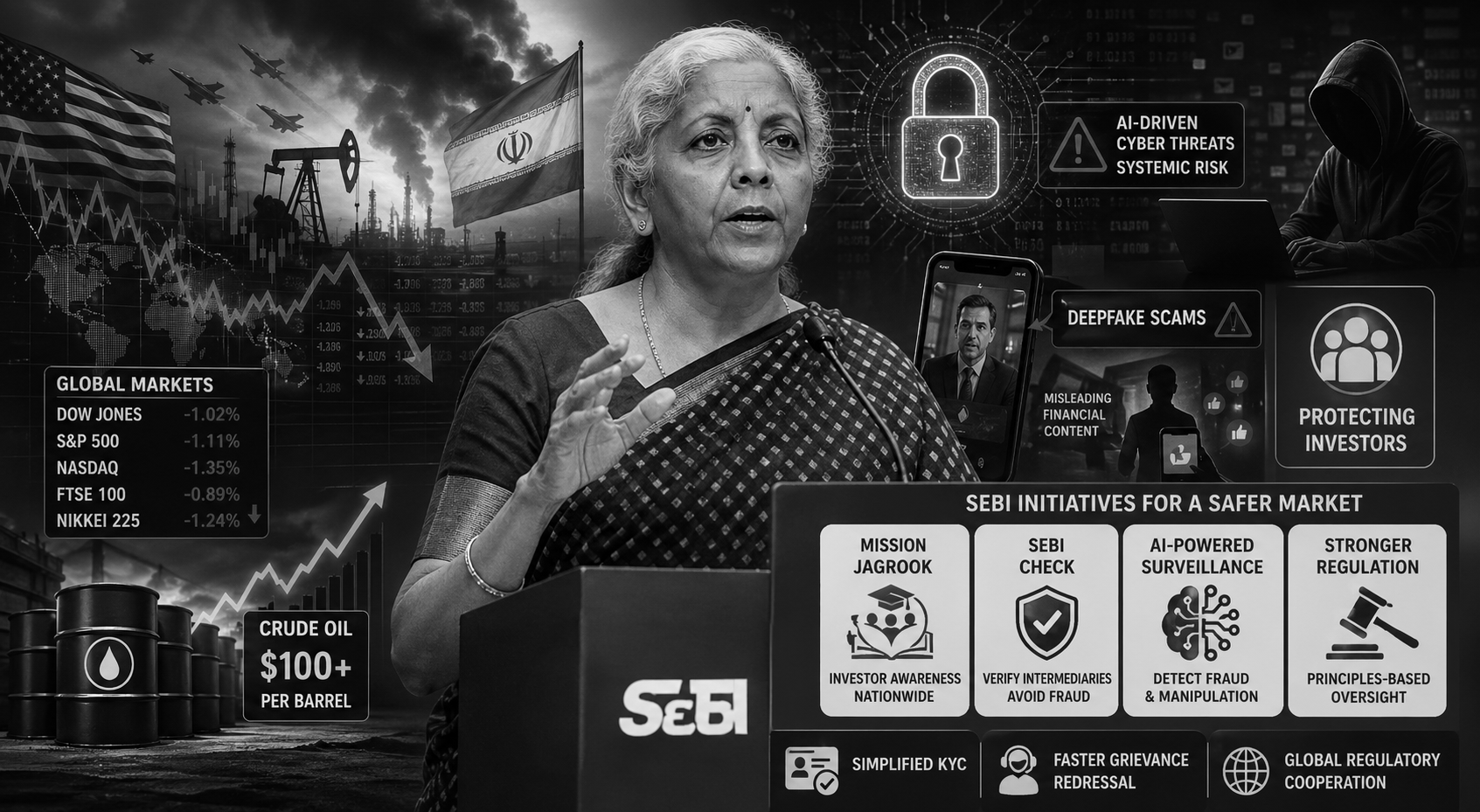
Union Finance Minister Nirmala Sitharaman on Saturday cautioned financial regulators to prepare for a rapidly evolving risk landscape, warning that emerging threats such as AI-driven cyberattacks and digital financial fraud could have systemic consequences comparable to major global shocks. Speaking at the 38th Foundation Day of the Securities and Exchange Board of India, she urged stronger regulatory vigilance , technology-led oversight , and enhanced investor protection mechanisms .
Her remarks come at a time when global financial markets are grappling with volatility triggered by escalating tensions in the US–Iran conflict . Equity markets across the United States, Europe, and Asia have witnessed sharp swings, with initial declines of up to one to two percent and deeper corrections in more vulnerable economies. The surge in crude oil prices driven by fears of supply disruptions in the Strait of Hormuz has further intensified inflation concerns , adding to market uncertainty.
While markets have shown intermittent recovery supported by strong corporate earnings and liquidity conditions, the conflict has underscored the fragility of global financial systems . Analysts point to a pattern of sharp sell-offs followed by quick rebounds, reflecting how modern markets are influenced not just by geopolitical developments but also by sectoral performance and investor expectations.
Against this backdrop, Sitharaman emphasised that risks to financial markets are no longer limited to traditional geopolitical events. She highlighted that advanced cyber threats powered by artificial intelligence are capable of evolving in real time, potentially targeting exchanges, brokers, and financial infrastructure at scale. A successful attack, she noted, could disrupt markets nationally, erode wealth, and damage investor confidence over the long term.
She also drew attention to the growing menace of deepfake-driven scams and misleading digital investment content, which increasingly target retail investors. In response, SEBI has intensified its crackdown on unregistered "influencers" and fraudulent advisory networks, signalling a tougher regulatory stance against misinformation and unauthorised financial activity.
To strengthen market integrity, SEBI is accelerating its transition towards technology-driven regulation . The regulator is leveraging artificial intelligence and advanced analytics through its digital forensics capabilities to detect complex fraud patterns and market manipulation. It has also introduced tools such as “SEBI Check” to enable investors to verify intermediaries and avoid fraudulent transactions, including those linked to fake IPO schemes .
A major initiative unveiled at the event, “Mission Jagrook,” aims to expand investor awareness across the country through multilingual and digital platforms. The programme is designed to educate retail participants about emerging risks, including fake investment apps, deepfake scams, and fraudulent IPO offers, reflecting the growing importance of retail investors in India’s capital markets.
Sitharaman further called for structural reforms such as simplified KYC processes , faster grievance redressal systems, and a shift towards principles-based regulation to balance ease of doing business with effective oversight. She also underscored the need for greater global regulatory coordination , noting that developments in one market increasingly influence financial systems worldwide.
The convergence of geopolitical tensions and technological disruption is reshaping the nature of financial risk. While the US–Iran conflict highlights the impact of external shocks on global markets, India’s regulatory response signals a forward-looking approach focused on market resilience , innovation, and trust.
In an increasingly interconnected and digital financial ecosystem, policymakers are making it clear that safeguarding markets will depend not only on managing geopolitical uncertainty but also on staying ahead of emerging technological threats .