
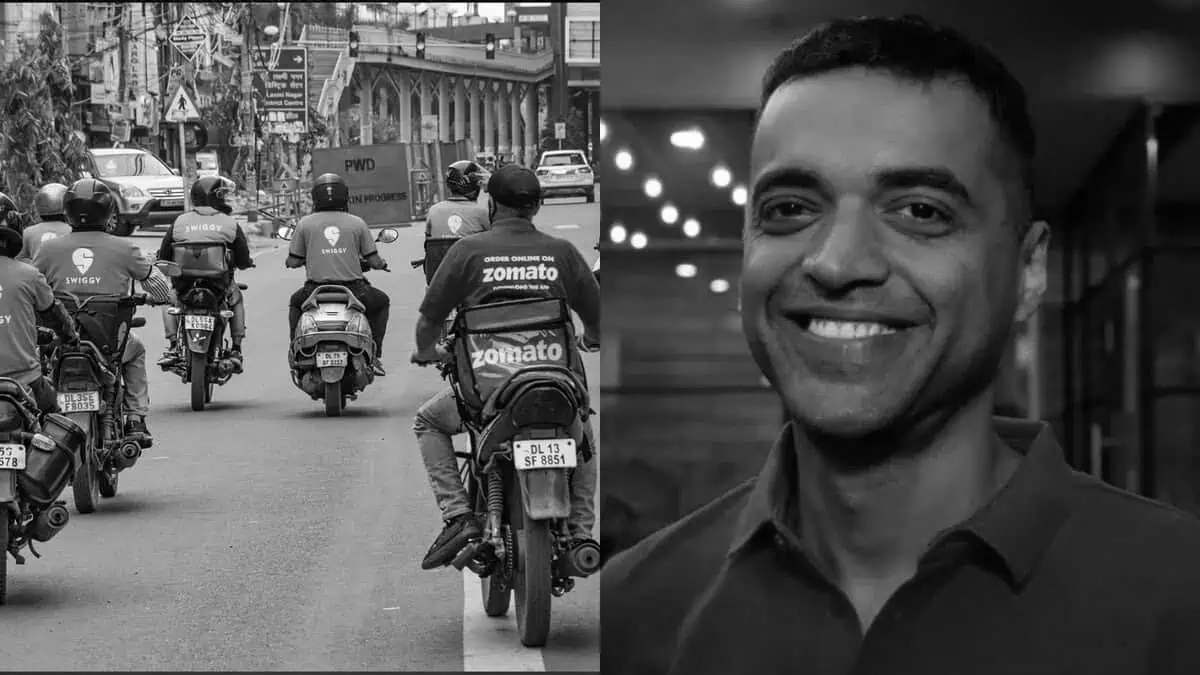
Gig workers raise concerns despite Zomato CEO’s assurances
The ongoing debate over gig workers’ pay, safety, and working conditions took centre stage this week as Deepinder Goyal , Founder and CEO of Eternal , defended the gig model, while unions accused the platform of ignoring critical worker concerns. Eternal owns Zomato and Blinkit , two of India’s largest food and quick-commerce delivery platforms.
Speaking on social media platform X , Goyal highlighted the benefits and financial structure of gig work. “In 2025, Zomato and Blinkit spent over Rs 100 crore on insurance coverage for delivery partners,” he said. He added that average hourly earnings (EPH), excluding tips, rose to Rs 102 in 2025 from Rs 92 in 2024, a nearly 11 percent year-on-year increase. Over the longer term, EPH has shown steady growth. Goyal also explained that flexible schedules and welfare benefits make gig work a reliable source of income for many, noting that most delivery partners work a few hours on select days, not full-time.
To illustrate, he said a partner working 10 hours a day for 26 days in a month could earn a gross of around Rs 26,500, with net take-home of approximately Rs 21,000 after accounting for fuel and maintenance costs. Safety measures, he added, ensure that the 10-minute delivery promise does not pressure riders to drive unsafely. Average order distances were 2-2.5 km, with speeds capped at 16-21 km/h. Additional support includes accident insurance up to Rs 10 lakh, medical coverage of Rs 1 lakh, rest days for women, income tax filing assistance for 95,000 partners, and National Pension Scheme enrollment for 54,000 workers.
Yet, the Telangana Gig & Platform Workers’ Union (TGPWU) maintained that Goyal’s claims do not address the core issues. Shaik Salauddin , the union’s Founder President, said, “The CEO is trying to save himself amid organizational pressure. Many questions from workers remain unanswered.” Salauddin highlighted that peaceful strikes by gig workers last month caused delays in 60% of orders and warned that these were only a “teaser” of potential future action. He also demanded the immediate removal of the 10-minute delivery mandate , citing mental and physical stress for delivery partners.
Goyal responded that the gig model is designed for flexible, part-time participation rather than full-time employment, arguing that demanding benefits such as Provident Fund or guaranteed salaries contradicts the model’s design. He emphasised that flexibility, choice of work area, and log-in times are the core advantages of the platform, offering a secondary income opportunity with minimal barriers to entry.
The debate has drawn wider attention from the business community. Investor Sanjeev Bikhchandani praised Goyal’s handling of the one-day strike, while critics questioned whether gig workers receive sufficient protection and earnings.
The discussion comes at a time of major policy reform. The government has notified all four labour codes , introducing universal social security coverage for gig workers. Draft rules under the Social Security Code 2020 , published on December 31, propose a 90-day annual work threshold as mandatory eligibility for social security benefits. Estimates suggest India’s gig workforce currently exceeds 12.7 million , and is expected to rise to 23.5 million by 2029-30 , according to NITI Aayog .
As the gig economy grows, balancing flexibility with worker welfare remains a challenge, and both platforms and unions face pressure to find solutions that safeguard livelihoods without compromising operational efficiency.