
Geopolitics today driven by natural resources, says Bhupender Yadav
Union Minister for Environment, Forest and Climate Change Bhupender Yadav on Monday underlined the strategic importance of natural resources, saying that contemporary geopolitics is increasingly shaped by their availability and utilisation, and that India must pursue development without over-exploiting its ecological assets.
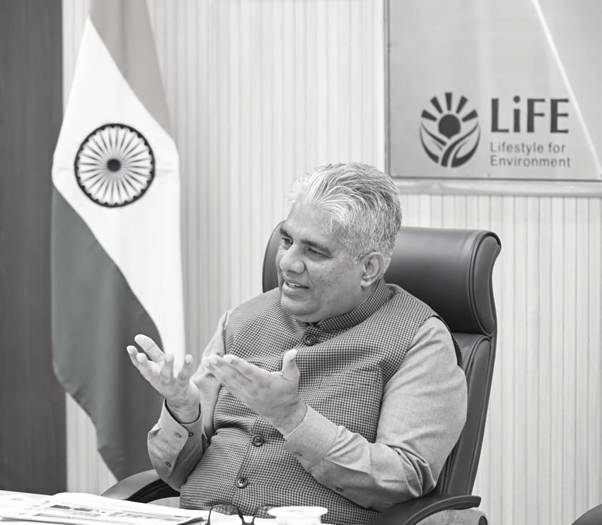
Chairing a meeting of the National Institute for Research & Application of Natural Resources to Transform, Adapt and Build Resilience (NIRANTAR) platform, Yadav said India’s real strength lies in its natural and bio resources, which ultimately sustain the four essentials of life — food, medicine, energy and oil. While the country has made rapid strides in manufacturing, data and software-driven industries, he noted that these fundamentals continue to be rooted in nature and require careful stewardship.
Stressing the need for a balanced approach, the minister said India must evolve policies that protect the environment while supporting industrial and economic growth. He pointed out that the country has a vast repository of natural resources and that their balanced, suitable and wise utilisation was critical for long-term resilience and development.
NIRANTAR functions as a coordination platform of the environment ministry, bringing together over a dozen research, survey and capacity-building institutions to improve collaboration, data sharing and policy support on natural resources and climate issues. Rather than a standalone institute, it aligns bodies such as the Forest Survey of India, the Botanical and Zoological Surveys of India, the Wildlife Institute of India, the Indian Council of Forestry Research and Education, the GB Pant National Institute for Himalayan Studies and the National Centre for Sustainable Coastal Management under four functional verticals covering ecosystem surveys, research and management, capacity development and climate change support.
Under the platform, member institutions undertake bioresource and ecosystem projects including the use of mycorrhizae (beneficial fungi that grow in association with plant roots to help absorb water and nutrients) and root nodule microsymbionts (helpful bacteria that live in small nodules on plant roots and fix nitrogen from the air to improve soil fertility) as biofertilisers, bamboo-based vegetative embankments for soil and riverbank erosion control, and research on biologically active compounds from native plant species to support sustainable livelihoods. Research outputs compiled on the NIRANTAR portal are used to inform environmental policymaking, land-use planning and sustainable forestry practices through evidence-based inputs to the ministry’s decision-support mechanisms.
Referring to climate change challenges, Yadav warned that glaciers are shrinking and said development in ecologically sensitive regions such as the Himalayas must be carefully balanced. Recent scientific data show that the Hindu Kush Himalaya experienced one of its lowest snowfall levels in over two decades during the 2024–25 winter season, signalling significant shifts in regional hydrology. Major assessments caution that Himalayan glaciers could lose up to three-quarters of their volume by 2100 under current emission trends, posing serious risks to water security and fragile ecosystems downstream.
The minister said institutions such as the GB Pant National Institute for Himalayan Studies and the National Centre for Sustainable Coastal Management could play a vital role in addressing these challenges through closer cooperation and collaborative research. He added that the environment ministry should act as a contributor to national development while ensuring that natural resources are not over-exploited, noting that policies on conservation and preservation have a wide impact on the economy.
Yadav said NIRANTAR should focus on strengthening research, sharpening its role in policymaking and charting the way forward, while emphasising the importance of institution-building backed by committed and capable human resources. He suggested that a small group of scientists could help coordinate efforts and bridge gaps across institutions, and concluded that a “Whole of Government” approach, supported by stronger coordination and cooperation, was essential for delivering meaningful outcomes through the NIRANTAR platform.