
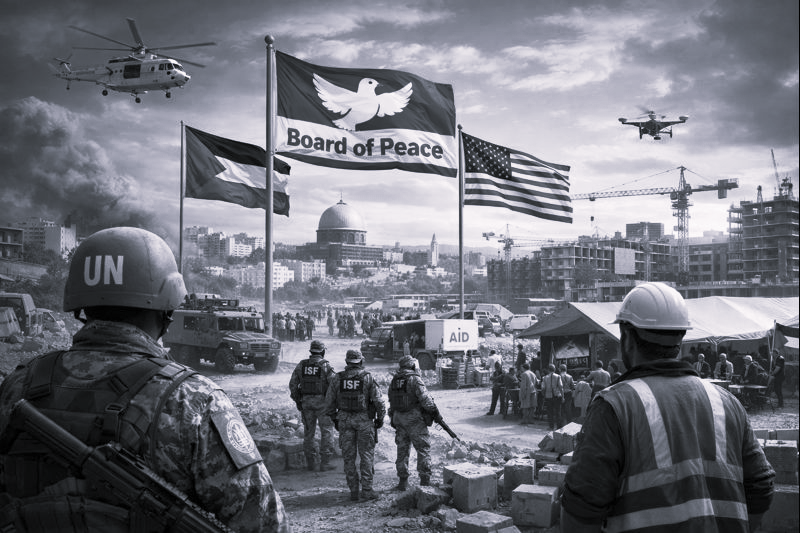
Gaza’s Post-War Roadmap: What the Board of Peace Means for the Region
The formation of U.S. President Donald Trump’s proposed Board of Peace marks a significant step in international efforts to stabilise Gaza, but its success will depend on a complex sequence of political, security and reconstruction measures. The initiative is part of a broader Gaza peace plan endorsed by the United Nations Security Council Resolution 2803 , which authorised a transitional administrative mechanism , the deployment of an international force , and the creation of governance structures to manage the territory after the war.
One of the immediate priorities is demilitarisation of Gaza , which the United States has said would include an internationally funded weapons buyback programme aimed at persuading militant groups to surrender arms. Israeli troop withdrawals are expected to be linked directly to Hamas relinquishing its weapons , while international monitors would oversee the destruction of military infrastructure.
The peace framework also mandates the establishment of an International Stabilization Force (ISF) a multinational peacekeeping mission tasked with providing security, supporting demilitarisation, training vetted Palestinian police forces , and facilitating humanitarian operations. As the force gradually takes control and stability improves, Israeli forces would withdraw in stages based on agreed milestones.
Administratively, the Board of Peace is expected to coordinate redevelopment efforts until Palestinian governance structures are reformed. It has the authority to appoint a National Committee for the Administration of Gaza to handle day-to-day governance, signalling a temporary international role in managing the territory.
Disarmament negotiations remain a critical variable. Hamas has entered discussions and is reportedly seeking integration of its police force into a new technocratic governing body , though Israel opposes any role for the group in Gaza’s future administration. Israeli leaders have stressed that demilitarisation not reconstruction is the next essential step in the process.
Washington also believes any agreement could involve some form of amnesty for Hamas members who decommission weapons and commit to peaceful coexistence, with safe passage potentially offered to those wishing to leave Gaza.
On the reconstruction front, early projects are already being discussed, including plans for a planned community in southern Gaza providing housing, healthcare and education as part of a broader redevelopment push. However, the proposal has drawn criticism from rights groups concerned about surveillance measures and possible displacement.
Despite momentum, international consensus is far from assured. Some countries remain cautious about joining the Board, seeking clarity on the mission’s long-term purpose and structure. Experts note that the Gaza peace plan ultimately envisions a sequence of steps: a ceasefire , hostage exchanges, demilitarisation, deployment of the stabilization force, transitional governance , large-scale reconstruction and a conditional pathway toward Palestinian self-determination .
In practical terms, the next phase after the Board’s formation will likely focus on enforcing disarmament, deploying international troops, establishing interim governance and initiating reconstruction all while navigating deep political divisions. Whether the initiative leads to lasting peace will depend largely on securing cooperation from regional actors, ensuring Palestinian political rights and maintaining international support over what is expected to be a long and fragile transition .