
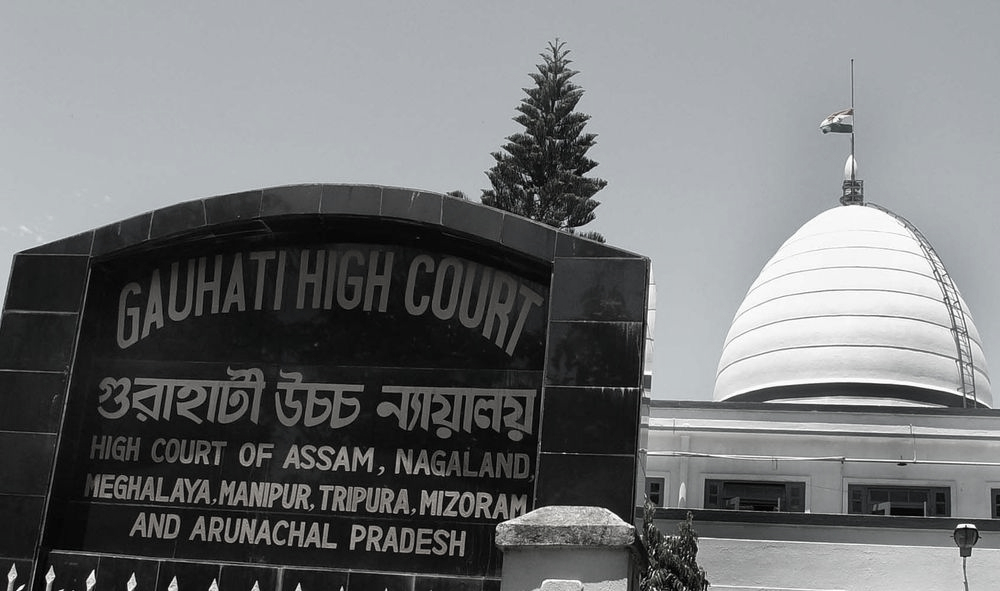
Gauhati HC Bar begins hunger strike against proposed shift of court complex, govt defends move
Members of the Gauhati High Court Bar Association (GHCBA) on Thursday began a three-day hunger strike opposing the Assam government’s decision to shift the Gauhati High Court complex from its existing location in central Guwahati to North Guwahati.
The protest, led by GHCBA president K.N. Choudhury , started at 10 am in front of the historic High Court building at Uzan Bazar. The lawyers will observe the hunger strike for six hours each day on Thursday, Friday and Sunday, following a decision taken at an emergent Extra-Ordinary General Body meeting earlier this week.
The state government has proposed constructing a new High Court complex as part of a judicial township at Rangmahal in North Guwahati, spread across 129 bighas (over 42.5 acres). The Chief Justice of India is scheduled to lay the foundation stone of the project on January 11, a ceremony the Bar Association has decided to boycott.
The GHCBA reiterated its long-standing opposition to shifting the principal seat of the High Court across the Brahmaputra river, stating that the decision would cause inconvenience to lawyers, litigants and the general public. The Association said its stand was consistent with earlier resolutions and a referendum conducted among its members.
At present, the Gauhati High Court functions from the Uzan Bazar area in the heart of Guwahati, where a heritage building and a modern multi-storey structure stand on opposite sides of Mahatma Gandhi Road. The two buildings are connected through an underground tunnel with escalator facilities, offering what the Bar describes as an already well-equipped and accessible judicial setup.
Government’s stand
The Assam government, however, has defended the relocation plan, stating that the proposed judicial township is aimed at creating a modern, integrated judicial infrastructure with space for future expansion. Officials have maintained that the new complex in North Guwahati would provide improved facilities for courts, lawyers and judicial staff.
The government has also linked the relocation to its broader plan to develop the Brahmaputra riverfront, for which the land currently occupied by the High Court is required. In November last year, the state cabinet approved ₹479 crore for the first phase of the judicial township project, signalling its commitment to the move.
Despite repeated appeals by the Bar Association to halt the project in the interest of stakeholders and the public, the government has so far shown no indication of reconsidering the decision.
The standoff has highlighted growing tensions between the legal fraternity and the state government, even as preparations continue for the foundation stone laying ceremony of the new High Court complex.