
Ganesha Is Here: But Do We Know the Story Behind the Celebration?
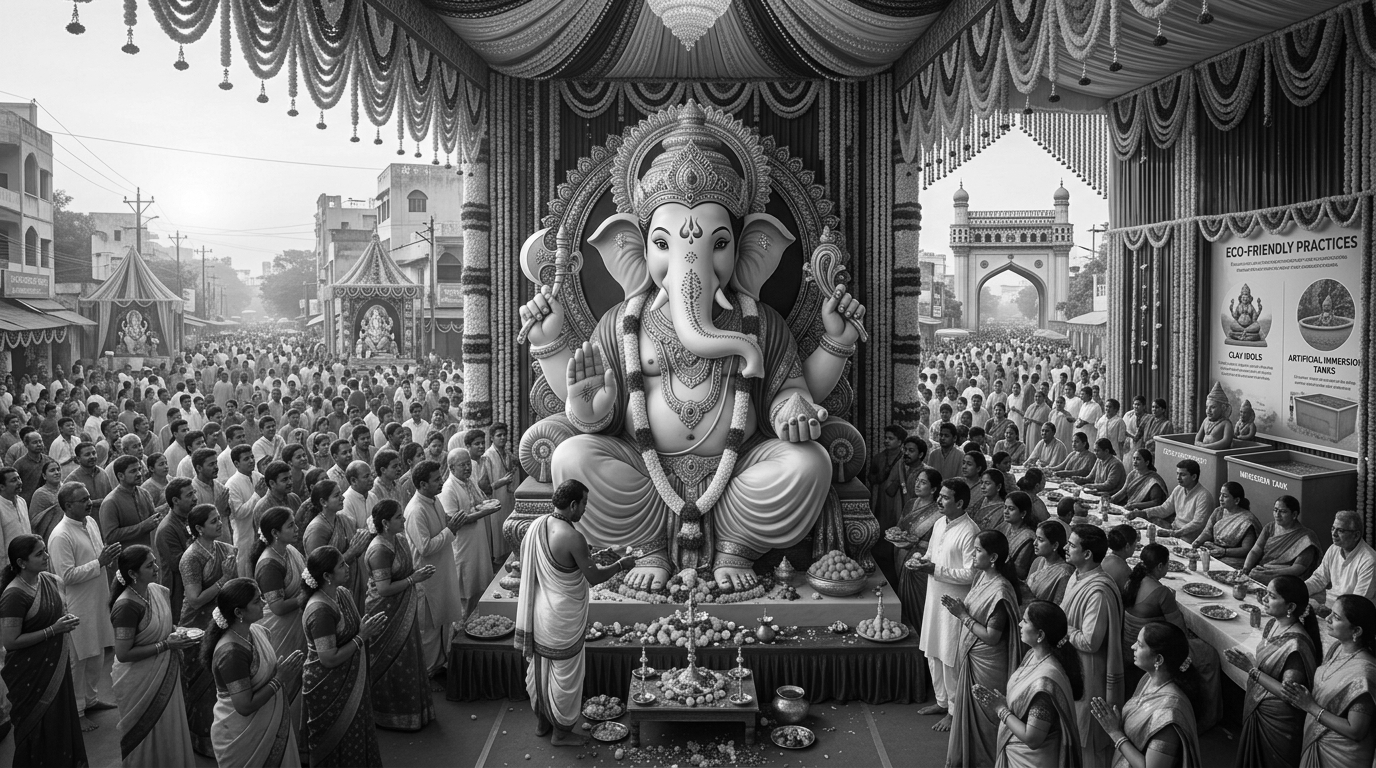
The arrival of Lord Ganesha today will bring a familiar transformation to homes and streets across India. From small household shrines to towering public idols, the country will welcome the elephant-headed deity with prayers, music, flowers, sweets and chants of “Ganpati Bappa Morya”. Yet behind the colourful decorations and grand celebrations lies an ancient story that has travelled through generations, changing with the times while retaining its central message of wisdom, faith and new beginnings.
Ganesh Chaturthi is celebrated as the birth anniversary of Lord Ganesha, one of the most widely revered deities in Hindu tradition. He is associated with wisdom, prosperity, good fortune and auspicious beginnings. For millions of devotees, Ganesha is the deity they remember before starting something important a new business, an examination, a journey, a marriage or another major phase of life. His popular name Vighnaharta, or remover of obstacles, reflects this enduring belief that his blessings can help clear difficulties on the path ahead.
The story of Ganesha's origin is one of the best-known narratives in Hindu mythology. According to a widely told version, Goddess Parvati created Ganesha from material associated with her own body and appointed him to guard the entrance while she bathed. When Lord Shiva returned and attempted to enter, Ganesha stopped him, unaware that he was Parvati's husband and determined to obey his mother's instructions.
The confrontation escalated and Shiva severed Ganesha's head. Parvati was overcome with grief and anger and demanded that her son be brought back to life. Shiva agreed and ordered his followers to find the head of the first living being they encountered. They returned with the head of an elephant, which Shiva placed on Ganesha's body before restoring him to life.
The transformation gave Ganesha the form by which he is recognised today. He was also granted a special position among the gods, with the assurance that he would be worshipped before other deities and before important undertakings. That belief continues to shape one of the most familiar practices associated with Ganesha invoking his name before beginning something new.
The festival itself is observed on Chaturthi, the fourth day of the bright fortnight of the Hindu month of Bhadrapada. Ganesh Chaturthi is being celebrated today, with devotees installing idols in homes, temples and public pandals. In Hyderabad, the Madhyahna puja period is observed around the middle of the day, when families traditionally perform the main worship.
The installation of the idol is not simply a decorative ritual. The ceremony known as Pran Pratishtha symbolically invokes the divine presence into the idol. Once installed, Ganesha becomes the centre of prayers and offerings. Devotees perform aarti, offer flowers and fruits, and seek blessings for health, prosperity and the well-being of their families.
Among the many offerings associated with Ganesha, modak holds a special place. The sweet, traditionally prepared using ingredients such as rice flour, coconut and jaggery, has become almost inseparable from images of the festival. Durva grass and red flowers are also commonly offered. These rituals, repeated year after year, connect household celebrations with traditions that have been passed down over generations.
But the Ganesh festival that India knows today was not always a massive public spectacle. Much of its traditional observance was centred around homes and temples. Its transformation into a major public celebration is closely linked with Lokmanya Bal Gangadhar Tilak, who played a key role in popularising public Ganesh celebrations in Maharashtra in 1893.
During the colonial period, public gatherings offered an important way for communities to come together. Tilak recognised the ability of the festival to bring people across social groups into a common cultural space. What was largely a private religious observance gradually became a public celebration involving neighbourhoods, cultural programmes and collective worship.
More than a century later, that public character has become one of the defining features of Ganeshotsav. Maharashtra remains particularly famous for its grand celebrations in cities such as Mumbai and Pune, but the festival has developed its own distinctive identity across different parts of India.
Hyderabad's Ganesh festival has grown into a major cultural and devotional event, marked by large idols, neighbourhood pandals, cultural programmes and elaborate immersion processions. Among its most recognisable symbols is the Khairatabad Ganesh, whose tradition dates back to 1954. What reportedly began with a one-foot idol eventually developed into one of the city's most prominent Ganesh festival landmarks.
The scale of the festival today also makes it an important economic event. Behind every large idol and decorated pandal is a network of artisans, painters, sculptors, transport workers, electricians, decorators, flower sellers, food vendors and other small businesses. Preparations often begin weeks or months in advance, turning the festival into a seasonal source of income for thousands of people.
For idol makers, the festival is also a showcase of craftsmanship. Clay and other materials are shaped into different forms of Ganesha, with artisans paying attention to facial expressions, ornaments, colours and intricate details. The demand for customised and artistic idols has helped traditional skills survive while also creating new forms of creative work.
The festival's public character goes beyond worship. Pandal committees frequently organise devotional programmes, music, cultural events, competitions, charity initiatives and community meals. Children take part in decorations and performances, while older generations share stories, rituals and traditions with them. In this way, Ganesh Chaturthi becomes a meeting point between generations.
The number of days for which Ganesha remains in a home or pandal varies according to local and family traditions. Some devotees perform immersion after one and a half days, while others keep the idol for three, five, seven, nine or 10 days. The larger public celebrations generally culminate on Anant Chaturdashi.
The immersion, or Visarjan, is perhaps the most emotionally charged part of the festival. After days of worship, devotees carry the idol through streets in processions filled with drums, music, dancing and chants of “Ganpati Bappa Morya”. The idol is then immersed in water, marking the end of that particular cycle of worship.
Anant Chaturdashi and the main Ganesh Visarjan will be observed on September 25 this year. However, many households and local groups will complete their immersion earlier, depending on the duration for which they keep the idol.
Visarjan carries a meaning deeper than the end of a festival. The idol is created from earthly material, worshipped as a representation of the divine and eventually returned to nature. The cycle reflects the idea that physical forms are temporary and that creation is followed by dissolution and renewal.
That symbolism has gained new relevance in an age of growing environmental awareness. The traditional use of natural clay allowed idols to dissolve more easily after immersion. However, the widespread use of Plaster of Paris and chemical-based paints in many modern idols has raised concerns over the impact of immersion on lakes, rivers and other water bodies.
The environmental debate has increasingly become part of the festival itself. Clay idols, natural colours, seed-based idols and other biodegradable alternatives are gaining attention. Civic authorities and environmental groups have also encouraged the use of artificial immersion tanks and responsible waste management.
The challenge is particularly significant in large cities. In places such as Hyderabad, where thousands of idols are immersed and huge crowds participate in processions, the festival puts considerable pressure on urban infrastructure and water bodies. The question is no longer simply how grand the celebration can become, but how responsibly it can be conducted.
For many organisers, sustainability does not mean abandoning tradition. Instead, it means finding ways to preserve the spirit of the celebration while reducing its environmental impact. From eco-friendly idols and natural decorations to better waste collection and controlled immersion facilities, the festival is slowly adapting to a changing understanding of responsibility.
Ganesh Chaturthi has also travelled far beyond India's borders. Indian and Hindu communities in countries such as Nepal, Mauritius, Fiji, Malaysia, Singapore, the United States, the United Kingdom, Canada and Australia observe the festival through temples, community associations and cultural programmes. For these communities, the celebration serves as a link to Indian traditions while also becoming part of their local cultural landscape.
Despite the scale and variety of modern celebrations, Ganesha's symbolic meaning remains largely unchanged. His elephant head is traditionally associated with wisdom and intelligence. His large ears are often interpreted as a reminder to listen carefully, while his small eyes symbolise concentration. His image therefore carries lessons that extend beyond religious worship.
Perhaps this is why the festival continues to remain relevant even as its form changes. An ancient myth has evolved into a household tradition, a public celebration, an economic opportunity, a platform for artistic expression and, increasingly, an occasion for discussing environmental responsibility.
For families, welcoming Ganesha is deeply personal. A small idol may occupy a corner of a home, surrounded by flowers and lamps. Elsewhere, enormous idols may dominate public spaces and attract thousands of devotees. The scale may differ, but the underlying sentiment remains the same — inviting Ganesha into one's life and seeking his blessings for the journey ahead.
The festival also carries a powerful reminder about impermanence. The same idol that is welcomed with excitement and worshipped with devotion is eventually carried to the water for immersion. The farewell may be emotional, but it also represents acceptance of change and the promise of renewal.
Every arrival eventually leads to a departure, and every departure creates the possibility of a new beginning. That idea gives Ganesh Chaturthi a meaning that extends beyond the rituals surrounding it.
As India welcomes Lord Ganesha today, homes will light lamps, pandals will fill with devotees and streets will echo with festive chants. Artisans will see the culmination of months of work, communities will gather in celebration and families will create memories that will be carried into another year.
From the ancient story of Parvati creating her son to the transformation of Ganesh Chaturthi into a massive public festival, the journey of Ganesha reflects the ability of tradition to evolve without losing its identity.
The celebration is therefore about more than idols, modaks, music and processions. It is about wisdom before action, faith in the face of obstacles, community over isolation and responsibility towards nature.
And when the celebrations eventually end with Visarjan, the message remains: what is created will one day return to nature, but the values associated with Ganesha wisdom, humility, devotion and hope for a better beginning can continue long after the festivities are over.