
Gandhi Death Anniversary: Jairam Ramesh releases Nehru–Patel letters on RSS
On the occasion of Mahatma Gandhi’s death anniversary, senior Congress leader Jairam Ramesh made sharp political remarks, releasing historic letters written in 1948 by India’s first Prime Minister Jawaharlal Nehru and then Home Minister Sardar Vallabhbhai Patel . Ramesh shared the letters on social media platform X , noting that both leaders had strongly criticised the conduct of the Rashtriya Swayamsevak Sangh (RSS) and the Hindu Mahasabha in correspondence addressed to Syama Prasad Mukherjee .
Ramesh said that in a letter written two days before Gandhi’s assassination , Nehru described the activities of the Hindu Mahasabha as “highly objectionable”. He recalled that Nehru had warned that leaders of the organisation were making speeches suggesting that Gandhi was an obstacle to the nation and that it would be “better if he died soon”. Nehru also stated in the letter that the government possessed extensive information on RSS activities and that its conduct was even more reprehensible, Ramesh said.
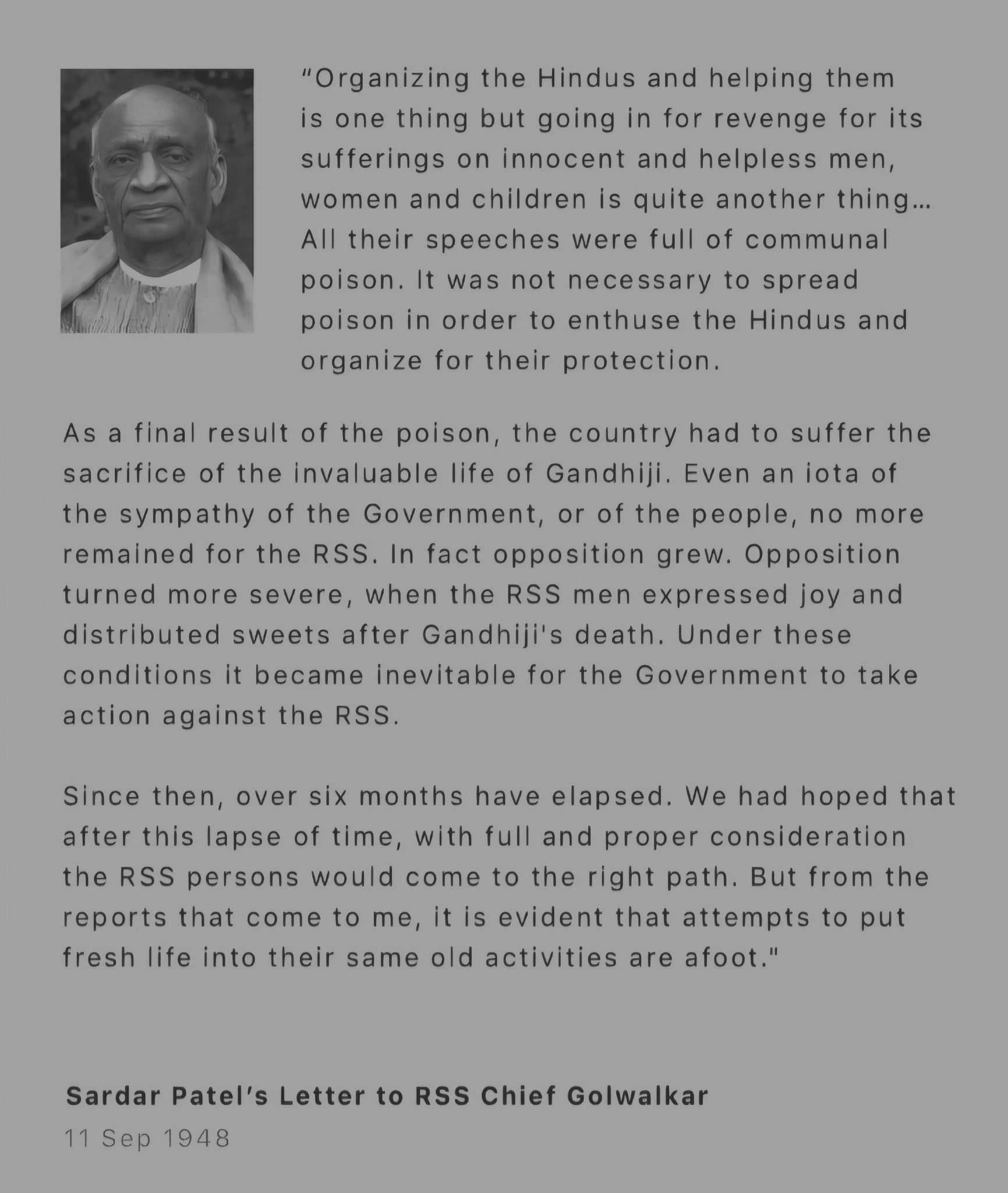
Similarly, Ramesh noted that Sardar Patel , in a letter dated July 18, 1948 , had strongly criticised the stance of the Sangh Parivar in his communication to Syama Prasad Mukherjee. Patel, he said, believed that RSS speeches after Partition were fuelling communal hatred and that the “poison of communalism” spread by the organisation was responsible for Gandhi’s sacrifice. Ramesh also released screenshots of Patel’s letters in this regard.
Taking aim at the present political situation, Ramesh said it was “shameful” that the Prime Minister was blessing an individual who claimed he did not know whom to choose between Gandhi and Godse . These letters, he argued, exposed the true mindset of those who claim to be the sole inheritors of nationalism. He also recalled that the nation was marking the day on which Gandhi was assassinated by Nathuram Godse in 1948 .
Ramesh suggested that the timing of the release was intended to counter the BJP’s claim to nationalism . With January 30 , Gandhi’s death anniversary, being symbolically significant, he said the aim was to remind the public how Nehru and Patel, as the country’s top leaders at the time, viewed the communal hatred that led to Gandhi’s killing, and to place historical evidence before the people.
He further argued that while the BJP and the RSS project themselves as the true nationalists and claim Sardar Patel as their ideological icon, Patel himself had described RSS activities as “poisonous”. By highlighting this, the Congress seeks to challenge the BJP’s exclusive claim over Patel’s legacy.
According to political observers, the Congress expects multiple gains from this move: reclaiming Patel’s legacy, projecting itself as the inheritor of the Gandhi–Nehru secular tradition , and shifting from a defensive posture to an offensive one against the BJP. Overall, the release of the letters is seen not merely as a historical disclosure, but as a strategic political effort by the Congress to shape public opinion by invoking history.