
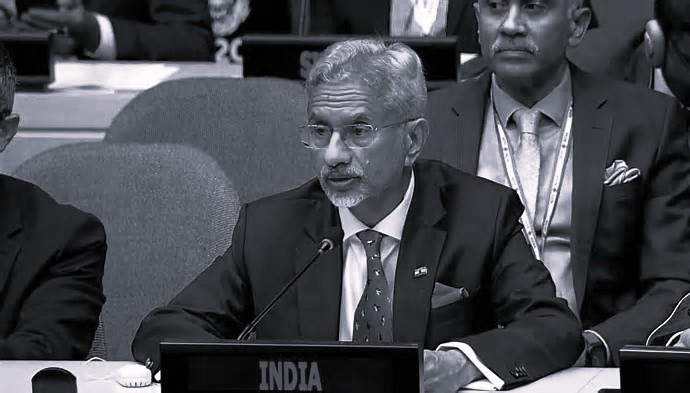
“G4 reaffirms commitment to UNSC reform” : Jaishankar at UNGA
India’s External Affairs Minister S. Jaishankar had a packed day at the 80th United Nations General Assembly (UNGA 80) on Thursday, joining the G4 Foreign Ministers’ Meeting, attending the G20 Foreign Ministers’ session, and holding a string of bilateral engagements.
At the G4 meeting —which brings together India, Japan, Germany and Brazil in their joint push for permanent membership of the UN Security Council—Jaishankar reaffirmed the group’s demand for reforms. “Glad to join the G4 Foreign Ministers Meeting along with colleagues Takeshi Iwaya, Johann Wadephul and Mauro Vieira in New York today. G4 reiterated its commitment to reforming the United Nations including the UN Security Council. It also assessed the current state of the Inter-Governmental Negotiation IGN process,” he posted on X.
Earlier, Jaishankar addressed the G20 Foreign Ministers’ Meeting , hosted by South Africa on the sidelines of UNGA 80. The G20, comprising the world’s major economies, has become an important forum beyond economics. Jaishankar underlined its role in ensuring stability in a politically and economically turbulent world, stressing dialogue, counter-terrorism efforts and energy security.
In a series of bilaterals, the External Affairs Minister exchanged greetings with Malaysian Foreign Minister Mohamad Haji Hasan, and met with the UK’s newly appointed Foreign Secretary Yvette Cooper. He also had a “warm conversation” with Egyptian Foreign Minister Badr Abdelatty and a “catch-up” with Australian Foreign Minister Penny Wong.
The UNGA , where all 193 member states have equal voice, is largely a platform for diplomacy and agenda-setting, even though its resolutions are not binding. Against this backdrop, Jaishankar used the occasion to highlight India’s priorities—ranging from UNSC reform to strengthening international cooperation through the G20.
Why India wants UNSC reform
• The Security Council still reflects the power structure of 1945, dominated by the five permanent members (US, UK, France, Russia, China).
• India argues that with its population, growing economy, contributions to UN peacekeeping, and global role, it deserves a permanent seat.
• The G4 (India, Japan, Germany, Brazil) supports expanding both permanent and non-permanent categories of membership.
• Reform, however, has been stuck for years due to lack of consensus among current permanent members.
Jaishankar’s engagements at UNGA 80 have underscored India’s proactive diplomacy on multiple fronts, reinforcing its global presence and commitment to shaping international discussions on security, stability, and reform.