
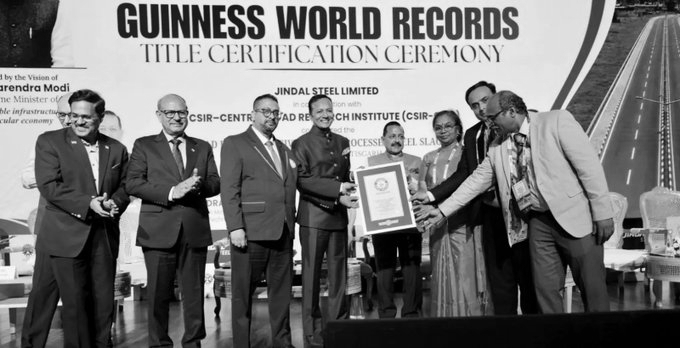
From Steel Waste To Roads: Jindal Steel Earns Guinness Record For World’s Longest Slag Road
What was once largely treated as an industrial by-product is increasingly finding a second life beneath India’s roads. Jindal Steel Limited has now taken that idea to a record scale, with its Raigarh project in Chhattisgarh earning a Guinness World Records title for the world’s longest road built exclusively with processed steel slag aggregates.
Built in collaboration with CSIR-Central Road Research Institute (CSIR-CRRI), the 1.85-km, four-lane road uses around 2 lakh tonnes of processed steel slag, replacing natural aggregates that would otherwise have to be extracted through quarrying.
The project is significant, but it is not the first steel-slag road in India. A 1-km six-lane road at Hazira, Gujarat, was developed in 2022 using about 1 lakh tonnes of processed slag. JSW Steel subsequently used around 80,000 tonnes of processed slag in a section of NH-66 in Maharashtra. Tata Steel, AM/NS India and other steelmakers have also worked with CSIR-CRRI on wider applications of the material.
The scale of the opportunity is growing with India’s steel industry. Steel slag generation is expected to reach around 55-60 million tonnes annually by 2030 as steel production capacity expands. Using even a significant portion of suitable slag in construction could reduce dependence on natural aggregates while giving steelmakers a productive outlet for a growing industrial by-product.
The process, however, involves more than simply replacing stone with slag. Steel slag must be scientifically processed to control issues such as volumetric expansion, metallic iron and potential leaching before it can be used safely in roads. Proper pavement design, drainage and quality control are also essential for long-term performance.
Industry estimates suggest processed steel-slag roads can be 30-40 per cent more cost-effective and potentially more durable than conventional alternatives, although the actual cost and long-term lifespan of the Raigarh road will require continued monitoring.
Jindal’s project therefore represents more than a Guinness record. It demonstrates how India’s expanding steel industry could increasingly connect waste management with infrastructure development, turning a difficult industrial by-product into a domestic construction resource while reducing pressure on natural stone reserves.